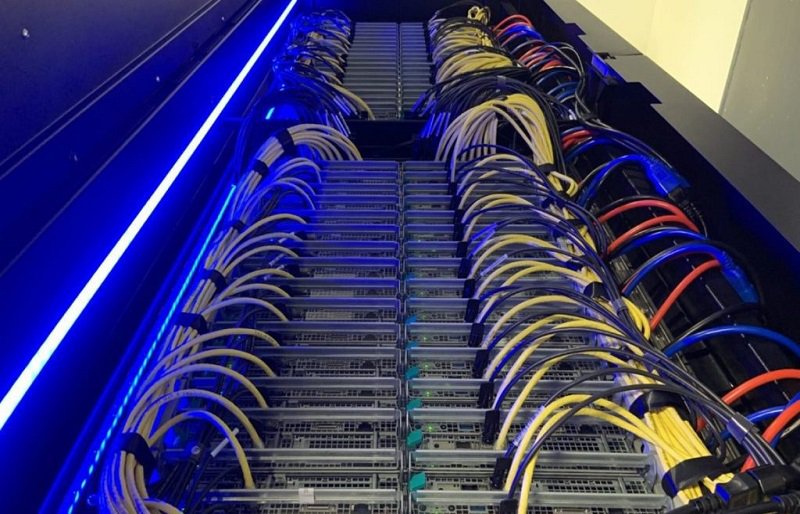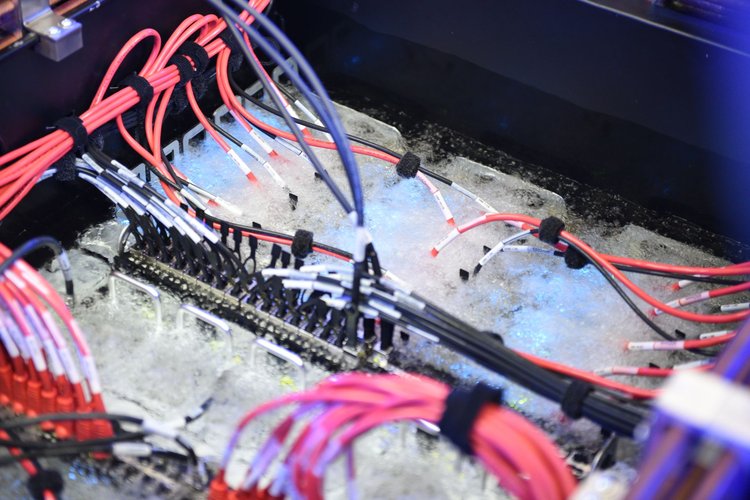
Liquid cooling is quickly becoming a widely accepted option for keeping high-density IT gear within its optimal operating temperature.
And so the growing adoption of direct-to-chip (which can use water or dielectric fluid) and immersion cooling for high-density workloads has opened a window of opportunity for numerous providers to enter the market to make dielectric fluids of their own.
But what is the dielectric fluid that is used in liquid cooling systems?
In short, the fluid is a non-conductive liquid used in immersion cooling to safely remove heat from servers.
“A dielectric fluid is a liquid that conducts heat but does not conduct electricity,” says Lucas Beran, director of product marketing at liquid cooling firm Accelsius. “Because it is electrically non-conductive, it can come into direct contact with live electronics without risking short circuits or equipment damage.”
What are dielectric fluids made from?
What dielectric fluids are made from will depend on the type of company it is sourced from. They are typically based on highly refined hydrocarbons, engineered synthetic fluids, or ester-based formulations such as fats and oils. Some are derived from mineral or gas-to-liquid processes, others are synthetically engineered, and some are plant-based.
“The feedstocks generally fall into two categories: petrochemical-based versus naturally sourced (aka plant-based),” says Beau Van Vaerenbergh, principal R&D engineer at chemical firm Oleon.
A number of petrochemical firms, including HF Sinclair, Shell, Castrol, ExxonMobil, ENEOS, Gulf Oil, Petronas, Perstorp, and SK Enmove, have brought dielectric cooling fluids to market, made from the same oil they use to produce fuel such as petrol. Many have been developing specialized lubricants and coolants for electric vehicles (EVs), and are using that expertise to move into fluids for data centers.

Achieving efficient data center cooling
“Immersion cooling liquids can come from various feedstocks,” says Nick Barrett, Castrol data center OEM liaison. “Castrol Immersion Cooling products are synthetic hydrocarbons, specially formulated by our chemists and engineers to provide excellent performance.”
Infinium, a US developer of synthetic low-carbon efuels, in January 2025 announced it was entering the data center sector with a fluid of its own. The company uses captured CO2 mixed with hydrogen to make fuel and now, cooling fluid.
There are several companies also offering plant-based fluids. US food giant Cargill’s NatureCool, is at least 90 percent based on soy oil.
Oleon is a subsidiary of Avril, a French firm specializing in the development of green chemicals. It launched Qloe in 2025, which it says is a plant-based fluid that is fully biodegradable and non-toxic, while offering high-performance cooling to data center operators.
Shahar Belkin, EVP at liquid cooling vendor ZutaCore, tells DCD: “Manufacturing generally involves chemical synthesis using fluorination and related reactions to create the desired molecule or molecules. It is critical to remove ionic contaminants, which can affect dielectric performance. Moisture must also be eliminated, along with any impurities emerging from low or high-boiling, and to prevent reactive byproducts.”
He continues: “There needs to be tight quality control on the liquid’s properties in this respect, with strict measures in place to avoid contamination during the filling and packaging process. Performance and safety depend heavily on purity and consistency, so supplier quality matters.”
Key features of dielectric fluid
According to Accelsius’s Beran, the metrics that matter most are thermal performance, environmental profile, safety, and cost.
“Global warming potential (GWP) and Ozone depletion potential (ODP) are the important sustainability numbers,” Beran says. “Operators building infrastructure for the next 20 years need to choose fluids that will not face regulatory phase-outs. A GWP at or below 300 is considered low and future-proofs the choice.”
On thermal performance, operators “should look at the fluid’s boiling point and latent heat of vaporization,” he adds. Beran also notes having fluids that are rated non-flammable and non-toxic under normal operating conditions is important. It is also critical that liquids don’t degrade the seals, gaskets, or electronic components of systems.
When selecting dielectric fluids, two-phase operators should focus on safety and regulatory metrics such as the fluid’s toxicology profile and exposure limits, and the flammability classification. Some fluids are non-flammable, while some are mildly flammable depending on class.
“From an operational perspective, purity specifications, typically measured in parts per million, and moisture limits are critical,” ZutaCore’s Belkin adds.
Other metrics that can be worth noting include boiling point and the saturation curve, as they shape how the system behaves. Vapor pressure at operating temperature, thermal conductivity and viscosity, electrical performance (measured in dielectric strength), volume resistivity or conductivity, and water content tolerance are also important measures.
“Finally, stability and material compatibility must be verified,” says Belkin. “This includes thermal stability, decomposition thresholds, and compatibility with elastomers and plastics used in seals, O-rings, and gaskets. The risk of corrosion with metals is low, but still needs to be verified.”
How to store and maintain dielectric fluids
Many fluids are delivered in sealed drums/barrels, while others will be delivered in intermediate bulk containers (aka totes or pallet tanks). Designs vary but often come as 330-gallon containers made of heavy plastic with a metal cage reinforcement that can be transported by forklift truck.
In our visits to various data centers that utilize liquid cooling, there doesn’t seem to be any established best practices for how and where to store spare dielectric fluid. DCD has seen barrels of dielectric fluid kept in data center loading bays.
“Sealed containers should be used at all times and opened as infrequently as possible. There needs to be temperature control to avoid heat in storage areas that increases vapor pressure,” says ZutaCore’s Belkin. “Leak-tight transfer equipment is essential, with closed transfer systems preferred wherever possible. Planning should also account for secondary containment and vapor-aware spill-planning.”
How much fluid actually needs to be stored on-site is still an open question, as is the replacement schedule. Barring any major incidents, fluid rarely needs to be replaced, so keeping large amounts of excess could be a waste. Operators typically keep five-15 percent reserve volume on-site to accommodate sampling, system adjustments, or hardware changes.
Immersion tanks that aren’t in closed systems might see some evaporation, but even then the need to top up might be a rare occurrence. Australian firm DUG, an early adopter of immersion fluid that uses open tanks, has previously told DCD that the company does regular chemical analysis on its fluids, but has rarely, if ever, had to top up or change the fluid in any tanks.
Liquid cooling systems will have their own monitoring systems to check on the health of the overall system, and some operators may take regular manual tests and send them off for inspection by the fluid maker. A baseline sample is often taken at commissioning, followed by periodic checks – typically twice per year – to monitor insulation performance, moisture levels, and cleanliness. If needed, the fluid can be filtered in place to maintain quality.
“It is critical that the fluid health is monitored frequently,” says Castrol’s Barrett. “To do this, physical samples can be taken, but this means top-ups to replace the amount removed.”
Barrett notes that the company has developed a solution that provides realtime, online monitoring to ensure the fluid is always within specification.
Accelsius’s Beran also advises that operators “maintain a good relationship with your fluid supplier & manufacturer.”
“They are the experts on their chemistry and can advise on testing cadence, reclamation options, and end-of-life recycling programs,” he says. “This is a partnership, not a commodity purchase.” Immersion-cooled servers being removed will need to have fluid cleaned off them, usually requiring a drip tray and a cleaning solution. If there are actual spillages, cleaning what can be a viscous, oily substance can be a pain for staff.
Oil-rated pads or granules will do for many fluid spillages. Some fluid providers are developing their own dedicated cleaning products for this purpose. Cargill, however, says its plant-based NatureCool fluid spills just need soap and water. A similar process is used for Oleon’s fluid.
“For our plant‑based, non‑hazardous fluids, any leakage can be easily absorbed using commercially available absorbent paper,” says Oleon’s Van Vaerenbergh. “The affected area can then be cleaned with a mild soap solution and subsequently flushed or diluted with water.”
While most liquid-cooled systems are still relatively new, it is expected that many dielectric fluids within them will last 10-20 years if well cared for. At the end of life, most fluid providers have a collection service where they will retrieve the dielectric fluid. Once collected and placed into barrels or totes, it may be reused at another deployment or possibly reprocessed again for another use.
Castrol’s Barrett notes some operators consider it best practice to replace the fluid at the same time as IT equipment refresh, but fluid providers can provide testing to determine best course of action.
Safety and other tips
Dielectric fluids are no joke, and should be treated with respect by data center operators and staff.
3M’s Novec, previously a commonly used fluid for two-phase cooling deployments, was withdrawn at the end of 2025. The chemical was a polyfluoroalkyl substance (PFAS), a group of so-called “forever chemicals” that are known to impact health.
Non-PFAS fluids on the market aren’t as toxic, but should be treated with respect. Gloves and other protective gear are recommended. And – despite DCD hearing of people doing this as a stunt in the past – don’t drink it.
“Safety varies by specific fluid, but attention should be paid to the dangers of vapor exposure from low boiling points with risks of asphyxiation in confined spaces. Safety data sheet (SDS) recommendations should be followed to prevent skin or eye contact, using gloves and eye protection,” ZutaCore’s Belkin says. “ln the event of a large spill, good ventilation is important. Surfaces can present a slip hazard until the liquid has fully evaporated, so appropriate precautions should be taken.”
“Disposal must follow local hazardous waste rules, the SDS classification, and any environmental reporting requirements, as some jurisdictions treat fluorinated fluids with higher scrutiny,” he adds. “Regulatory risk is another factor, particularly around PFAS classification, reporting obligations, and restrictions. Operators should consider the dangers from leaks and how these would be managed.”






Read the orginal article: https://www.datacenterdynamics.com/en/analysis/everything-data-center-operators-need-to-know-about-dielectric-fluids/