

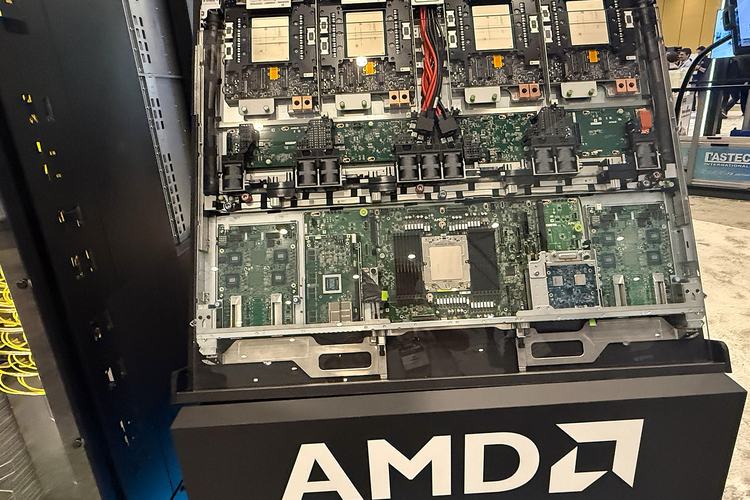
Vultr has revealed it will offer the AMD Instinct MI455X GPU and support for AMD’s Helios rackscale solution via its cloud platform.
The company is currently accepting preorders for the hardware, which will be offered starting in Q4 2026.
AMD launched its MI400 series GPUs earlier this month, including the MI455X and MI430X GPUs. The former is designed for AI training and inference, and the latter targets sovereign AI and HPC workloads.

The chips are built with the company’s new CDNA 5 architecture and on a 2nm process node. Each MI455X GPU includes 432GB of HBM4 memory, a 1.5x increase over the 288GB of HBM3E in the MI355X, with around 2.9x the peak memory bandwidth. They include 3.6 TBps of low-latency scale-up bandwidth across 36 links.
The company also launched the Helios rackscale system the same day, which combines 72 AMD Instinct MI455X GPUs, 6th Gen AMD Epyc ‘Venice’ server CPUs, AMD ROCm software, and AMD Pensando networking into a singular rack-scale architecture with 18 compute trays and six switch trays.
“Customers are rapidly moving from AI experimentation into production, and increasingly that means agentic and inference-heavy workloads that require infrastructure built for scale,” said J.J. Kardwell, CEO of Vultr. “The AMD Instinct MI455X and Helios rackscale architecture give our customers the flexibility, control, and price-to-performance they need to scale their AI initiatives. Making this architecture available across Vultr’s global infrastructure enables teams to build and deploy without constraints.”
“AMD Helios rackscale solution brings the best of AMD compute and networking technology together into a single rack-scale building block, delivering leadership performance, performance per watt, and cost per token for the next wave of AI,” added Andrew Dieckmann, corporate vice president and general manager, data center GPU business unit, AMD. “As demand accelerates for large-scale inference and frontier-model training, AMD Helios gives customers a clear path to scale from rack to cluster with the efficiency, economics, and openness needed to power the most demanding AI workloads.”
This comes shortly after Vultr and AMD partnered with the University of Cambridge in the UK on a project to develop “TESSERA,” an AI foundation model designed to monitor environmental change internationally.
The University of Cambridge used AMD Instinct MI325X GPUs on Vultr’s cloud platform to generate global embeddings with a 10m resolution using data from the European Space Agency Sentinel satellites covering the Earth’s land surface between 2017 and 2025 to monitor agriculture, biodiversity conservation, and renewable energy infrastructure.
Professor Anil Madhavapeddy, Professor of Planetary Computing at Cambridge’s Department of Computer Science & Technology and co-director of the Cambridge Centre for Earth Observation, said: “Our goal is to democratize access to planetary-scale environmental monitoring. By making TESSERA’s embeddings freely available under a CC-BY license and publishing the complete training pipeline, we’re ensuring that any researcher, government, or organization worldwide can deploy this technology for their specific conservation needs.”
“This partnership exemplifies how cloud infrastructure can accelerate scientific research with genuine planetary impact,” he added. “We’re enabling a new paradigm for open, accessible environmental monitoring that can inform policy decisions and conservation actions in the UK and worldwide.”





Read the orginal article: https://www.datacenterdynamics.com/en/news/vultr-adds-amd-instinct-mi455x-gpus-to-its-cloud-platform/


