

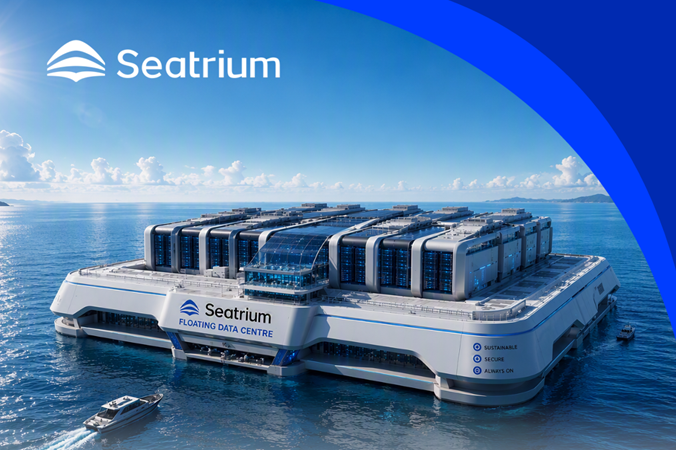
Offshore drilling specialist Seatrium is pressing ahead with plans for a pilot 30MW floating data center.
The company has had its designs validated by the Bureau Veritas, an organization that classifies ships and monitors offshore safety measures around the world.
Floating data centers are enjoying a boom in popularity as developers look to the waters to avoid constraints on land.
News of Seatrium’s project comes as Y Combinator-backed startup Atomarine pitches floating data centers powered by nuclear ships, and a Scottish firm, Mocean, is raising money to fund development of its compute-at-sea venture.
Seatrium’s floating boxes
Singapore-based Seatrium says its floating data center will comprise six of its independent 5MW “Data-In-A-Box modules,” which resemble large shipping containers and will be deployed on a jetty-moored, non-propelled barge. The location of the floating data center has not been revealed.

Each module integrates IT equipment, cooling systems, power distribution, and supporting infrastructure within a compact, modular design, the company said. “By combining modular construction, natural seawater cooling, embedded power generation, and flexible offshore siting, the concept is designed to provide scalable, relocatable, and energy-efficient computing capacity for the rapidly growing AI, Cloud, and digital economy,” it added.
Bureau Veritas has signed an approval-in-principle (AIP) endorsing the design of the system, which the company says validates its plans.
“Floating data centers are a natural extension of Seatrium’s decades of expertise in delivering complex offshore and marine assets,” said Aziz Merchant, EVP for technology and new product development at Seatrium.
“Bureau Veritas’ AIP provides an important validation of the concept and strengthens our confidence in progressing the development of this innovative, next-generation, offshore platform.”
Offshore data centers go nuclear
Meanwhile, in the US, Atomarine is proposing floating data centers powered by nuclear ships.
The company says its data centers will be housed on moveable platforms, with a single nuclear ship providing the energy. Rendered images show the ships connected to the data center platform by a series of cables.
Atomarine intends to use seawater in its data center cooling loop, and says it has modeled power usage effectiveness (PUE) of 1.1 for its facilities.
The startup has not identified a type of nuclear reactor for its ships. It is presumably banking on small modular reactors (SMRs) coming to market in the near future, with several different SMR designs at various stages of development around the world. However, this technology remains unproven.
In the near term, Atomarine intends to power its first data center with natural gas and is aiming for a 2028 deployment. The company was founded by two MIT graduates, Dimitris Koutentakis and Emile Germonpré, and is part of the Y Combinator summer 2026 intake.
“Using our nuclear ships to provide isolated power, the economics really stack up,” Germonpré says in a LinkedIn video introducing the firm.
Compute in Mocean
Scottish renewable energy firm Mocean has revealed a nautical data center platform powered by solar and hydro energy.
Its new data center platform, Blue Core, will build units capable of generating between 500kW-1MW via solar panels and wave energy. These will feature battery storage systems and connect to networks via low Earth orbit satellites. It also intends to use the sea for cooling, and says this will help cut the power required for the data center.

The company is currently raising money to fund the development of the floating data centers, which will be aimed at serving AI inference workloads. It hopes to make first commercial deployments by 2030.
Mocean already has an offshore energy generation platform, Blue Star, which has been trialed at sea over the last 18 months. The company hopes to begin sales of Blue Star by 2028.
Cameron McNatt, managing director of Mocean Energy, said: “We’ve spent years proving this technology works in some of the harshest sea conditions anywhere in the world. Blue Core takes that same proven system and points it at a much bigger problem.
“We’re not trying to build another data center. We’re trying to remove the barriers around power, land, and social licensing that are currently holding the industry back.”



Read the orginal article: https://www.datacenterdynamics.com/en/news/seatrium-plans-30mw-offshore-data-center-pilot/


