
Data centers often get a bad rap when it comes to aesthetics.
The thought of giant grey boxes springing up has caused stirs with local residents and planning officials the world over.
To counter this, many operators seek to make their buildings more alluring. Some add windows to give the appearance of an office. Others opt for green walls and the burden of keeping hundreds of plants alive. Some, however, instead choose walls of solar panels – often known as facade solar.
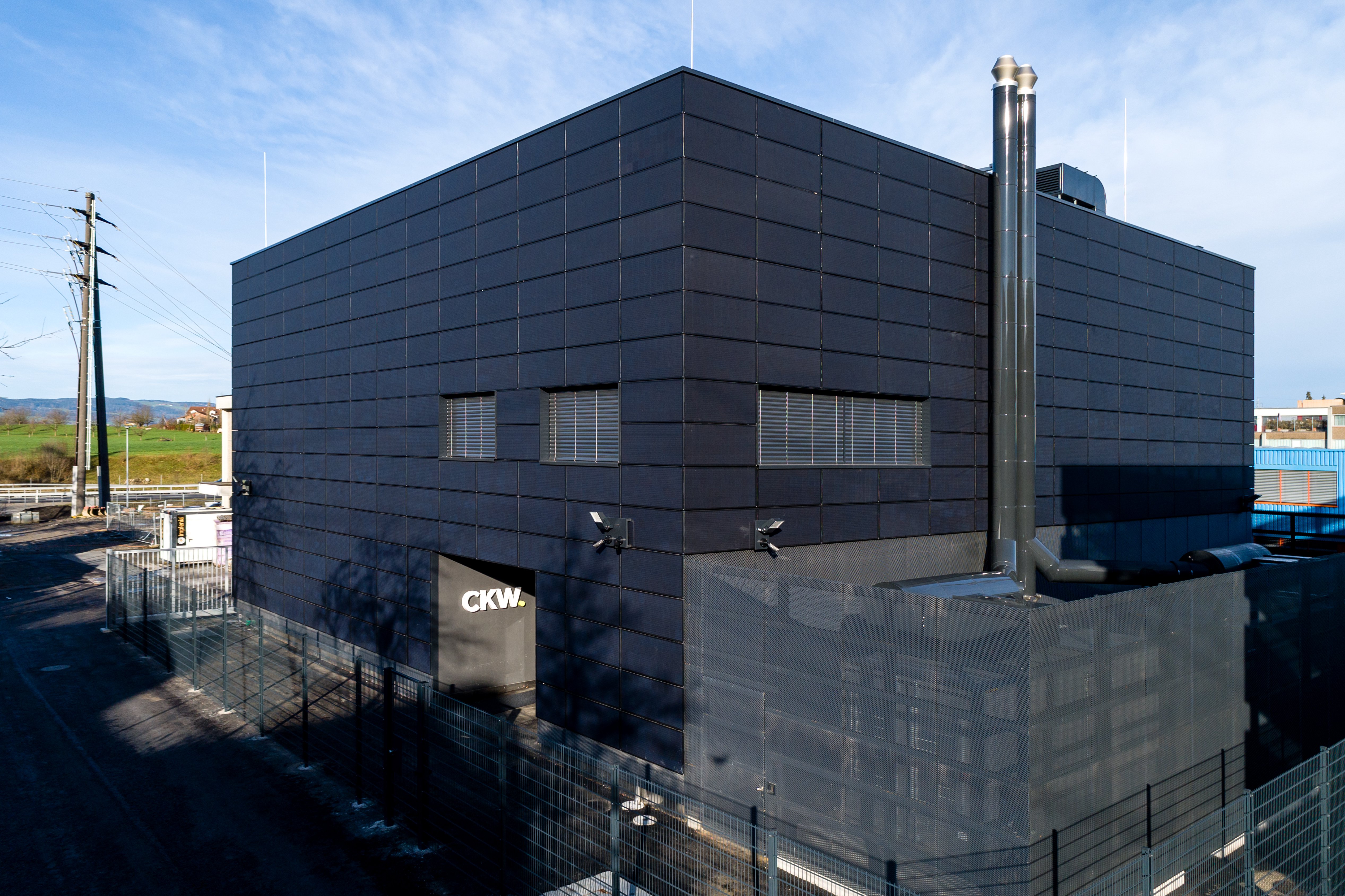
The sleek, shiny, black of facade solar not only looks better than your average concrete wall, but also offers a way to provide some on-site power – though usually only enough to power any office component or UPS systems.
But solar facades are an added cost that come with design and operational considerations that need to be addressed.
Facade solar comes to light
While less common than rooftop deployments, a number of operators have deployed facade solar at data center sites in the US, Europe, and Africa.
European operator Penta Infra has solar PV deployed at around half of its sites – a mix of rooftop and facade, both integrated and retrofitted – with more in the planning pipeline. It has facade deployments in Leeuwarden (Netherlands), Copenhagen (Denmark), Hamburg (Germany), and Brussels (Belgium).

Building for the future
“Most of the time there’s no space on the roof, so you’re going to look into alternatives which could well be a facade,” says Stijn Daniels, chief development officer at Penta Infra. “We are developing buildings that don’t need windows, so facades are a more obvious choice than if you had a piece of commercial real estate that needs windows.”
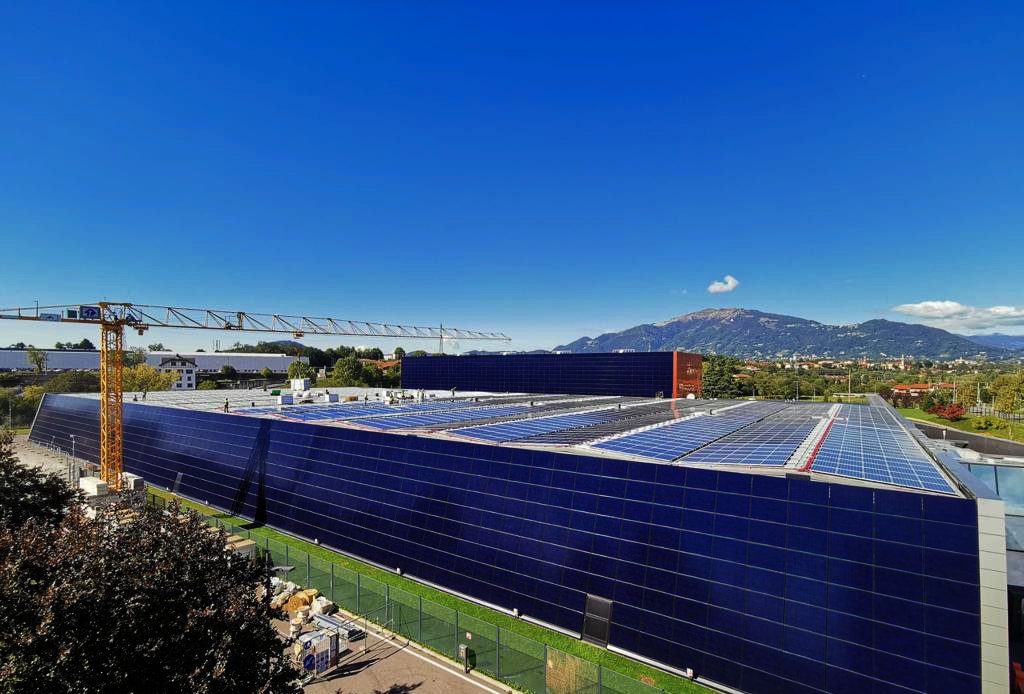
Swiss Fiber firm CKW has covered its facility outside Lucerne in Rotkreuz with solar panels. In Italy, local operator Aruba has deployed facade solar on buildings at its campus in Ponte San Pietro, Bergamo.
Spanish operator Adam is due to have facade solar on its upcoming data center in Parc de l’Alba in Cerdanyola del Vallès, Barcelona. The company says the deployment will be able to cover up to 40 percent of the facility’s needs. In Madrid, Templus’s data center also has facade solar. The 10MW facility was acquired from insurance firm Mapfre in 2024. Another project in Spain, Edged/Merlin’s Madrid data center, has a solar facade installed by Onyx Solar. The 3,600 sqm (38,750 sq ft) of panels generate 600kWp of solar power: The three-story facility totals 20MW of capacity across 22,900 sqm (246,493 sq ft). The company’s MAD02 data center on the same site is also set to feature a solar facade, as does Edged’s Barcelona campus.
Why the facade?
Installing solar on the rooftops is the more common and straightforward way of deploying panels, but isn’t always practical at data center sites.
Data center roofs are often filled with important M&E equipment, such as chillers, that are key for keeping the facilities operating as required. Smaller facilities, especially, might not have the available space to justify investing in a small solar deployment.
Likewise, weight considerations can sometimes be a blocker. A single panel can often weigh some 18kg (40lb) or more, with the weight concentrated at specific attachment points.
While most new or purpose-built facilities should be able to handle the extra weight of some solar panels, repurposed buildings converted to data center use might not be able to take the strain. Some reports suggest that up to 40 percent of commercial buildings are not strong enough to handle rooftop solar.
Solar can help ease data center projects through the planning process. The sleek, shiny look of facade solar might well help projects overcome any concerns from local officials or residents over the aesthetics of data centers.
Generating some on-site power also helps with any sustainability requirements a project might need in order to make it through planning. Like rooftop deployments, facade solar will rarely be able to power a full data center unless it is a small or low-density facility. But the tens to hundreds of kilowatts the average facade could generate should be more than enough to power the office component of many data centers.
NTT eyes facade solar in Japan
NTT has done very little on-site solar at its data centers, but has trialed a lightweight solar technology on a data center facade in Japan.
First announced in 2023, NTT Data was planning a roll-out of lightweight solar cells on the exterior walls of its data centers and offices in Japan. The company was looking to use film-type perovskite solar cells, a thinner and more lightweight technology than traditional silicon PV panels, in partnership with Sekisui Chemical Co.
Perovskite solar cells are lighter than traditional silicon-based photovoltaic cells. The technology is still evolving, but perovskite is better at absorbing light than crystalline silicon and more tolerant of defects. They are also more flexible than rigid silicon panels. Perovskite cells can have shorter lifespans than silicon panels, however, due to their susceptibility to heat and moisture. The material is also more toxic.
A small trial deployment was tested on the exterior wall of the NTT Shinagawa TWINS Data Tower in Tokyo. At the time, the company said it could introduce the system at all 16 of its data centers and offices in Japan if the trial is successful.
Speaking to DCD last year, Bruno Berti, SVP of global product management at NTT Global Data Centers, said the trial was set to run until March 2025.
The trial deployment in Tokyo was small – reportedly amounting to “just a few kilowatts” – on a small portion of one side of the building. We have reached out to NTT for the final results of the deployment, but at the time, Berti said the trial had been “getting good results.”
“One of the challenges that we’ve always had with solar is obviously the size of the panels and where to put them,” Berti says. “The rooftops for most of our data centers are already filled with chillers and mechanical equipment typically there, so there’s no real good location to put solar panels.”
“The installation of the film-based solar is a lot simpler, it’s a tenth of the weight, and it’s a lot cheaper to produce. It just gives you a lot more options as to where to put these panels.”
At the time of trial, Berti said the panels were seeing “pretty good efficiencies” versus the traditional silicon panels.
Berti says that the company is still “in its infancy” around solar and “looking at everything,” but on-site solar isn’t a necessity for NTT’s data centers.
“It’s not a mandatory or key focus of ours. Using it to offset any more than just lighting doesn’t seem feasible because of the amount of real estate and the diurnal nature of solar. But helping with lighting could be pretty significant, because most of our data centers have some level of office.”
Berti notes that if the technology in the trial works, it could be rolled out more widely in order to help the company reduce its Scope 1 emissions and achieve its 2030 net zero goals: We’re keeping a ‘wait and see’ and optimistic view of using solar in general.”
Solar facade considerations
There are various ways to install solar panels on a facade, but they are generally fixed to concrete, steel, or masonry using anchors.
Consideration around how solar panels will fix onto the building facade needs more thought than rooftop solar, according to Richard Clifford, director of solutions at Keysource at the time of conversation (Keysource has since been acquired by Salute Mission Critical and Clifford is now VP of sales and solutions).
“It’s probably easier to deploy it on a roof space than potentially a facade,” he says. “The load-bearing portion of a facade is what you’re going to be trying to bolt onto and then direct the load through structural beams from the outside.”
Like with rooftop solar, facade solar is easier to deploy as part of a new-build facility compared to a retrofit. For retrofits, weight will need to be given careful consideration: some legacy facilities may struggle to support heavy solar panels.
A single panel can often weigh some 40 pounds or more. Like with rooftop solar, ensuring panels are fixed appropriately for the inclement weather is critical.
Digital Realty has 19 sites hosting behind-the-meter solar installations totaling 9.8MW capacity, mostly comprising rooftop deployments.
“We have not had a strong focus on facade or building integrated PV systems, largely because the cost, complexity, and maintainability of those systems is just much greater than rooftop or even carport,” Aaron Binkley, Digital Realty’s VP of sustainability, told DCD last year.
“When it’s on the building, you have to navigate getting a lift or scaffolding up to the building, getting up there, and then physically removing part of the building’s cladding system if you need to do maintenance on those panels. So not only are they more expensive to install, but they also tend to be more expensive to maintain.”
Binkley also notes that building orientation is key: a solar facade needs to directly face the sun, and so the building needs to be pointing in the right direction and not be shaded by any neighboring structures.
“Facade solar is possible in some areas,” he says, “but it really depends on the location of the building, its orientation, and the feasibility of that. But it’s less of a commercial commodity and more of a customized application.”
“That’s not to say there aren’t opportunities for it, but it’s not been the primary focus for us, either from a performance or a cost standpoint, up to this point.”
More in Construction & Site Selection




Read the orginal article: https://www.datacenterdynamics.com/en/analysis/data-centers-and-facade-solar-everything-you-need-to-know/