

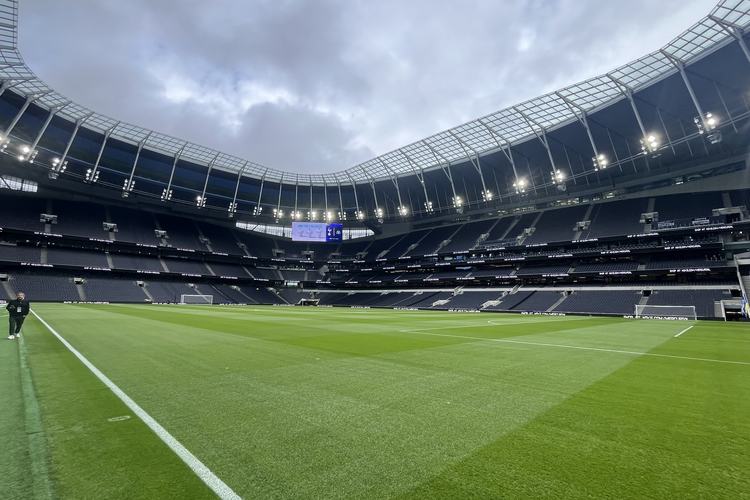
HPE has expanded its technology partnership with Tottenham Hotspur Football Club, as part of plans to further modernize the Tottenham Hotspur Stadium.
As part of the latest modernization upgrades at the stadium, one of the technologically advanced football stadiums in the world, HPE is supporting Tottenham Hotspur’s path to an AI-driven network infrastructure.

HPE and Tottenham Hotspur have long-standing ties, with the former sponsoring the club’s football shirts in the 90s, and most recently again for the 2013-2014 campaign.
Since 2017, HPE has been Tottenham Hotspur’s official technology partner, during which time the company has supported the club’s move into its 62,850-capacity stadium. The company is also the official hybrid cloud and IT Enterprise networking partner for the club.
The two have extended that long-term partnership, as part of efforts to further future-proof the stadium for AI opportunities.
HPE states that the upgrades will enable Tottenham Hotspur to gain “greater agility, predictable and optimized IT costs, improved sustainability performance, and AI-powered operations that deliver the resilience and efficiency required to support major sporting and entertainment events.”
WiFi coverage boost
A number of upgrades are currently being carried out at the ground, including the introduction of WiFi 7 across the stadium, replacing the current WiFi 6 routers dotted around the ground.
The latest upgrades also include the introduction of HPE Aruba Central and self-driving network capabilities to improve reliability and reduce operational complexity.
DCD visited the stadium over the weekend as part of a technology tour of the stadium, where the rollout of these WiFi 7 units is currently ongoing. In total, there are 1,651 WiFi access points located across the stadium, including 842 of these access points underneath seats in the ground.
HPE’s WiFi is used by up to 30,000 fans at any given time during matchday at the stadium, notes Rob Pickering, chief technology officer, Tottenham Hotspur Football Club.
He points out that it rarely drops below 15,000 users and can even exceed more than half the capacity of the stadium during other events such as concerts.
The WiFi 7 upgrades provide faster speeds, lower latency, and higher capacity than the previous generation. HPE notes that the stadium is one of the first to deploy WiFi 7 outdoors.
Pickering told members of the press on the tour that WiFi 7 will be able to provide “many orders of times more bandwidth than WiFi 6.”
The latest multi-million-pound upgrades are part of Tottenham Hotspur’s plans to simplify its technology operations at the stadium. Within the next month, the club expects to finish the rollout of HPE’s latest WiFi offering.
“Our goal isn’t simply to refresh our infrastructure. It’s to build a simpler, more resilient technology environment that gives us the flexibility to innovate for years to come, streamline operations, and support the Club’s long-term growth,” said Pickering.
“By bringing together AI, hybrid cloud, networking, services, and financial solutions through a single strategic partner, HPE is helping us simplify operations so our teams can focus on supporting every part of the Stadium, from match days to third-party events and day-to-day operations, rather than managing technology. Ultimately, the best technology is invisible to our fans.”
The not-so-invisible data center
What isn’t entirely invisible at the stadium is an HPE data center, which is located in the stadium’s north stand. Data centers are often hidden from public view, but not in N17, where it’s presented on show to the public.

“First of all, we’ve made it a publicly visible asset, which shows the importance of our partnership with HPE. It underpins a lot of what we do from a technology perspective in here,” notes Pickering.
“As we’ve invested in replacing all the infrastructure in the stadium from a server, storage, and network perspective, we moved entirely to the HPE GreenLake portfolio, underpinned by HPE OpsRamp and Morpheus. This is at the heart of what we do, and it is all in there now.”
In total, there are two data centers housed at the Tottenham Hotspur Stadium. The club also has another data center off-site at its training ground in Enfield, plus two more at Lilywhite House, the corporate offices attached to the ground, one at the club’s retail warehouse and one.
“We actually have more data centers than I would like at the moment, and part of this project is consolidating those down,” Pickering told DCD. “By the end of this, we will have two here and two at the training ground.”
He didn’t give a timeframe for the consolidation plans.

According to HPE, this is all being managed via its HPE Aruba Central platform, as the company pushes to unify data center, campus, and Edge networking under a single agentic AI operations model at the stadium.
The “self-driving network” is able to continuously analyze user, application, and network experience data, proactively detect issues, and automatically take action to optimize performance, resolve problems, and keep the network operating at its best with minimal IT intervention.
HPE, through its HPE ProLiant Compute and HPE Alletra Storage infrastructure, also helps to power the stadium operations, cashless commerce, security, digital signage, broadcast services, corporate IT, and business-critical applications. All of this is connected to the club’s network.
“We need to make sure it works 365 days a year,” said Pickering, who explained that the emergence of AI operations has formed a large part of the latest stadium technology upgrades.
“We have a reasonably small team from a technology perspective to manage this infrastructure, and to do that effectively 365 days a year is really very challenging unless you can leverage things like AI to do that.”
He said that the club has been able to reduce CO2 emissions through the use of AI, as it utilizes AI operations to manage the technology across the stadium, such as the radio power in the access points.
“Together, we’re helping Spurs build an AI-driven technology backbone that powers every aspect of the stadium, from critical operations behind the scenes to the digital experiences supporters enjoy on match days and beyond,” said Matt Harris, senior vice president & managing director, UK, Ireland, Middle East & Africa, HPE.
He adds that the implementation of AI ops is moving away from just being about predictive maintenance, but also around how best to optimize the network. AI won’t help predict the correct score all the time, but it will help Tottenham Hotspur keep on top of its network.
With close to 2 million visitors to the stadium each year, and 20,000 network access points dotted around the venue, the need for connectivity is essential, especially for those disgruntled supporters who want to vent or celebrate on social media during the game.


Read the orginal article: https://www.datacenterdynamics.com/en/news/hpe-rolls-out-ai-focused-connectivity-upgrades-at-londons-tottenham-hotspur-stadium/


