

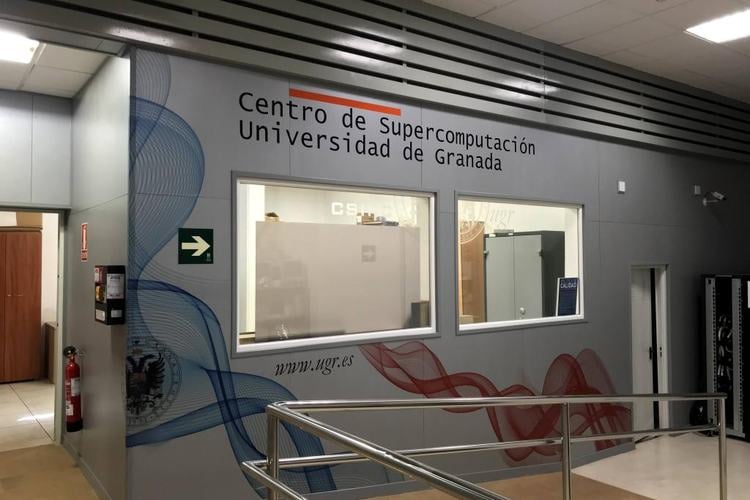
The University of Granada (UGR) in Spain is set to boost its high-performance computing capacity by adding a second supercomputer.
The system is being funded through a €3.5 million ($3.99m) grant from the European Eunomia project.
It will be installed alongside the €5 million ($5.7m) supercomputer that the Regional Government of Andalusia plans to acquire to serve the Andalusian research system, consolidating Granada’s position as one of the leading AI infrastructure hubs in southern Europe.
Both systems will be housed at the Center for IT Services and Communication Networks (CSIRC) on the Health Sciences Campus, where the university will adapt the facilities to accommodate the new infrastructure, including the power supply, cooling systems, and the technical space necessary for its operation. These measures will be funded from the budget allocated for the two systems.

Although they will share the same location, the two supercomputers will have distinct functions. The system with the greater capacity, valued at €5 million ($5.7m), will be used primarily for training artificial intelligence models and for high-performance research projects for the Andalusian scientific community. Its acquisition remains pending the signing of a memorandum of understanding between the Regional Government of Andalusia, the Andalusian Digital Agency (ADA), and the University of Granada, following delays stemming from the regional political calendar. The call for bids could be published after the summer.
The second system, funded through the European Eunomia project, will be used to develop and validate use cases for generative AI aimed at public administrations within a European consortium comprising 34 organizations from 14 countries. The goal is to provide a shared platform to accelerate the deployment of sovereign AI applications in the public sector, avoiding duplication of investment and leveraging shared resources.
The arrival of both systems marks a new step in the evolution of the University of Granada’s supercomputing infrastructure, which has a track record spanning several decades in this field. Following platforms such as UGRGRID, Alhambra, and 2022’s Albaicín, the institution will significantly expand its processing capacity to meet the growing demand for resources associated with artificial intelligence and scientific computing.
The plan is for the space renovation work to begin this summer and for the procurement of both supercomputers to be completed before the end of the year. If the planned deadlines are met, the two systems will be operational by spring 2027.
This piece was automatically translated from DCD’s Spanish site and edited by a member of DCD staff.




Read the orginal article: https://www.datacenterdynamics.com/en/news/ugr-will-expand-its-supercomputing-infrastructure-with-a-second-ai-system/


