
For many, the vision of a hydrogen-powered future has begun to fizzle out. According to recent analysis by the IEA, 2025 saw approximately 50 hydrogen projects canceled, with even more languishing in the pilot phase.
While much of the furor has concerned electrolyzer technology and the commercial potential of green hydrogen – hydrogen created solely through low-carbon auspices – another form of hydrogen power could be flying under the radar, which could have big implications for the data center sector.
Ammonia is a colorless, reactive gas composed of nitrogen and hydrogen. First synthesized in the early 20th century as part of the Haber-Bosch process, it has historically been used in the agricultural sector to produce fertilizers. However, over recent years, its potential as a fuel for power generation has gained traction due to its position as a major hydrogen carrier.
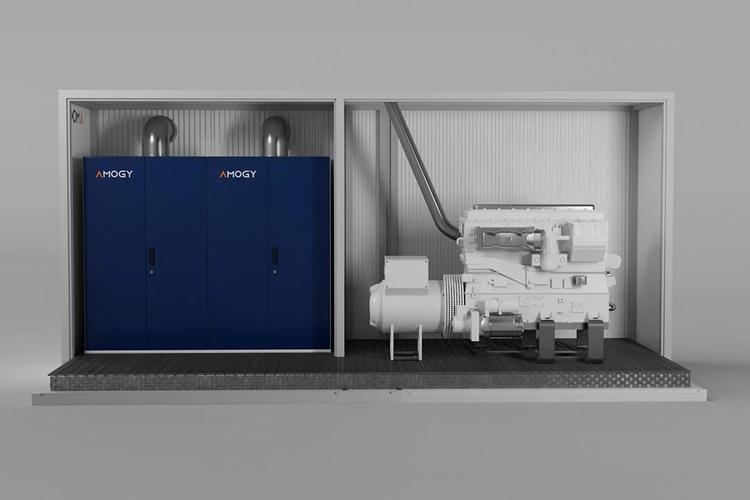
One company at the forefront of this new wave is Amogy. Founded five years ago, under the stewardship of MIT alumni Seonghoon Woo, the company has developed a proprietary ammonia cracking technology that converts ammonia into hydrogen, which is then used in engines or fuel cells to generate energy. While its early research and deployments initially focused on developing power systems for drones, tractors, trucks, and ships, it has recently cast its eye on the data center market.
Cracking
Ammonia is composed of 82 percent nitrogen and 18 percent hydrogen. While scientists have recognized its role as a hydrogen carrier as early as the 18th century, its identification as a potential fuel and energy source is a recent phenomenon.
To access hydrogen from ammonia, a process called hydrogen cracking is used. First developed in 1978, the process involves a system that typically comprises a reactor vessel and other components, such as heating elements, catalyst beds, and temperature and flow controls. Within the vessel, the ammonia is heated to a high temperature, decomposing it to its base elements in the presence of a catalyst, which causes the ammonia molecule to split, allowing hydrogen to be extracted. Subsequently, the hydrogen is fed into a hydrogen fuel cell system or into a hydrogen-compatible engine to generate power.
“In our system, ammonia is cracked into hydrogen and nitrogen using a catalyst. The nitrogen is released back into the atmosphere, while the hydrogen is used in engines or fuel cells to generate electricity — all within a single, integrated system,” says Woo.

Data centers face the energy dilemma
The biggest bottleneck in cracking technologies’ commercialization has been catalyst efficacy, which determines the reaction rate and the energy required to initiate the reaction. Historically, it has required temperatures of more than 900ºC (1,652°F) to elicit the reaction, necessitating huge amounts of energy. However, Amogy claims that its process, which utilizes ruthenium as a catalyst, can be 30 percent more efficient, offering a potentially cost-effective option.
Woo argues that due to its much higher efficiency, Amogy might have transformed hydrogen cracking from a scientific oddity into a scalable, more efficient alternative to traditional hydrogen production. Much of ammonia’s potential lies in its energy density, says Woo, with the carrier boasting up to 2.5 times the energy density of traditional hydrogen.
“Ammonia has the highest energy density among non-carbon fuels, even higher than liquid hydrogen, and it can be stored at room temperature,” he says. In addition, Woo contends, unlike conventional hydrogen production, which lacks a mature supply chain, there is already a global infrastructure for ammonia production, including pipelines, terminals, and ships.
The final advantage, claims Woo, is the system’s 24/7 baseload power profile, which allows it to be used not only as a backup generator or peaking unit but also as a prime power option. This makes it an attractive proposition for large-scale, always-on applications such as industrial power, maritime operations, and of course, data centers.
As a result, despite volatility in the hydrogen markets, Amogy has been able to secure significant economic backing for its system, raising approximately $320 million to date, including $100m in the past year alone, from strategic investors such as Amazon, Aramco, Mitsubishi, SK, and others.
This backing, says Woo, has spurred a highly aggressive strategy for the company, expecting to deploy multi-megawatt commercial pilots in 2026–2027 and scale to tens of megawatts by 2028–2029. Long-term, Woo claims, the technology could scale to hundreds of megawatts by combining hydrogen turbines with larger ammonia crackers. While the company has so far cut its teeth in the transportation sector, late last year it took aim at the data center market.
Floating power
As the demand for compute continues to grow, access to reliable power has fast become the biggest constraint. In many developed markets, constructing new power infrastructure is often a laborious process, hampered by permitting and other factors. This is especially true across the Asia Pacific, where power generation development in countries such as Singapore, Japan, and South Korea is stymied by land scarcity, long permitting timelines, and commitments to decarbonization, which has begun to stifle data center development.

In recognition of this bottleneck, late last year Amogy partnered with UK-based firm Kinetics, a subsidiary of Turkush firm Karpowerships, in what could be its first foray into the data center market. However, unlike most conventional power deals, this one comes with a twist, with the companies looking to deploy the solution offshore.
Karpowerships is a developer of floating power plants, also known as Powerships. The company has more than 40 operational plants within its fleet, powered predominantly by fossil fuels, with some boasting capacities of up to 500MW. However, as the importance of decarbonized systems grows, especially in the digital infrastructure space, the company turned to Amogy to decarbonize its offshore power options.
“Kinetics was excited about our technology and went on to invest in the company, which has led to an even closer collaboration between us,” Woo says.
Under the partnership, the companies envision integrated offshore platforms that combine power generation and data center infrastructure. “The expectation is that it will be an integrated solution in which ammonia-to-power systems are installed directly on the vessel, along with modular data center units. Alternatively, two vessels could be paired, with one supplying clean power to the other,” Woo explains.
The major advantage of siting offshore, says Woo, is its flexibility, offering several deployment routes that circumvent some of the traditional challenges data centers face in securing reliable power.
“The beauty of this solution is its flexibility. You can deploy both power generation and data centers offshore, or build the data center onshore and use the offshore system solely to provide power,” he contends.
Amogy is not the only firm to explore the potential of offshore data centers tied to ‘low carbon’ energy systems. Notable recent examples include a consortium of Japanese companies’ proposal floated last year to build an offshore floating data center demonstration project off the coast of Yokohama. The data center would be powered by solar and battery storage facilities, located on a minifloat moored at Yokohama Port’s Osanbashi Pier.
The floating data center concept was pioneered by US developer Nautilus, which has deployed two floating data center projects in Stockton, California, and Limerick, Ireland.
The concept is particularly relevant for smaller, densely populated countries such as Singapore, where demand for data center capacity continues to rise while land availability and renewable energy siting options remain limited.
“Floating power is becoming a very valuable option for countries like Singapore and Korea, where land is constrained and permitting onshore power plants can take five to six years,” says Woo. “Offshore power can be deployed in two to three years, and when combined with ammonia, it provides clean, fast, and reliable electricity.”
As a result, Singapore has become a crucial focus for Amogy in scaling its technology, and in order to scale its R&D efforts, it has partnered with the country’s Agency for Science, Technology, and Research (A*Star).
Singapore bets on hydrogen
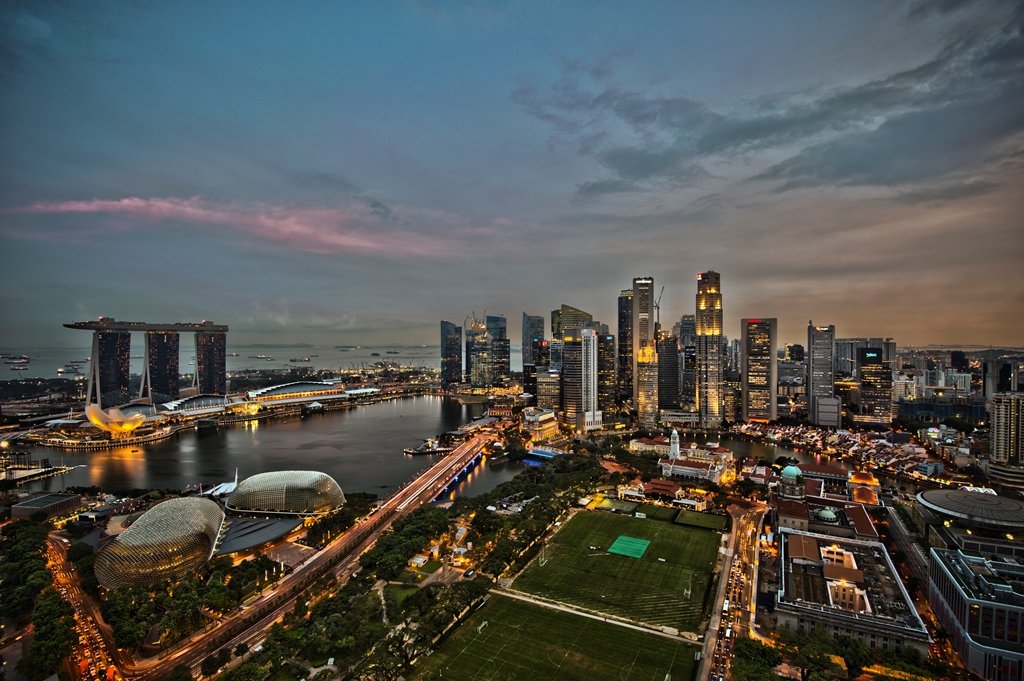
Singapore is very much an anomaly. Despite being one of the smallest states on earth, it is also considered one of the most technologically advanced.
However, its efforts to become a “Smart Nation” have been increasingly hampered by simple geographical constraints, which have not only stifled power generation development but also led to a de facto moratorium on new data center builds since 2019, which was partially eased in 2022. While the country has signed several interconnection deals with neighboring Malaysia to supply renewable power, it has increasingly bet on hydrogen as a potential, crucial power source to drive nationwide data center growth.

To support the growth of the hydrogen sector, the country has launched a National Hydrogen Strategy that aims to have hydrogen supply up to 50 percent of the country’s power demand by 2050. The strategy aligns directly with the country’s Green Data Centre Roadmap, which aims to help the data center sector deploy at least 300MW of additional capacity in the near term, while encouraging greater adoption of low-carbon technologies such as hydrogen.
This alignment led A*Star to partner with Amogy last year under a non-binding MoU to explore the potential of ammonia-based technologies. While discussions are ongoing on the exact deployment details, the agreement is expected to include a demonstration project on Jurong Island. The deal could prove to be the platform that Amogy requires to advance its solution from concept to commercialization.
Jurong test bed
Jurong Island is Singapore’s integrated petrochemical and energy hub, designed to serve as a test bed for companies in the chemicals, refining, and advanced manufacturing sectors. The island is set to play a starring role in Amogy and A*Star’s partnership, providing the hydrogen firm with a test bed to support its R&D and commercialization efforts.
“Jurong Island provides an industrial environment to evaluate low-carbon
technologies under real operating constraints,” Professor Lim Keng Hui, assistant chief executive, Science & Engineering Research Council, A*Star, tells DCD. “Under the MoU, Amogy and A*STAR will explore opportunities for piloting ammonia-to-power systems on Jurong Island, with a focus on validating performance in real-world conditions and clarifying safety, integration, and scale-up requirements.”
For A*Star, the partnership with Amogy is not merely a vehicle for downstream deployment but also an opportunity to drive high efficiency in the technology itself. Much of this centers on improving catalyst performance while reducing its cost, which is crucial to supporting the technology’s commercialization.
“We collaborated with Amogy to explore ammonia-to-power as a potential low or
zero-carbon pathway, while addressing the real engineering requirements for safe
deployment and scale-up,” Keng Hui says.
Expected to be operational by the end of 2027, the demonstration project is designed to bridge the gap between lab-scale research and pilot-scale demonstration, enabling technologies like Amogy’s to be tested in a real industrial environment. According to the partners, the collaboration will focus on pilot-scale demonstrations, digital modeling, and workforce training to ensure the technology can operate safely and efficiently in dense urban environments.
For Woo, gaining access to the Jurong Island test bed could prove catalytic in supporting the company to scale its solution. While admitting the technology is “still at the beginning of its industry lifecycle,” Woo argues that the Jurong Island project will provide the company access to A*Star’s world-class R&D capabilities and national mandate, which he claims will allow the company “to accelerate innovation, especially in core technologies like catalysts, and align with Singapore’s decarbonization goals.”
Barriers and bottlenecks
While there is confidence that the test bed in Jurong could prove transformational in supporting efforts to commercialize the system, as with any emerging technology, significant concerns remain.
Ammonia cracking faces numerous challenges as it seeks commercialization. The biggest being its high energy demand and efficiency losses, which are compounded by the need for costly purification steps and the difficulty of scaling advanced catalysts. The technical hurdles are joined by physical ones, with ammonia highly toxic and corrosive, adding complexity and cost constraints to widespread deployment.

The trepidation is shared in Singapore, which, despite being bullish on the potential, has yet to fully commit to ammonia as a fuel of the future. Despite the attention paid to ammonia as a hydrogen carrier, the country remains agnostic about its technology choices, with ammonia seen as promising but still requiring extensive assessments of technological readiness and overall safety.
Safety and handling risks are central to those evaluations, alongside questions about how the ammonia supply chain would develop at scale. As a result, Government agencies are studying not only how ammonia could be produced and transported reliably, but also how risks would be mitigated in the event of an incident.
At the same time, Singapore is closely watching developments in neighboring countries and exploring regional cooperation. According to sources, discussions are already underway on importing renewable hydrogen from abroad, reflecting a broader ambition to build a cross-border hydrogen economy across Southeast Asia.
Woo, for one, isn’t concerned about the supply chain. “There are about 200 million tons of ammonia produced annually today. What’s exciting is the surge in green ammonia, especially from countries like India and China, at prices approaching conventional gray ammonia, which gives real confidence in long-term supply,” he says.
While supply may not be a problem, hydrogen cracking technology must still reduce its operating costs to make it a viable alternative for industrial offtakers like data centers. In addition, concerns are mounting about the technology’s net-zero credentials. Despite many in the sector vaunting it as a low or even zero-carbon source of power, at present more than 95 percent of the world’s ammonia is produced via fossil fuels. As a result, despite not producing CO2 during the cracking process, the sector is likely to be saddled with significant Scope 3 emissions, which could ultimately scupper its potential as a clean baseload energy source.
Ultimately, it seems likely that the promise of hydrogen cracking as a future source of energy for data center providers will remain in its infancy in the foreseeable future; however, if the Jurong Island pilot proves successful, and with further backing, it could potentially spur significant uptake across the data center sector and beyond.
More in The Energy & Sustainability Channel





Read the orginal article: https://www.datacenterdynamics.com/en/analysis/haber-bosch-to-hyperscale/