

Undoubtedly, the rapid expansion of artificial intelligence (AI) has triggered a surge in demand for high-density computing power, leading to the large-scale construction of AI data centers (AIDC). With global AI spend set to hit $2.5 trillion in 2026, and with 40 percent of enterprise applications now embedding this technology, this demand has also driven the need for gigawatt-level (GW) campuses.
At MWC 2026 in Barcelona, Huawei Digital Power unveiled several solutions designed to address the challenges that high-density computing brings.: AIDC infrastructure for all data center customers, including carriers and enterprise carriers, and an AI-Powered Green Site solution designed for mobile operators to optimize base station energy and generate revenue by feeding stored power back to the grid.
Identifying AIDC challenges
Inevitably, the growth of the AIDC industry brings many obstacles that need to be overcome. Firstly, there is a challenge around reliability with the value of AI devices 40 times greater than that of general computing devices, but with a failure rate which is 1,000 times larger.

Then of course, there’s the challenge around energy consumption. Currently there are around 30 gigawatt (GW) campuses worldwide. However, by 2030 that figure is expected to rise to over 75. These GW campuses are extremely power hungry, capable of consuming up to 10 billion kilowatt-hours (kWh) of electricity annually – equivalent to the consumption of a city with one million residents.
That said, energy consumption and reliability aren’t the only issues that need to be addressed. Delivery times for AIDCs also need to be reduced from around 18-24 months at present to around 3-10 months. For example, the TTM (Time to Market) for a 100MW AIDC in Malaysia must be 10 months, otherwise there is the risk of losing tenants.
Finally, there is the need to ensure AIDC architecture evolve over time. It’s estimated that the investment of a 1GW AIDC will reach $10 billion (excluding IT devices) over its 10-year lifetime with three generations of chips and services required during this period.
Solutions for data center operators
Addressing these challenges, Huawei has reconstructed four core subsystems of power supply, cooling, energy storage and operations. Outlined below, together these provide a highly reliable, energy-efficient, fast-delivered and fully-compatible AIDC architecture.
- Power supply: Huawei has reinvented the power supply architecture from the power grid to chips, enabling coordinated development of AC/DC power supply.
- Cooling: From chips to outdoor heat dissipation, Huawei’s productized cooling system ensures efficient and reliable cooling.
- Energy storage: Multi-level energy storage collaboration is implemented from campuses to chips, addressing long-term energy storage and short-term load fluctuation.
- Operations: DC for AI and AI for DC. AI technologies are used to empower green and reliable operations of AIDC across its lifecycle.
Based on these four core subsystems and one construction mode, Huawei has built a future-oriented AIDC proposition comprising two core solutions: Power POD which provides a productized power supply sub-system and IT POD which is a productized cooling system.
The core benefits of these solutions include high reliability (99.999 percent), high energy efficiency (full-link between 80 and 85 percent), fast delivery (reducing delivery time from between 18 and 24 months to between 3 and 10 months) and full compatibility (100 percent compatibility with diversified chips/servers).
AI-powered Green Sites
Announced at MWC 2026, Huawei AI-powered Green Site solution is targeted specifically at mobile operators to enhance network resilience, reduce energy OPEX (operating expenditure) and increase revenue, empowering operators accelerated transition towards energy prosumers.
With global communication networks currently consuming over 300 billion kWh annually (accounting for approximately one percent of the world’s total electricity consumption) Huawei’s AI-Powered Green Site is the first to feature end-to-end intelligent synergy – moving beyond simple energy saving to active energy management.
A key component of this resilience is iBackup which uses algorithms to boost the duration of back-up power, increasing site power availability to 99.9 percent. For example, in Kuwait this solution has already increased emergency back-up time from three hours to six hours, effectively ensuring business continuity during unexpected power outages.
The AI-Powered Green Site Solution also introduces the ‘One Tank Fuel One Year’ initiative to address the high costs and emissions associated with diesel generators in remote areas. Using intelligent algorithms that integrate weather forecasts, grid power availability and load predictions for collaborative scheduling across solar (PV), energy storage and diesel systems, this solution has so far helped South African customers reduce fuel consumption by 75 percent, saving over $10,000 per site annually and cutting carbon emissions by 18 tons.
Finally, through its all-scenario virtual power plant (VPP) solution, Huawei is enabling operators to move ‘from backup to payback’ by using their existing energy storage assets to generate revenue by feeding stored power back into the grid. Huawei claims that in Northern Europe, this solution has already helped customers generate an additional €2,000 per site. This shift allows energy systems to become active assets rather than operational costs.
Building a Global AIDC Ecosystem
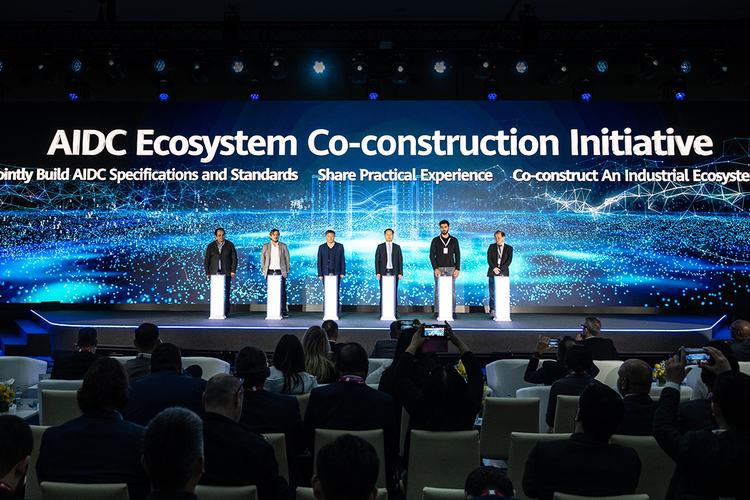
To support the development of this sustainable infrastructure, at MWC 2026 Huawei hosted the Global Digital Power Forum. Focusing on the theme of ‘Advancing All Intelligence, Empowering the Future Power System’, it used the forum to launch the AIDC Ecosystem Co-Construction Initiative, alongside Global Computing Consortium (GCC).
According to Jin Hai, Chairman of the Board of Directors of GCC, different countries and regions have various energy mixes, policy orientations, environmental protection measures and application scenarios which present both challenges for refining specifications as well as valuable opportunities for industry co-creation.
Designed to enhance the regional compatibility of standards and specifications by considering local policies, environmental conditions and technical needs, the AIDC Ecosystem Co-Construction Initiative aims to share practical experiences and build a dynamic global AIDC knowledge base through an alliance platform. By using specifications as a bridge, Huawei hopes this initiative will foster a thriving, open and mutually beneficial global AIDC industry ecosystem.
Conclusion
As the intelligent era rapidly unfolds, AI is unlocking vast growth prospects for the global ICT industry while simultaneously presenting unprecedented challenges for energy infrastructure. Huawei’s dual strategy – reconstructing AIDC core systems for data center customers and implementing AI-Powered Green Site solutions for mobile operators – directly addresses the critical pressures of surging energy consumption and power grid stability.
Central to this new infrastructure is the shift toward “tokens per watt” as the definitive efficiency metric for the AI era. While traditional metrics like PUE focus on the efficiency of the facility’s power delivery, “tokens per watt” measures the actual output of AI processing.
By focusing on this high-yield efficiency, Huawei Digital Power is enabling a transition where every joule of energy can be tokenized and imbued with human intent. Through continuous innovation in power supply, cooling and intelligent storage, Huawei and its global partners are hoping to build a stable, green and future-ready foundation to power this increasingly intelligent world.
More from Huawei

Sponsored
Huawei collaborates with GCC to launch the AIDC Ecosystem Co-construction Initiative
The initiative is designed to enhance the regional compatibility of standards and specifications by considering local policies, environmental conditions, and technical needs
Du pairs with Huawei to ramp up 5G Advanced push across UAE
The carrier has ambitions to deliver 10Gbps connectivity

Sponsored
Three-pillar MoU on AI capabilities, 5G evolution, and autonomous network technologies for next-generation networks
Read the orginal article: https://www.datacenterdynamics.com/en/marketwatch/huawei-redefines-ai-infrastructure-at-mwc-2026/


