

The picturesque Kent town of Sandwich is best known for lending its name to the eponymous bread-based snack invented by John Montagu, the fourth Earl of Sandwich, in the 18th century. It is less often recognized for its role (or should that be roll) on the frontline of Britain’s efforts in the Cold War.

When data centers go underground
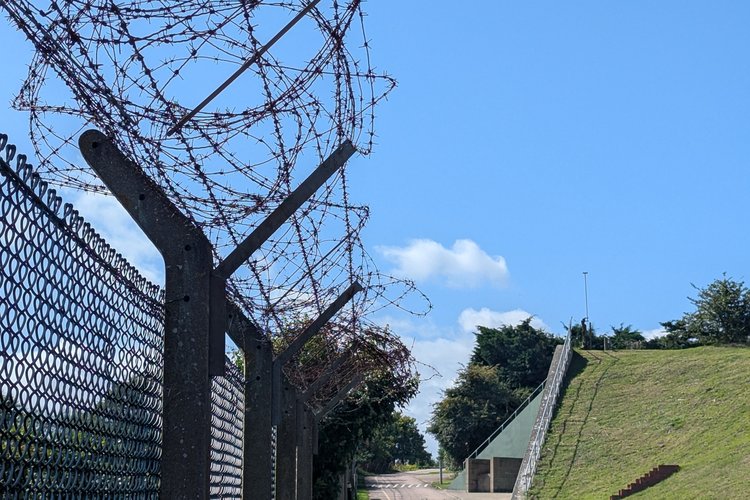
But venture less than a mile out of town and you will find the imposing gates and barbed wire-topped fence of the RAF Ash base. Built in the 1950s as part of the UK Ministry of Defence’s (MoD) ROTOR air defense radar system, staff at the base monitored the skies for signs that the Soviet Union was poised to launch a devastating atomic bomb attack.
To protect its radar operators from the impact of a nuclear blast, the MoD ensured staff at ROTOR facilities were housed in buildings that could withstand such an onslaught. In the case of the Ash base, this meant constructing an underground bunker encased in sand and concrete, where work could continue even as bombs rained down.
Seventy years on, the paranoia of the Cold War has receded, but the Ash bunker remains a hive of activity. Decommissioned in the 1990s, it no longer plays host to military personnel, but is now used to house a very different type of critical infrastructure; a data center.
The Bunker becomes a Fort
Military operations at Ash ceased in 1994, at which time the base was turned into a data center that became known as the Bunker.
Initially operated by Bunker Secure Hosting, it offered colo and managed services from Ash and another data center with military connections, a facility housed at Venture West, a former US Air Force base command center at New Greenham Park, Berkshire.
In 2017, The Bunker found new owners in the form of CyberFort Group, a freshly created cybersecurity company backed by investment firm Palatine Private Equity. Today, the data centers form part of a wider CyberFort offering covering cybersecurity consultancy and risk services, as well as “ultra secure colocation” at the data centers, and private and public cloud services, with a heavy emphasis on digital sovereignty.

Over lunch (of sandwiches, naturally), Rob Arnold, CyberFort’s chief digital officer, explains that the digital sovereignty push reflects the fact that where data resides is increasingly on the mind of the firm’s clients.
“The sovereignty piece is something we see coming up more and more in our conversations with customers,” Arnold says. “There’s a lot of interest in where data resides and how they can retain access to data, but also how they can remain compliant with regulations.”
Arnold attributes this, in part, to geopolitical factors such as Brexit, changing European regulations, and the uncertainty caused by Donald Trump’s presidency in the US, which, he says, has led some firms to consider repatriating workloads from US cloud hyperscalers.
Repatriation “is very much part of the conversation now, whereas it wasn’t three years ago,” he says. “Increasingly, the narrative is around who has access to data, be that a vendor or a state government. Sovereignty isn’t just for auditors anymore, it’s something tangible that is becoming important to businesses.”
CyberFort works with customers in sectors including healthcare, where it partners with a number of NHS trusts, and financial services, keen to tap into its expertise. “We are a UK company and our customers know we have UK data centers that are literally anchored in the soil here,” Arnold says.
Bunkering in
Before venturing into the bunker, DCD takes a tour of the above-ground portion of the site. Flanked by one of Kent’s trademark orchards, it is largely vacant but features several buildings – in various states of disrepair – that have endured since its days as a military base. One of these apparently used to house a model railway, built by staff at the base who clearly had too much time on their hands. More recently, the land has been used by the emergency services for training, while sheep are also grazed there throughout the year.
Also visible above ground are some staple elements of a data center campus, in the form of power and cooling infrastructure. Power to the site comes from two separate sources, something which CyberFort says adds to the data center’s resilience, with energy flowing through subterranean cables, as well as overground from a substation at nearby Wingham.
The bunker has 3MW of power to the site, and Arnold says this is sufficient for the company’s current needs, though there is potential for it to increase in time. “We’ve had discussions with UK Power Networks about growing capacity,” he says. “The availability is there, but we don’t want to do that and just wait for customers to arrive. We try to balance our investment strategy with demand, rather than going for stupid amounts of capacity for the sake of it.”
With dual power feeds, outages are rare, but backup is provided by a trio of 750kVA diesel generators. Their tanks contain enough fuel to power the data center for four days in the event of a power cut.
Cooling comes via two different air-cooled systems, one utilizing chilled water and another that is based on direct expansion (DX). The plan is to convert to full DX in the coming years, and Arnold says the company is not looking to follow the industry trend towards direct-to-chip liquid cooling because of the unique nature of its site.
“If you have a purpose-built data center where you can put chillers on the roof, liquid probably makes sense,” he says. “We have some unique challenges at this site getting water from the chiller to the data halls, meaning a lot of temperature is lost and a lot of energy is used. With DX you don’t have that issue.”
A series of pole-mounted proximity sensors are dotted around the site to detect intruders, providing an additional layer of security, though Arnold says these have previously also been triggered by a rogue sheep roaming too close to the bunker entrance.

Getting into the bunker itself involves going through some of the largest doors DCD has ever seen, then negotiating a series of stairs, more doors, complete with bulletproof glass, and corridors built at right angles to each other, apparently to help dissipate pressure in the event of a nuclear attack. The facility has a double outer wall, with a rubber layer in between, so that if the outer shell crumbles, those inside remain protected. The whole structure sits within a bed of sand and has a reinforced concrete slab on top. In other words, breaking in would be a challenge.
Inside is one of the original radar early warning system desks, fitted out with authentic 1980s digital infrastructure, in the form of some large monitors and very analog-looking keyboards. When operational, one of the bunker’s main rooms, which now serves as a data hall, was filled with eight desks, each operated by two ROTOR staff. Whether the red dial-up phone sitting on the desktop once provided a direct line to Downing Street is unclear.
Now the bunker’s rooms are filled with servers instead. It has regular colo data halls, as well as smaller individual rooms where companies can take an individual deployment for an extra level of security. The bunker’s warren of former offices, guard rooms, and decontamination shower areas (at least one of which is now a tape library) makes it ideal for this kind of set-up, but the irregular shape of the building means there is a lot more empty space than is usually found in a purpose-built, rectangular data center.
“We’ve got a couple of smaller rooms that are ready to go, and everything else can be ‘chopped up’ to fit the customer’s requirements,” Arnold says, pointing out a suite where an additional internal wall has been installed to subdivide the space. “Some clients will be happy with a basic wall, others will want a concrete wall built to meet their certification requirements – we had one which needed concrete with rebars [steel reinforcement bars] through it, and we had to evidence that.”
CyberFort’s clients usually foot the bill for such remodeling projects, and Arnold says leases typically run for at least three years. Average rack density in the data center is around 5kW, though the company is fielding requests for up to 20kW as more businesses look to deploy AI systems.
Future proofing
When it comes to expanding the bunker, there is plenty of space for the CyberFort team to get its teeth into. An extension of the bunker was built in the 1990s by its previous owners to accommodate backup generators, but was never fully fitted-out, and with the generators still above ground, it could be developed into white space instead.
“It’s early days,” says Arnold, when asked about how the extension will be utilized. “It would depend on the customer. We’ve had a few interesting conversations with businesses, but we still have rooms we can use in the main bunker, too.”

In terms of commissioned space, Arnold says the data center is “at around 50 percent capacity.” He adds: “We use what we have. For example, there’s a relatively small room that was used as a food store in the RAF days, and has got its own mantrap, so we rented that to a customer who only needed two or three racks but wanted an additional level of security.”
CyberFort also has plans to grow its presence at its other site in Newbury, to take advantage of the perceived trend towards digital sovereignty that the company has identified.
Exiting the bunker via a steep set of stairs and watching the reinforced steel doors and their enormous locks clanking shut, it is hard to escape the idea that the facility’s appeal is as much about security theater as it is security fact. After all, many modern data centers have big fences, multiple mantraps, armies of security guards, and, in some cases, even robot dogs to keep out undesirables.
But Arnold says the nature of the bunker does have practical benefits from a security compliance standpoint when the auditors come calling. “They’ll look at it and ask if the building can be ram-raided? Or if the glass meets certain specifications? Well, the bunker is underground and has no windows,” he says. “Things like that make a massive difference, especially because we’re doing audits every two or three months, and physical security is a big part of that.”
He adds: “We don’t advertise that we’re going to protect your data in the event Mr. Putin does something stupid, but it’s a nice-to-have, and it gives our customers a feeling of additional protection.
“There are a lot of UK data center companies, and our niche is that we can offer a portfolio of services around the data center. We’re not looking for 10,000 customers, we’d rather have 400 customers where we can offer a personalized service, and the bunker is part of what makes us unique.”
This feature first appeared in the DCD Subterranean Supplement. Register here to read the whole supplement free of charge.


Read the orginal article: https://www.datacenterdynamics.com/en/analysis/inside-the-data-center-built-to-withstand-a-nuclear-blast/


