

From ION–Acuris to BlackRock–Preqin, from LSEG–Refinitiv to S&P Global–With Intelligence, up to the latest Octus and AML Analytics deals. Here is why private markets professionals should not miss the Caffè di BeBeez on 9 November in Milan
There is a question that private equity funds should be asking themselves with some urgency: if the world’s largest financial groups are spending billions to buy companies that own proprietary data, what do those buyers know that other investors may not yet have understood?
Because the race for data and intelligence platforms did not start with ChatGPT. It was already in full swing years earlier. If anything, artificial intelligence is accelerating its industrial logic, increasing the ability to turn huge amounts of information into analysis, forecasts and operational decisions. Simply lining up some of the major deals of recent years shows the scale of the phenomenon.
In 2019 ION Investment Group, the group founded by Andrea Pignataro, acquired control of Acuris, owner of Mergermarket, Debtwire and other financial intelligence platforms, from BC Partners and GIC. Deal value: around 1.35 billion pounds, including debt (see here a previous article by BeBeez). ION is not a private equity fund, but an industrial group that has built a significant part of its growth by acquiring software, data and information tools for finance. Acuris was a strategic piece of that construction. For BC Partners, which had bought Acuris in 2013, the deal was instead an important exit in the financial information sector.
In January 2021 London Stock Exchange Group completed the acquisition of Refinitiv, announced in 2019 on the basis of an initial valuation of around 27 billion dollars, including debt. The seller was a consortium led by Blackstone together with Thomson Reuters. This was not just the purchase of a large financial information provider: LSEG was redefining its identity, turning from a market infrastructure operator into a global data, analytics and technology group (see here a previous article by BeBeez).
In June 2024 AlphaSense, an AI-based market intelligence platform, announced the acquisition of Tegus, a provider of expert-led research, content on private companies, financial data and workflow optimisation tools, for 930 million dollars, together with a 650 million round co-led by Viking Global Investors and BDT & MSD Partners, in which new investors also took part, including JP Morgan Growth Equity Partners, SoftBank Vision Fund 2, Blue Owl Capital and Alkeon Capital, as well as existing shareholders such as CapitalG (Alphabet’s fund) and Goldman Sachs Alternatives. Thanks to this financing, AlphaSense’s valuation reached 4 billion dollars. Here too, the point was to combine technology and proprietary content, in particular qualitative information on companies that is hard to find through ordinary public channels (see here the press release at the time).
Also in 2024, BlackRock announced the acquisition of Preqin for 3.2 billion dollars, completed in March 2025. Preqin is one of the world’s leading providers of private markets data: funds, managers, institutional investors, performance, fundraising and deals. Integrating it with Aladdin and eFront means bringing together data, software and investment processes in a single ecosystem (see here a previous article by BeBeez and the press release on the closing).
In October 2025 S&P Global announced the purchase of With Intelligence for 1.8 billion dollars from a group of shareholders led by Motive Partners, completing it the following November. With Intelligence collects and organises information on alternative managers, funds and investors. At the time of the announcement it had around 3 thousand clients and held data on around 30 thousand investors, 30 thousand managers, 70 thousand funds and 350 thousand deals. Once again, a large financial data group was buying an information asset developed with the backing of private equity (see here the press release at the time).
And this brings us to the last few weeks. On 22 October 2026 LSEG announced an agreement to buy Octus (formerly Reorg) from Permira and the other shareholders for 3.535 billion dollars, with closing expected in the first half of 2027. Octus, formerly Reorg, is an intelligence platform specialised in public and private credit, leveraged finance and restructurings. Permira had invested in it in 2022, on the basis of a valuation of around 1.3 billion dollars. The company is expected to exceed 300 million dollars in revenues in 2026, with an adjusted ebitda margin of around 40%. The agreed price is therefore equal to just under twelve times expected revenues. A multiple that shows how much a specialised information asset can be worth when it is embedded in the daily processes of funds, banks and advisors (see here a previous article by BeBeez). Finally, on 28 October Covalent Equity Partners announced a growth investment in the British company AML Analytics, without disclosing the amount or the stake acquired. The company provides independent data and benchmarks to test anti-money laundering and sanctions screening systems. It works with more than 1,450 financial institutions and more than 50 supervisory authorities in almost 60 countries. The investment will also be used to develop new AI-based testing tools (see here the press release).
Seven very different deals, sharing the same conviction: proprietary data, if reliable, up to date and embedded in decision-making processes, is strategic infrastructure. And it is no coincidence that in many of these stories private equity has played a leading role, as investor, seller or buyer.
At this point an objection naturally arises. If artificial intelligence can search, read, summarise and compare enormous amounts of information, why should the companies that collect that information be worth so much? The answer is probably that the ability to process information is not the same as the availability of quality information.
An AI model can analyse hundreds of documents in a few seconds. But it cannot invent a reliable data point that does not exist, nor can it automatically replace years of collecting, checking, normalising and updating information. Above all, it cannot turn an incomplete public source into a proprietary, structured and verified database simply because it has more computing power.
In private markets the problem is even more evident. Unlisted companies do not have the same disclosure obligations as listed ones. Valuations are less transparent, comparisons between companies more difficult, and information is often fragmented across financial statements, corporate documents, commercial sources and direct relationships.
Those who own better data can ask artificial intelligence better questions. And, above all, they can get more useful answers.
This does not mean that all information platforms are bound to become more valuable. Those that merely repackage easily accessible information risk, on the contrary, seeing their competitive advantage eroded. It is a truly differentiated proprietary asset, together with its reliability and integration into clients’ processes, that can create a barrier to entry.
For a private equity fund, these deals tell two stories at the same time. The first is about where to invest. Data and intelligence platforms can be very attractive businesses: recurring revenues, high customer retention, significant switching costs and the possibility of developing new products thanks to AI. The exits from Acuris, With Intelligence and Octus show that there are strategic buyers willing to pay significant valuations for these assets.
The second story, however, is even more important. It is about how to invest. How many funds already make systematic use of proprietary data to identify targets before their competitors? How many are able to combine financial, industrial and operational information to better assess an acquisition? How many use AI to analyse due diligence documentation, monitor portfolio companies in real time or identify add-on opportunities? And above all: how many have really built their own information infrastructure, rather than simply buying a few subscriptions and experimenting with generative tools?
Because there is a substantial difference between occasionally using an AI application and rethinking the entire investment process around reliable data, automated analysis and integrated decision-making tools. In the first case you may save time. In the second you can build a competitive advantage.
The risk for those who stand still is not only being less efficient. It is systematically arriving after the others: in finding targets, in understanding risks, in assessing opportunities and in creating value in portfolio companies.
It is no coincidence that EdiBeez, the publisher of BeBeez, has also decided to take this path, naturally on a different scale and in a different way from the large international groups. Last May, with this goal in mind, we announced an agreement with Metriks AI spa, a Milan-based data company listed on Euronext Growth Milan, aimed at turning BeBeez Private Data, BeBeez’s proprietary database on Italian private capital, into an AI-native platform. The information asset built over more than thirteen years of editorial activity can thus be queried in natural language through intelligent agents, allowing funds, banks and advisors to identify potential targets, reconstruct deals, analyse sectors and monitor portfolio companies (see here a previous article by BeBeez).
The industrial logic is the same that emerges from the large international deals: combining exclusive data, specialist expertise and artificial intelligence to move from simply consulting information to producing intelligence that can be used in investment decisions.
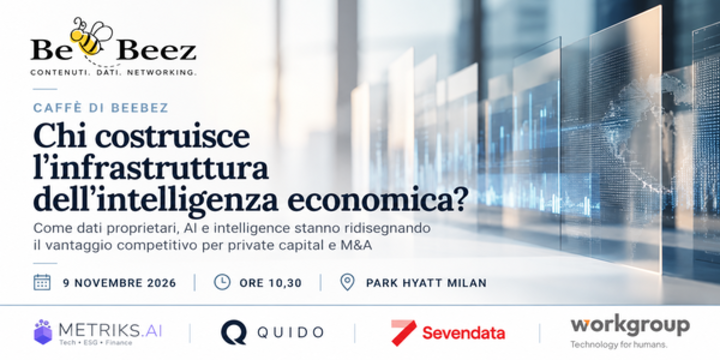
It is precisely from these considerations that the next Caffè di BeBeez was born, scheduled for Monday 9 November at the Park Hyatt Hotel in Milan, and dedicated to a topic that should today be on every fund manager’s agenda: Who builds the infrastructure of economic intelligence? How proprietary data, AI and intelligence are reshaping competitive advantage in private capital and M&A.
The aim is not to discuss artificial intelligence in general terms, nor to present yet another technology set to revolutionise everything. It is to understand, together with those who develop these solutions and those who invest in companies, how the value chain that leads from data to decision is concretely built. We will therefore talk about deal sourcing, due diligence, company analysis, portfolio monitoring and process automation. But also about a broader industrial question: who will control the data and tools that will allow funds to make better decisions? The discussion will be particularly useful for private equity and private debt managers, institutional investors, M&A professionals and advisors, as well as for those who work every day on the transformation of portfolio companies.

We look forward to seeing you
on 9 November at 10.30 am
in Milan, at the Park Hyatt Hotel, via Tommaso Grossi, 1
at the Caffè di BeBeez on
Who builds the infrastructure of economic intelligence?
How proprietary data, AI and intelligence are reshaping
competitive advantage in private capital and M&A
Click here to book your seat
(the event will be held in Italian)
Programme
10.30 am Welcome Coffee
10.50 am Round table
1. Operational data – Where does the information that matters come from?
Antonio Torino, ceo Workgroup
Every invoice, order and stock movement recorded in SMEs’ management systems is real-time information on the health of a company, long before the financial statements arrive. But how much of this asset is really usable? And how do you turn fragmented and “dirty” data into a reliable indicator for managers and investors?
2. Data intelligence – How to spot opportunities others do not see?
Fabrizio Vigo, co-founder & ceo Sevendata
Financial statements and official registers, but also websites, digital signals and territorial data: by combining traditional and alternative sources with AI, a company, a supply chain or a market can be read much more promptly. How is this information advantage built, and how does it change the assessment of a target’s risk and growth potential?
3. AI agents – When does intelligence become action?
Tiziano Cetarini, founder & ceo Metriks AI
How AI agents can turn data and information into automated processes: from reading company performance to monitoring portfolio companies, up to the early detection of anomalies, risks and operational opportunities.
4. The investor’s job – How much can the analyst’s work change?
Francesco Paolo Calia, co-founder Quido
Scouting, financial statement analysis, data rooms, document due diligence and preparation of materials for the investment committee: which activities can be accelerated by AI, how much time can be saved and where does human judgement remain indispensable?
5. Private equity – AI as a lever for value creation
Francesco Casiraghi, managing director Advent International
Advent International is one of the founding partners of OpenAI Deployment Company, the company promoted by OpenAI to accelerate the adoption of AI in businesses. What does this change of perspective mean, in which funds no longer just use AI but invest directly in the infrastructure and services needed to spread it? And how can this experience translate into a new model of value creation, both in the work of investment teams and in portfolio companies?
Moderated by Stefania Peveraro, editor-in-chief of BeBeez
What will we take home from the discussion? A concrete map of the opportunities offered by artificial intelligence across the entire investment cycle: from deal sourcing to due diligence, from portfolio monitoring to value creation in portfolio companies, with examples, tools and practical guidance to understand where to invest time and resources, what results to expect and how to measure them.
12.30-1.00 pm Networking aperitivo
Click here to book your seat


