

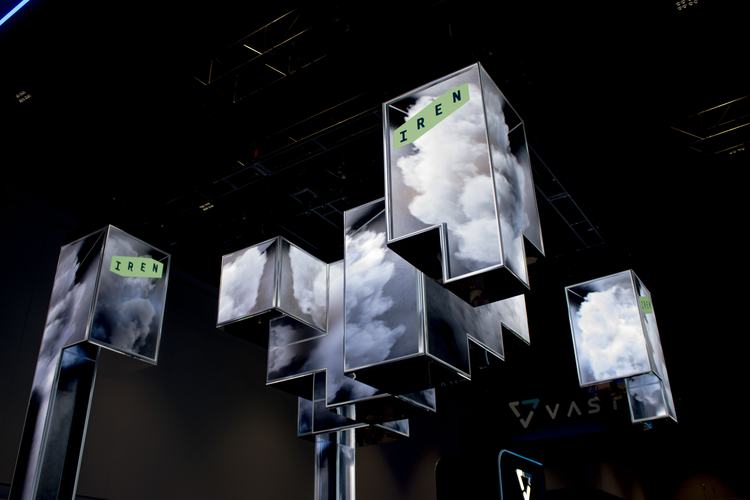

“We’re sitting on a very large amount of secure power and land,” Iren’s chief commercial officer, Kent Draper, tells DCD with a grin.
Amid the broader wave of cryptominers and data center hopefuls targeting the neocloud market, the company has sought to carve out its own niche by building its own infrastructure and owning as much of the chain as possible.
This feature originally appeared in the neocloud supplement. Read it for free today.
“We’re vertically integrated, so that is a pretty big difference versus your Nebiuses and CoreWeaves,” Draper says.
“We think there are very distinct advantages to that: It allows you to scale more quickly. You’ve got more control over how you deliver what you’re doing because you’re not relying on third-party colocation providers. It’s better for customer support. And, there should be a cost-benefit to it.”
Initially a Bitcoin miner named Iris Energy, Iren has shifted to developing a few massive data centers for AI clients. Its existing Canadian portfolio has been converted and expanded – 160MW of air-cooled capacity in British Columbia across three sites. But its biggest bets are in the US, where it hopes to deploy gigawatts of liquid-cooled capacity.
In Childress, Texas, the company operates 750MW. Further south in the state, two sites in Sweetwater are planned to grow to 2GW, with operations starting this year. Over in Oklahoma to the east, another 1.6GW is planned from 2028.
The proximity of the three mega-scale projects is critical during this period of workforce competition, Draper explains. “We have been lucky that we’ve been permanently under construction in Texas for the last three years, so we already had a big workforce on site and have established contractor relationships. I think if you were coming into that market from scratch today, it would be very difficult.”
The Oklahoma development is “close geographically, which is super helpful, because all the same contractors that we already have relationships with can work on that project, but it’s a different jurisdiction from a grid perspective,” Draper says.
The company favors building in rural areas, which can support massive land and power requirements, despite being farther from population centers, which increases latency.
“Even 18 months ago, everyone was asking whether West Texas was a reasonable location for these data centers,” Draper says. “Now it’s turned into one of the biggest markets globally.”
Earlier this year, JLL reported that the Lone Star State is expected to become the world’s largest data center market by 2030. “Unless you’re trying to put a data center in the middle of the Pacific Ocean, the latency is not going to be an issue,” Draper argues. “It’s just becoming less and less of an issue, even for inference.”
The company’s view has been reinforced by Microsoft, which signed a $9.7 billion cloud contract with Iren late last year – alongside similar deals with its rivals.
“We started building the data centers that are servicing the Microsoft contracts on spec,” Draper says.
“We were only building the first two out of four that we ended up doing,” he adds. “The customer contract then allowed us to commit to everything. One of the key issues that we find in this industry is the chicken-and-egg problem – you go to a customer, and they say, ‘When can you bring the clusters online?’ And you say to them, well, when can you commit? And you just go around in circles, right?”
Committing to projects early has given the company a window to capture a portion of the market, Draper believes. “If you rewind 12 months, everyone was like, ‘okay, 2026 is pretty tight, 2027 looks okay, 2028 totally fine.’ Today, it’s ‘2026 there’s nothing, 2027 very tight, 2028 pretty tight…’”
Similarly, Iren signs supply contracts early – a trend now seen in much of the industry. “If you’re signing your customer contract and only entering your procurement contract months later, the market could be vastly different,” Draper says. “Because we’re building the data centers as well, we make a big effort to get ahead of the long lead procurement items and make sure we’re ordering them well in advance so we’re not subject to delays down the track.”
He lists off the key components still seeing a crunch: “High voltage circuit breakers, high voltage transformers, generators, and chillers… I think chiller supplies will ramp manufacturing relatively quickly, but high voltage equipment, there’s only a handful of suppliers, and it requires very expensive manufacturing facilities.”
Iren also buys GPUs on spec in advance of contracts. “If you’re comfortable with that, the GPUs are actually most valuable right as they’re about to come online, and you can contract them very easily at that point,” he notes.
The company in March 2026 announced plans to purchase some 50,000 Nvidia B300 GPUs, giving it a fleet totaling 150,000 GPUs (including AMD hardware). But speculative purchasing and building carry risk.
“The fact that Microsoft is highly creditworthy was a big deal to us,” Draper admits, “particularly because it makes it a very capital-efficient model. We’ve got a lot of growth ahead of us, and we need to finance all of that. To give you an idea, with their prepayment and debt financing, we funded 95 percent of the cost of the GPU, so it was extremely efficient from a financing perspective.”

AI clouds reshape the digital infrastructure landscape
The company aims to target investment-grade customers for the majority of its contracts, but “because of the size we’re at already, you can have an element of your compute go to customers” that are more precarious and dependent on endless AI growth.
Like many in the AI cloud space, Iren is talking with those customers about how much redundancy they need. “We’ve set it up with full redundancy over everything for the Microsoft one,” Draper says.
“But increasingly, the conversations we’re having, people are willing to accept certain areas where there may not be redundancy. Frankly, a large part of that is us telling them that we don’t think that they need it. The additional cost to get 0.1 percent additional uptime just doesn’t often make sense.”
For training runs in particular, “they’re writing to set points every two to six hours, depending on who it is,” essentially saving work that can be easily resumed should disaster strike. “So there’s just no reason to do it in our mind. What we say is, you want to keep your core networking up the whole time, because that takes longer to recover.”
While some customers are reevaluating their redundancy needs, others are dealing with data center providers that have failed to bring capacity online at the rate initially promised.
“You see this in any new industry,” Draper says, when we ask about reports rival Crusoe was behind schedule on its Abilene, Texas, campus. “Everybody comes in excited, they’re promising the world, and then underdeliver,” he says, not referencing the project specifically.
“That’s one of the key elements that we hang our hat on. Even when we were doing more Bitcoin mining stuff, we were giving capacity targets to the market. We hit every capacity target that we ever set. So it is a very important element, and I think a lot of people will struggle to get their capacity online when they said they would.”
Draper has spent the last nine years at Iren, and remembers when the company was solely focused on mining. “Within the AI industry, people don’t like to draw analogies [to crypto] because they think this is a much more high-brow use case and whatever. But many of the fundamental tenets remain the same.
“You need access to land and power. You need to be able to construct very large-scale infrastructure. You need to do it on time and on budget. You need to be able to operate the equipment.”
Again, Draper makes the argument that vertical integration was key to its success in that adjacent compute field. “A lot of people took a capital light model,” he recalls. “And then it turned out they didn’t have control of their scalability. They didn’t have control of delivery of the data centers. They ended up paying a lot more because, on top of all their costs, they had a hosting margin.”
Dominant neocloud provider CoreWeave used its ‘data center light’ approach to great success, focusing debt raises on GPU purchases. But it has since repeatedly sought to acquire its hosting provider, Core Scientific, most recently with a $9bn bid that ultimately failed.
“I think you’re seeing Nebius and CoreWeave trying to get more vertically integrated,” Draper says. “That is probably a good indication that we’re on to something.”
Read the orginal article: https://www.datacenterdynamics.com/en/analysis/the-vertically-integrated-neocloud/


