

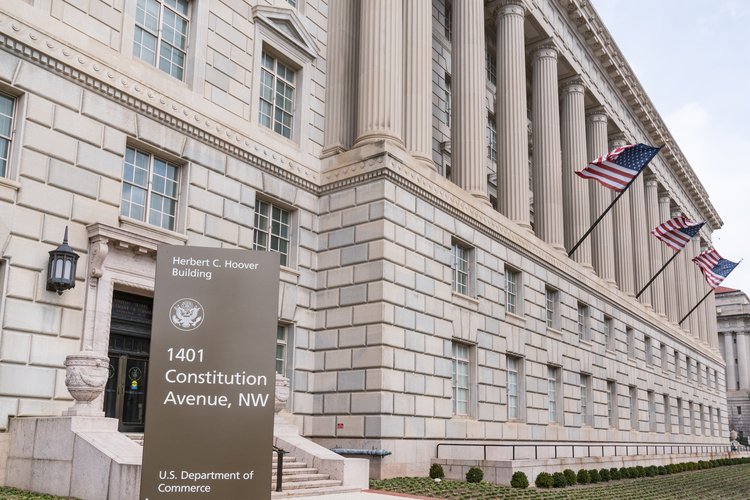
The US Department of Commerce has signed nine letters of intent with quantum computing companies to provide $2.013 billion in federal incentives under the CHIPS and Science Act.
Announced last week (May 21), the companies include two US quantum foundry companies – IBM and Global Foundries – and seven quantum computing firms – Atom Computing, Diraq, D-Wave, Infleqtion, PsiQuantum, Quantinuum, and Rigetti Computing.

Building the chips to power quantum computers
IBM will receive $1 billion from the department, the largest funding agreement of the nine, to establish a new superconducting quantum foundry subsidiary, while GlobalFoundries will receive $375 million to establish a US-based quantum foundry that supports multiple quantum modalities.
Atom Computing, D-Wave, Infleqtion, PsiQuantum, and Quantinuum will receive $100 million each. Rigetti will receive up to $100m while Diraq will receive $38m.
All the quantum hardware companies will use the funding to further advance their respective quantum modalities and “accelerate R&D for the most consequential unresolved engineering problems, including device reproducibility, optical complexity, error rates, cryogenic systems integration, control hardware, ultra-fast readout electronics, photonic loss, and interconnects,” the Department of Commerce said in a statement.
As a condition for receiving the funds, the Commerce Department will receive a minority, non-controlling equity stake in each company. The move mimics deals made by the US government last year, in particular its $8.9bn investment in chipmaker Intel in exchange for a 9.9 percent stake.
“With today’s CHIPS Research and Development investments in quantum computing, the Trump administration is leading the world into a new era of American innovation,” said Secretary of Commerce Howard Lutnick. “These strategic quantum technology investments will build on our domestic industry, creating thousands of high-paying American jobs while advancing American quantum capabilities.”
Bill Frauenhofer, executive director of Semiconductor Investment and Innovation, added: “The CHIPS R&D Office is taking a portfolio approach to strengthen and accelerate US leadership across multiple quantum modalities at once, while focusing each award on discrete technological problems of genuine consequence. We will be providing incentives to build domestic quantum capacity, solve the hardest engineering challenges, enable multi-year acceleration of technology roadmaps, and drive continued US quantum leadership.”
Reports first emerged in October 2025 that the US Department of Commerce had held conversations with a number of quantum computing companies, with a view to taking equity stakes in the businesses in exchange for federal funding.
At the time, Riggeti, D-Wave, and Atom Computing were all reported to be considering such an arrangement, alongside IonQ – a company that Steve Feinberg, the US Deputy Secretary of Defense (now stylized as the Deputy Secretary of War), held shares worth approximately $134 million in via his hedge fund Cerberus Capital Management.
In February 2026, short seller Wolfpack Research published a report accusing IonQ of misleading investors about the state of the company’s finances, claiming that lost government contracts have left $54.6m “black hole” in the company’s revenue.
Following the May 21 announcement, the FT noted that several of the companies set to benefit from the $2bn funding agreement also had ties to the Trump administration.
Emil Michael, who took D-Wave public in 2022 via a SPAC merger with his company DPCM Capital, is the current US Under Secretary of Defense for Research and Engineering. Additionally, Donald Trump Jr. is a partner in venture capital firm 1789 Capital, which invested in PsiQuantum’s April 2025 Series E funding round.
The FT went on to cite a person close to PsiQuantum who stated that 1789 was a passive minority investor with no involvement in PsiQuantum’s operations.
The Department of Commerce said that the agreements with the nine companies are not final, adding that it would continue to solicit proposals from additional eligible applicants.
Other quantum computing news you might have missed
Europe
- French quantum computing startup Alice & Bob has expanded its €100 million ($116m) Series B funding round with an investment from Nvidia’s venture capital arm NVentures. The size of the investment was not disclosed, but the startup’s CEO, Théau Peronnin, said that Alice & Bob had been working alongside Nvidia to connect its cat-qubit architecture within the chip giant’s computing ecosystem.
- Elsewhere in France, President Emmanuel Macron announced an additional €1 billion ($1.2bn) in funding to support the country’s Quantum Plan, adding that the country would also commit €550m ($638m) to support a future European semiconductor program. Originally running between 2021 – 2025, France’s Quantum Plan has already received €2.3bn in funding from the government, €500m ($582m) of which originated from a program to support public procurement in the country’s defense sector.
- Poland’s Poznan University of Technology has deployed a Radiance R1 quantum computer from IQM Quantum Computers, the institution’s first locally installed system. The Radiance R1 will give researchers, students, and engineers direct access to a quantum computer, helping to support Poland’s quantum roadmap, alongside broader European quantum initiatives.
- The government of Romania is planning to install its first quantum computer in the city of Iași later this year, supported by an investment of more than €100 million ($116m). Local media reported that Alexandru Ioan Cuza University will play a “central role” in running quantum training and research programs once the system has been installed.
Australia
- In addition to signing a letter of intent with the US government, Australian quantum computing firm PsiQuantum last week announced it has moved its planned quantum computing center away from a site near Brisbane airport to a parcel of land in the City of Moreton Bay in north Brisbane. In a statement, the company said the land is the site of the former Petrie Paper Mill and has the “power and utility infrastructure needed for complex manufacturing.” Early site works have already begun, with a formal groundbreaking scheduled for June. This week, the company will open its Test and Validation Lab at Griffith University’s Nathan campus in south Brisbane.




Read the orginal article: https://www.datacenterdynamics.com/en/news/us-dept-of-commerce-awards-nine-quantum-computing-companies-2bn-in-exchange-for-non-controlling-equity-stakes/


