

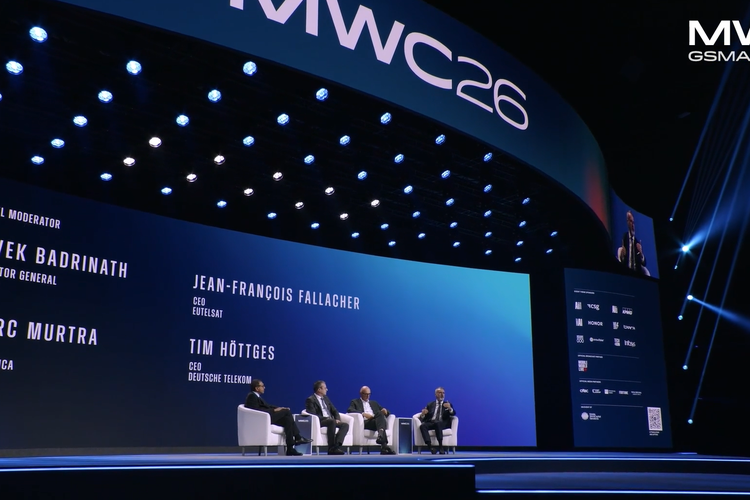
The CEOs of Eutelsat, Deutsche Telekom, and Telefónica sketched a bullish, sovereignty-driven vision for Europe’s digital future, but warned that without lighter, more coherent, pro-investment regulation from Brussels, the bloc cannot realistically compete with the US and China.
Speaking during a keynote panel at Mobile World Congress, Eutelsat CEO Jean-François Fallacher positioned his company as the only sovereign European satellite constellation and said it was “in a fighting mode” to counter the growing dominance of Starlink, China’s Guowang, and the new market entrant in Amazon Leo.
“We are having to fight in a world of giants,” Fallacher said. “We’re operational, we’re selling, the activity is going well … 20 percent of our turnover, over €200 million ($232m), and experiencing a 60 percent year-on-year increase. We are clearly benefiting from the momentum to be the alternative to the American players and the future Chinese ones.”
Fallacher was firm in his view that Europe should “master” lower orbit constellations, stressing it was a technology that the bloc “cannot be dependent” on other nations, adding: “The current geopolitical environment is pushing us even more towards that.”

The former Orange CEO said the geopolitical climate was providing Eutelsat with more wind in its sails as a concept of sovereignty, and that to compete with giants like Amazon and SpaceX, Europe needs scale and support.
“I’m deeply European, but still, what I see on a daily basis is that we are a collection of 27 countries,” Fallacher said. “We are not, unfortunately, yet behaving like one country, and there is always a temptation of fragmentation; that each of us are willing or wanting to build its own local, national [service].
“I understand that temptation, but I believe it would be a big [defeat], and that’s why we at Eutelsat are really advocating to get all the European countries united, not only around Eutelsat, we have this project, this European project, to build a v2 of our constellation, which is called IRIS², where we really need all European countries and all public money to get around us to have these sovereign constellations thriving in the future,” Fallacher continued.
Deutsche Telekom CEO warns of ‘hedgehog day’ malaise in Brussels
If Eutelsat and Fallacher were in fighting mode, then Deutsche Telekom CEO Tim Höttges was fervent in his frustration with a lack of regulatory change in Europe.
In a blunt show of force on stage in Barcelona, Höttges said that bureaucracy is up and investment is down, which he links directly to Europe falling further behind the US and China.
“I would say hedgehog day,” Höttges said, citing the European equivalent to the US Groundhog Day and film of the same name with its famous premise of a day that repeats itself over and over.

“One year down the road and in Brussels, nothing has improved … all the ambitions which Europe had at the beginning to say, ‘come on now, this is all about incentivizing investments,’ nothing has happened. One year down the road, our industry is investing another two percent less in Europe than the year before,” Höttges said. “Our industry, and I speak for the industry, we are very frustrated. Europe is falling behind the US, and China and other markets have a better setup for the industry, and I can tell you, it will have its consequences prospectively.”
The Deutsche Telekom CEO said his concerns stretched beyond the telecom market, saying he was worried about cloud, AI, and GPUs.
“Looking only to mobile services or fixed-line services is not wide enough,” Höttges said. “We should broaden it because our industry is expanding into [those] regions as well.”
Höttges sketched a vision of a new industrial era in which Europe’s factories are run not by “classical blue collar workers” but by highly automated, data-driven systems.
That model, he said, rests on five pillars: data hosting in the cloud or at the edge; powerful GPUs and specialized chipsets to process it; AI systems to act on it; high-quality connectivity to link global production sites; and advanced robotics to execute decisions on the factory floor. Together, he argued, these technologies finally make the long-touted idea of Industry 4.0 a reality after years of hype.
“This is exactly what’s happening in the US these days,” Höttges said. “They are investing in exactly these things. They have the chipsets, they have the data centers, they have the AI tools, they have the connectivity. And on top of that, they’re developing more and more automation tools that they can take advantage of this production against the arbitrage and labor arbitrage disadvantages they had in the past.”
“If we want to keep the sovereignty, the wealth in the European constituencies, we have to own these categories, because otherwise our wealth is moving out of the continent,” Höttges added.
Telefónica chief calls for scale, speed, and ‘pro-technology’ rules
Telefónica CEO Marc Murtra picked up the sovereignty theme from a different angle, arguing that Europe’s competitiveness ultimately hinges on building companies with real scale and regulatory frameworks that reward calculated risk-taking rather than caution.
“With regards to European competitiveness, we need three things,” Murtra said. “The first thing we need is scale. We need larger companies that assume more risks, attract better talent, and have deeper technological investments.”

The second, he argued, is a shift to “pro-technology regulation that simplifies rules and prioritizes the creation of new technology over adding layers of compliance, and the third is speed.”
Murtra contrasted the “seismic and profound” changes unleashed by AI in just three months with a regulatory environment that has barely shifted in more than a decade.
“We can see one AI product leapfrogging the next one,” Murtra said, noting that the way software is programmed, tested, and integrated “has changed completely,” while European rules still move at a pre-digital pace.
At Telefónica itself, Murtra said the response is to double down on future-facing capabilities and accept that some legacy businesses will have to go.
“We’re letting go [of] obsolete technologies,” Murtra said. “So that means we need to let go [of] obsolete business units, and we need to focus on future skills.”
Murtra added that for Telefónica to succeed and meet his vision of a European company at scale, it has to be “more vertical, have a higher impact, and that probably means assume more calculated risks.”
“Calculated risks, of course, have the upside to make money or to be successful, but the downside is that a lot of the decisions you make are not right, and the organization, starting with me, its president, needs to understand that and work in line with that,” Murtra said.




Read the orginal article: https://www.datacenterdynamics.com/en/news/europes-digital-sovereignty-dead-on-arrival-without-regulatory-overhaul-telecom-ceos-warn/


