

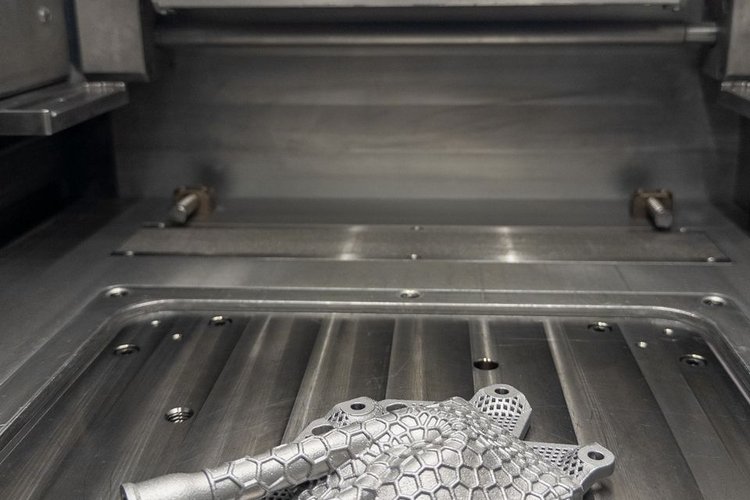
Researchers have developed a 3D-printed cooling component for liquid-cooled data centers.
The Danish Technological Institute and Heatflow, together with Open Engineering from Belgium and Fraunhofer IWU from Germany, have developed and tested a 3D-printed cooling component for data centers and high-performance computers.

The solution uses a coolant that evaporates on the hot surface. The vapor rises, removing heat, and then condenses again, using gravity to return to where the heat originates. The key component in the new system is an evaporator that Heatflow and the Danish Technological Institute have developed and manufactured using 3D printing.
The solution uses passive two-phase cooling and achieved a cooling capacity of 600 watts in tests – 50 percent more than the original target of 400 watts. No pumps are used, reducing energy requirements for cooling.
“By 3D printing the component, we can integrate all necessary functions into one complete part. This eliminates assembly points, reduces the risk of leakage, and makes the component more reliable. At the same time, we only use one material, which makes it easier to recycle,” said Simon Brudler, 3D printing specialist and senior consultant at the Danish Technological Institute.
The project is part of the AM2PC European research initiative. The project is supported by M-ERA.NET, with a grant from the Danish Innovation Fund.
The focus of the project has been to develop and manufacture the evaporator and validate its performance.
“We are seeing a trend where the power density in servers is increasing faster than ever before, and traditional air cooling is simply not sufficient anymore. With our two-phase solution, we can remove heat passively without pumps or fans, which significantly reduces energy consumption for cooling,” said Paw Mortensen, CEO of Heatflow, who led the AM2PC project.
Founded in 2018, Heatflow is a Danish electronics cooling provider focused on two-phase cooling.
M-ERA.NET is an EU-funded network established to support European research programs and funding in materials science and engineering. The Danish Technological Institute is a self-owned and non-profit research and development institute.
The vapour chamber was developed using Laser Powder Bed Fusion (PBF-LB), a metal additive manufacturing method that uses a laser to fuse powders together.
The solution removes heat at temperatures between 60–80°C (140-176°F), potentially offering utility in district heating schemes relying on waste heat from data centers.
“We have not focused on the actual integration into district heating, but we have demonstrated that the technology makes it possible. It is an important step towards more energy-efficient data centers that can contribute positively to the overall energy balance,” added Brudler.





Read the orginal article: https://www.datacenterdynamics.com/en/news/danish-researchers-develop-3d-printed-vapour-chamber-for-two-phase-liquid-cooling/


