No Result
View All Result
  • Private Data
  • Membership options
  • Login
  • COUNTRY
    • ITALY
    • IBERIA
    • FRANCE
    • UK&IRELAND
    • BENELUX
    • DACH
    • SCANDINAVIA&BALTICS
  • PRIVATE EQUITY
  • VENTURE CAPITAL
  • PRIVATE DEBT
  • DISTRESSED ASSETS
  • REAL ESTATE
  • FINTECH
  • GREEN
  • PREMIUM
    • ItaHubHOT
      • ItaHub Legal
      • ItaHub Tax
      • ItaHub Trend
    • REPORT
    • INSIGHT VIEW
    • Private Data
Subscribe
  • COUNTRY
    • ITALY
    • IBERIA
    • FRANCE
    • UK&IRELAND
    • BENELUX
    • DACH
    • SCANDINAVIA&BALTICS
  • PRIVATE EQUITY
  • VENTURE CAPITAL
  • PRIVATE DEBT
  • DISTRESSED ASSETS
  • REAL ESTATE
  • FINTECH
  • GREEN
  • PREMIUM
    • ItaHubHOT
      • ItaHub Legal
      • ItaHub Tax
      • ItaHub Trend
    • REPORT
    • INSIGHT VIEW
    • Private Data
Home DISTRESSED ASSETS

When Should Banks Consider Selling Credit Exposures? – Strategic Guidance for UK Banks

Debitosby Debitos
January 20, 2026
Reading Time: 3 mins read
in DISTRESSED ASSETS, PRIVATE DEBT, UK&IRELAND
Share on FacebookShare on Twitter

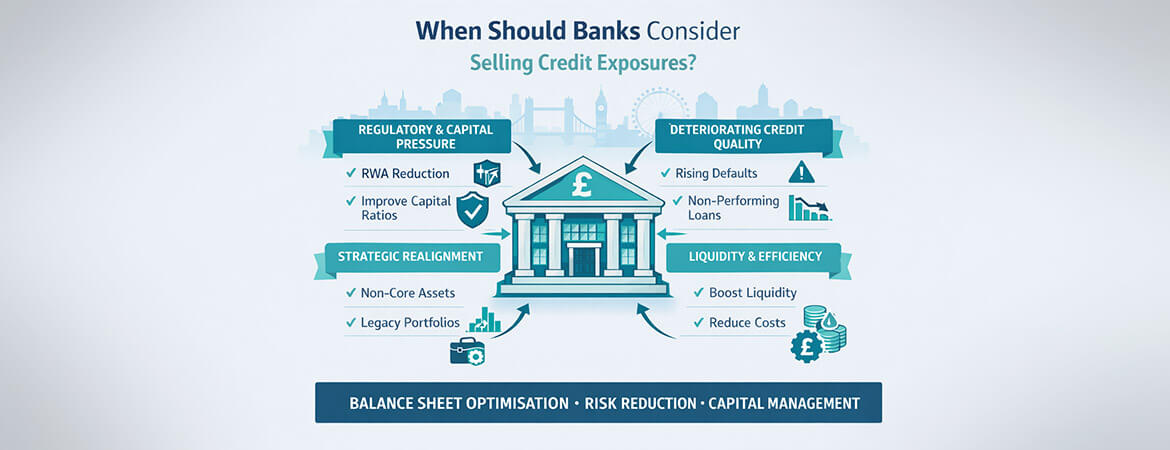
The question of when banks should consider selling credit exposures has become increasingly relevant within the UK banking sector. Heightened regulatory scrutiny, changing capital requirements, economic uncertainty and competitive pressure are forcing banks to manage their loan portfolios more actively than ever before. Today, the sale of credit exposures is no longer merely a reaction to distress but a core component of strategic balance sheet and risk management.

Regulatory Pressure and Capital Efficiency

One of the primary drivers for selling credit exposures in the UK is regulatory and capital optimisation. UK banks must continuously comply with capital adequacy, leverage and stress testing requirements. As risk-weighted assets (RWAs) increase, capital ratios can come under pressure, limiting lending capacity and strategic flexibility.

By selling selected credit exposures, banks can reduce RWAs, improve capital efficiency and free up regulatory headroom. This approach allows institutions to strengthen their balance sheets without raising additional equity or materially restricting new business, making credit sales a valuable tool in periods of heightened supervisory expectations.

Deterioration in Credit Quality

Another key moment to consider selling credit exposures arises when credit performance begins to weaken. Early warning signals include:

  • persistent payment arrears

  • rising probability of default

  • covenant breaches

  • negative sector or macroeconomic trends

For non-performing loans (NPLs) or “unlikely-to-pay” exposures, early divestment can be commercially prudent. Timely portfolio sales may limit further impairment charges, reduce provisioning volatility and prevent the accumulation of long-term workout and legal costs. In many cases, proactive disposal delivers better economic outcomes than delayed or forced sales.

Strategic Portfolio Realignment

Banks should also consider selling credit exposures that no longer align with their long-term strategy. This may include:

  • legacy loan portfolios from previous growth phases

  • exposures to non-core sectors

  • geographic markets outside strategic focus

  • assets with unattractive risk-adjusted returns

Credit exposure sales allow UK banks to streamline their portfolios and reallocate capital towards higher-margin, lower-risk or strategically important activities. This targeted portfolio optimisation enhances transparency, improves management focus and supports sustainable profitability.

Liquidity Management and Funding Considerations

In periods of market volatility or increased funding costs, liquidity management becomes a critical concern. Selling credit exposures can generate immediate liquidity, strengthening funding profiles and reducing reliance on wholesale markets.

At the same time, banks can lower ongoing operational costs related to loan monitoring, restructuring and recovery processes. These efficiency gains can have a direct positive impact on profitability, particularly in environments characterised by compressed margins and rising cost pressures.

Operational Relief and Risk Reduction

Beyond balance sheet effects, the sale of credit exposures provides meaningful operational benefits. Complex or distressed loans often require significant internal resources, including specialised credit, legal and workout teams. By transferring these exposures, banks can reduce operational complexity, free up internal capacity and refocus on core lending and client relationship management.

In addition, portfolio sales help reduce concentration risk, leading to a more resilient and diversified credit book with improved predictability and risk control.

Conclusion: Credit Sales as a Strategic Management Tool

For banks operating in the United Kingdom, selling credit exposures is no longer a purely reactive measure but a proactive instrument of balance sheet, capital and risk management. Institutions that regularly review their loan portfolios and act early can strengthen capital ratios, enhance liquidity, reduce risk and improve long-term competitiveness.

A well-structured and professionally executed sale process is essential to maximise value, ensure regulatory compliance and achieve optimal market outcomes.

Strategic planning, clear portfolio segmentation and expert transaction execution are key success factors when implementing credit exposure sales in the UK banking market.

Disclaimer

Read the orginal article: https://www.debitos.com/news/when-should-banks-consider-selling-credit-exposures-strategic-guidance-for-uk-banks/

Gateways to Italy

Gateways to Italy – Offer your services to funds and investors willing to explore opportunities in Italy. Become a partner!

Gateways to Italy – Offer your services to funds and investors willing to explore opportunities in Italy. Become a partner!

by Partner
June 6, 2023

Sign up to our newsletter

SIGN UP

Related Posts

GREEN

Metacon secures temporary project financing of SEK 50 million from Fenja Capital

January 20, 2026
GREEN

The biggest data center stories of 2025

January 20, 2026
PRIVATE EQUITY

2025 telco talking points: AI, fiber frenzy, and an M&A boom

January 20, 2026

ItaHub

Crypto-assets supervision rules in Italy, Banca d’Italia will supervise payment systems and Consob on market abuse

Crypto-assets supervision rules in Italy, Banca d’Italia will supervise payment systems and Consob on market abuse

November 4, 2024
Italy’s SMEs export toward 260 bn euros in 2025

Italy’s SMEs export toward 260 bn euros in 2025

September 9, 2024
With two months to go before the NPL Directive, in Italy the securitization rebus is still to be unraveled

With two months to go before the NPL Directive, in Italy the securitization rebus is still to be unraveled

April 23, 2024
EU’s AI Act, like previous rules on technology,  looks more defensive than investment-oriented

EU’s AI Act, like previous rules on technology, looks more defensive than investment-oriented

January 9, 2024

Co-sponsor

Premium

Italian private equity accelerates, driven by add-ons. BeBeez reports.

Italian private equity accelerates, driven by add-ons. BeBeez reports.

September 7, 2025
AlixPartners: Automotive, retail and manufacturing sectors may go through restructuring in 2025

AlixPartners: Automotive, retail and manufacturing sectors may go through restructuring in 2025

July 11, 2025
Funds vying for management consulting firm BIP, a CVC portfolio company. All deals in the sector

Funds vying for management consulting firm BIP, a CVC portfolio company. All deals in the sector

March 6, 2025
Private equity, Italy 2024 closes with 588 deals as for investments and divestments from 549 in 2023. Here is the new BeBeez’s report

Private equity, Italy 2024 closes with 588 deals as for investments and divestments from 549 in 2023. Here is the new BeBeez’s report

February 10, 2025
Next Post

From eggs to avocados - Germany's Orbem raises €55.5 million for AI-powered MRI expansion

Finnish NPHarvest taps €1.2 million deeptech accelerator funding to commercialize waste-to-fertilizer tech

EdiBeez srl

C.so Italia 22 - 20122 - Milano
C.F. | P.IVA 09375120962
Aut. Trib. Milano n. 102
del 3 aprile 2013

COUNTRY

Italy
Iberia
France
UK&Ireland
Benelux
DACH
Scandinavia&Baltics

CATEGORY

Private Equity
Venture Capital
Private Debt
Distressed Assets
Real Estate
Fintech
Green

PREMIUM

ItaHUB
Legal
Tax
Trend
Report
Insight view

WHO WE ARE

About Us
Media Partnerships
Contact

INFORMATION

Privacy Policy
Terms&Conditions
Cookie Police

Welcome Back!

Login to your account below

Forgotten Password?

Retrieve your password

Please enter your username or email address to reset your password.

Log In
No Result
View All Result
  • COUNTRY
    • ITALY
    • IBERIA
    • FRANCE
    • UK&IRELAND
    • BENELUX
    • DACH
    • SCANDINAVIA&BALTICS
  • PRIVATE EQUITY
  • VENTURE CAPITAL
  • PRIVATE DEBT
  • DISTRESSED ASSETS
  • REAL ESTATE
  • FINTECH
  • GREEN
  • PREMIUM
    • ItaHub
      • ItaHub Legal
      • ItaHub Tax
      • ItaHub Trend
    • REPORT
    • INSIGHT VIEW
    • Private Data
Subscribe
  • Login
  • Cart