

Data center cooling firm Airsys has invested in a UK ‘digital boiler’ startup that aims to use GPUs to heat homes.
The company this week announced it was the lead investor and technical partner supporting UK GPU compute company ThermAI and its development of a distributed, heat-reusing computing infrastructure. The investment sees Airsys make its first move into circular heat reuse.

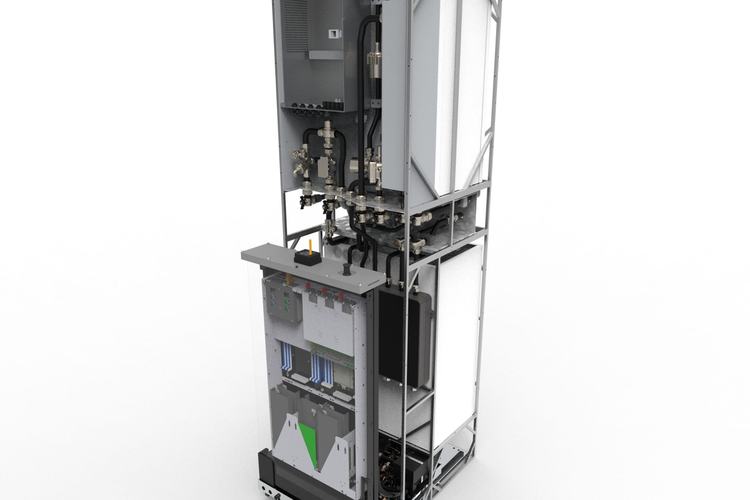
ThermAI has developed FlightDeck, a GPU compute platform that heats water for households. ThermAI turns heat from GPU workloads into heating and hot water at no cost to participating households.
ThermAI’s HeatBridge system is built around its LiquidDock server cassette, which uses Airsys’ LiquidPack spray-cooling technology to capture heat from AI and research computing.
“We’re designing the computing platform and the heating system together, so heat reuse is part of the infrastructure from the start,” said Christopher Smart, founder and CEO of ThermAI. “Our aim is to make that work as a commercially viable model that can scale.”
Heat your home, power our GPUs
ThermAI has closed a pre-seed funding round led by Airsys, with participation from venture capital firm Augur VC and angel investors.
Full terms of the investment were not shared.
“ThermAI brings together a commercial opportunity in GPU computing and a practical way to make homes more affordable to heat,” said Dan Chapman, president of Augur VC. “We see strong potential in the model and are pleased to support Chris and the team.”
Each installation pairs a custom six-GPU ThermAI Node with HeatBridge. Customers can access the computing remotely through ThermAI’s FlightDeck platform. 2CRSi is building the servers, using Nvidia RTX PRO 6000 Blackwell Server Edition GPUs.
An Airsys heat exchanger moves the recovered heat into a water circuit, where Sunamp heat batteries store it until the home needs it. Rather than submerging servers in fluid, LiquidPack sprays an electrically non-conductive fluid directly onto the hardware inside a sealed cassette, recovering heat as outlet water of up to 60°C (140°F).
Airsys said ThermAI’s initial rollout will focus on social housing, where residents are more likely to experience fuel poverty, especially during the colder winter months.
Following initial pilots, ThermAI is targeting deployment in 100 homes with UK social housing providers in 2027.
Professor Jonathan Hirst of the University of Nottingham’s School of Chemistry has signed a letter of intent to take part in a ThermAI compute pilot as a customer, supporting GPU-based research such as drug discovery and molecular dynamics.
“ThermAI’s approach is a highly sustainable one that would benefit local communities,” said Professor Hirst. “Initiatives like this could play an important role in maintaining and improving the sustainability of organizations such as ours.”
Airsys said the same spray-cooling technology it is bringing to data centers could one day recover heat from full deployments and feed it into district heat networks.
“Heat reuse is the next frontier for thermal infrastructure, and ThermAI shows what it looks like when you design for circularity from the server up,” said Yunshui Chen, founder and CEO of Airsys. “For the first time, our spray-cooling technology is not only keeping servers cool, but turning their heat into a vital utility for the home. If we can prove this circular model in a single household, the same approach can scale to data centers feeding district heating. That is what ‘Balance the Environment’ demands of us: treating every watt of energy as a resource that does double duty.”
ThermAI secured more than £20,000 ($26,450) in angel investment last year.
Another digital boiler offering enters the fray
Digital boiler companies looking to put compute hardware in residential buildings and use the waste heat to provide warmth have been attempting to scale for a number of years.
French startup Qarnot was an early mover in the space, but has mostly moved to larger-scale deployments focused on heating networks. Heata has a similar initiative going on, with UK cloud Civo as a partner. Hestiia, another French firm, uses recycled chips in its boiler. Thermify is working on a pilot with UK energy network operator UKPN. Deep Green has a similar offering, but is focused on heating swimming pools.
Electrical panel company SPAN has developed a “distributed data center” product that uses underutilized electrical capacity in homes and commercial spaces to power on-site Nvidia GPUs.
Not every company that has attempted to bring this alternative heating method to the masses has seen success, however. Other companies that have now exited the field include Germany’s Cloud&Heat, which now offers efficient Edge data centers instead of digital boilers; Dutch startup Nerdalize; and New York-based Exergy.






Read the orginal article: https://www.datacenterdynamics.com/en/news/airsys-invests-in-digital-boiler-startup-thermai/


