

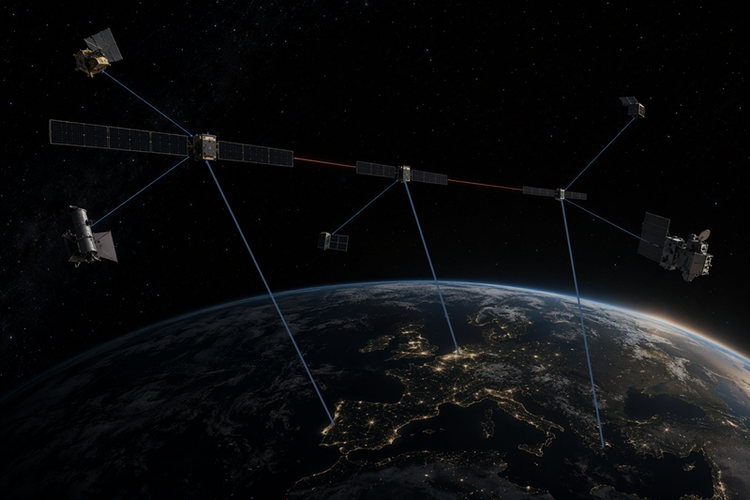
Luxembourg space startup OwlO Cloud has emerged from stealth with plans for a new orbital data center constellation.
The company this week announced a memorandum of understanding (MoU) with satellite manufacturing giant Thales Alenia Space and another with space networking startup Edge Aerospace on collaboration on a compute constellation.

“Our goal is to build a constellation by 2030, including more than ten Orbital Cloud Node satellites,” OwlO Cloud CEO Jason Aspiotis told DCD exclusively. “We will be scaling capacity as operational demand develops over the next few years and in the early 2030s. We believe in proving the economics and technical value of orbital computing through concrete use cases before moving towards larger-scale infrastructure.”
OwlO Cloud seeks to provide megawatts of elastic compute capacity in orbit starting in 2030 for the European space supply chain, utilizing Luxembourg-based Edge Aerospace’s multi-kilowatt space computers, designed for use in orbital data centers (ODCs), and has participated in Thales Alenia Space’s (a joint venture between Thales and Leonardo) space business catalyst accelerator program.
OwlO Cloud declined to comment on funding.
This year, the European Space Agency and similar bodies that inject public capital into critical space applications have begun empowering dual-use and strategic sovereign capability with unprecedented enthusiasm. Aspiotis has recognized these conversations turn to orbital compute with increasing frequency at European forums.
“It is definitely not too late for Europe to catch up and lead in this emerging and global orbital cloud industry,” Aspiotis said.
Orbital capability, not supremacy
The claim ODC developers tend to make – that they can render Earth data centers obsolete with unique access to solar energy and radiative cooling – has been dismissed by some reputable voices. OwlO is keen to distance itself from that argument, making its appeal closer to a sovereign, pragmatic angle.
“We can foresee the need for tens of megawatts worth of compute in orbit that we can address by 2035,” Aspiotis told DCD. “As for technical challenges: OwlO Cloud is not competing with terrestrial compute, so we don’t need to solve for significant satellite scalability (our Orbital Cloud Nodes will be 10kW-class) nor try to provide computing hours at a comparable price as terrestrial data centers. Given our focus on near real-time satellite operations, our unit economics benchmark is the cost of moving exabytes of data to Earth and the opportunity cost of not processing valuable raw data fast enough into intelligence for defence, civil, science, and commercial users of space data.”
While the narrative of so many US-based ODC startups has been to lean into the apparent audacity of orbital compute with bombastic branding, enormous plays, and ambitious language, OwlO doubles down on communicating its vision’s practicality, unwilling to marry its business to the artificial intelligence boom.
Drawing attention to the original usage of orbital compute; to perform a kind of Edge processing that slims down data packets for downlink, OwlO suggests its services would contribute to more efficient Earth observation, maritime surveillance, disaster response, security, and defence.
“Our engagement with players such as Thales Alenia Space and Edge Aerospace is just the beginning,” Aspiotis says. “We will be announcing further partnerships in the coming months, as we bring together the European industrial and technological capabilities needed to turn a European orbital cloud into operational and commercially viable infrastructure.”
With so much doubt, verging on mockery, still haunting orbital data centers, a plan to produce ten powerful computing nodes for critical government processes sounds like a better bet than promising one million by 2035, scaled to catapult humanity into a Kardashev Type-II civilization.
More in Investment / M&A / Financing



Episode
2027 Trends and Outlooks: Europe



Read the orginal article: https://www.datacenterdynamics.com/en/news/owlo-cloud-emerges-from-stealth-promising-european-scalable-orbital-compute-ai/


