


This is the second in a two-part feature on opposition to data centers in the US. Read part one, here.
“I need a data center in my neighborhood / I want a data center in my town / Please put a data center in my neighborhood / That way, my rent might actually go down,” reads the lyrics to Data Center, a tongue-in-cheek, lo-fi rap track by Hovey Benjamin.
“I don’t care about the noise / I’m out here getting hearing damage with the boys / Maybe I could get lung damage too / Just so you can ask, ‘Grok, is this true?’ I don’t need electricity, My bill going up isn’t scary to me (Not at all) / No, my biggest fear / Is losing ChatGPT / I don’t need my water to be clean / Line goes up when I look at my screen / Rent goes up like year after year (Every year) / Hey, data center, get over here.”
DCD Magazine #62 – The coming wave
Will compute at sea sink or swim?
The fact that the song was made by a so-called “comedy rapper” –“Data Center” is listed among the artist’s top five most streamed songs on Spotify alongside “send bobs”, “Bruh”, and “Flexing On My Ex” – is proof that opposition to data centers is a genuinely popular stance. So popular, in fact, that anti-data center sentiment has been dubbed “anti-tech violent extremist activity” by American law enforcement agencies, according to unpublished reports and files seen by Wired.
The data center issue has become one with clear national dimensions, for a number of reasons. The physical demands of running a data center lean on resources that are shared at a larger level; the technology that a data center supports is not necessarily tethered to its physical location; this technology is AI, heralded as the single most important technological development of the 21st century; and AI requires buildout on a massive scale that pushes data centers into places they have never been built before.
But what has catapulted the issue into visibility is the media attention given to the issue. This is true both at the level of memes, as per Benjamin’s song, and at the level of legacy media.
All major news outlets and magazines based in the US have run at least one long-form investigative piece about the opposition to data centers. This includes The New York Times, The Washington Post, The Wall Street Journal, The New Yorker, The Atlantic, Harper’s Magazine, and more.
On YouTube, progressive news media organization More Perfect Union has produced dozens of videos and shorts about people impacted by data centers in their neighborhood.
The story of the Morrisses – the pair living in Mansfield, Georgia, who were impacted by Meta’s Stanton Springs Data Center – is perhaps their best-known data center work, leading to coverage of the Morisses’ plight on mainstream outlets and across social media, where images of the pair’s murky drinking water have, in the public consciousness, become inseparable from data centers.
More Perfect Union also posts short-form videos about data centers across its social media platforms. These videos include footage of data center proposals being rejected in local town meetings, where people get visibly angry at local authorities who are trying to get data centers approved; interviews with people who have seen their electricity bill go up; laborers talking about how they refuse to build data centers; and more.
Politicians on the left and the right have rushed to claim the issue for themselves, fitting opposition to data centers into a broader political project, whether that has to do with affordability, AI regulation, anti-oligarchy, environmentalism, farmer’s rights, or democracy.
“AI and robotics are creating the most sweeping technological revolution in the history of humanity,” said Senator Bernie Sanders in a statement accompanying the debut of a bill co-developed with Senator Alexandria Ocasio-Cortez (AOC) that would impose a nationwide moratorium on data center development.
“The scale, scope, and speed of that change is unprecedented. Congress is way behind where it should be in understanding the nature of this revolution and its impacts,” Sanders said, focusing on the role played by data centers in training and utilizing AI.

AOC’s questioning of Jessica Kramer, the Environmental Protection Agency’s assistant administrator for water, about the impact of data center construction on water quality whilst brandishing two jars of muddied water taken from the house of the Morrises – the pair living in Mansfield, Georgia, who were impacted by Meta’s Stanton Springs Data Center – went viral.
Videos of AOC speaking to and finding common ground with Republican voters affected by nearby data centers also spread quickly online, depicting the data center problem as an issue of class and oligarchy that takes precedence over party politics.
Congressman Ro Khanna introduced a ‘Data Center Bill of Rights’ in early August 2026 that would prohibit data centers in residential areas and within 2,500 feet (762 meters) of homes, schools, childcare facilities, hospitals, and nursing homes; require all data centers to use clean and reliable energy while adhering to noise and air pollution limits; mandate an impact report assessing the impact of data centers by reference to various indices including utility prices, public health, housing availability; limit the kinds of perks that could be offered in tax exemptions; and more.
Khanna, a Democrat, frames the proposed measure as a means of returning political power to the people. “Americans deserve the right to know what is being proposed, to decide what gets built in their neighborhoods, and to share in the economic benefits,” he said in an accompanying press release.
The issue has also catalyzed an uneasy alliance between the progressive left and the Trumpist right.
“Across the country, families are watching the construction trucks roll in and asking the obvious questions. Will my electric bill double? Will my well run dry? Who will pay for this? The answer cannot be that the tech oligarchs reign supreme and the rest of us can just absorb their externalities,” Republican Senator for Missouri and Trump loyalist Josh Hawley recently said in an op-ed.
“We are not raw material in the hands of Silicon Valley. We are citizens. We are husbands and wives, fathers and mothers, sons and daughters, all made in the image of God. We still get to choose what kind of country this technology is going to build. At least, so long as we make the choice now, while it is still ours to make.”
Florida Republican gubernatorial candidate James Fishback has taken a strong stance against data centers in the state, saying that they were turning “Florida farmland into a dystopian wasteland.
“As Governor, James Fishback will not reform data centers. He will not regulate them. He will ban them in all 67 counties by preventing county commissions from approving them in the first place,” says Fishback’s campaign website.
President Trump himself has made attempts to assuage his voter base that he is on their side, advancing a non-binding, largely ornamental initiative called the Ratepayer Protection Pledge. Signatories to the pledge, of which there are more than 200 utilities, data center developers, cooperatives, and states, say that they will “fund the electricity generation and infrastructure their projects require.”
One of Trump’s campaign promises, after all, was to slash electricity and energy prices by half “within 12 months, maximum of 18 months.”
The data center issue is also shaping up to be an election winner – or loser. Next week, the US will hold midterm elections for all 435 seats in the House of Representatives and 35 out of 100 seats in the Senate. Gubernatorial elections will also take place in 36 states.
But some of this opposition is nakedly opportunistic. As re-election draws near, many former cheerleaders of the data center industry find themselves metamorphosing into critics.
Republican Texas Governor Greg Abbott, a historic friend of the industry who has overseen the growth of Texas into the second-largest US market by state for data centers, has been taking increasingly drastic steps to prove his opposition bona fides.
In June, Abbott said that data centers should be banned from rural areas of Texas. In July, he said that developer Diode Ventures had done “the right thing by withdrawing their project.” And in August, Abbott effectively paused approvals of data centers in the state by forcing the Public Utility Commission of Texas and the Electric Reliability Council of Texas to audit all projects. Any projects that fail to meet set requirements will be denied access to the grid.
Concrete and abstract concerns
Another way to think about this uneasy coalition between left and right, national and local, is to sort opposition by the kinds of concerns they have.
Some have concrete concerns involving physical things that can be touched or measured, like the quality of water, an electricity bill, or the state of the physical environment. For others, their opposition is more abstract.
Both concerns can be intertwined as a matter of political messaging. Both Senator Ocasio-Cortez and Hawley, for instance, talk about the impact of a data center on the cost of living and link it to a general argument about democratic oversight and control of tech companies.
Worries about water often lend themselves to a combination of the two, drawing on visual images of polluted taps and fears about resource scarcity to produce conspiracy theories about what tech companies are ‘really’ doing with the water.
“The more I went down the rabbit hole, the more one single question kept burning in my mind: why in the hell do these data centers need millions of gallons of fresh water every single day? It’s a cover-up. They’ll give you some slick, engineered press release about evaporative cooling systems and keeping server racks from overheating. They’ll tell you it’s just the price of digital progress. Think about that for five seconds,” says @aliencozmo111 in a reel with 143,000 likes and 83,700 sends.
“That’s when it hit me: it’s not a tech boom. It’s a resource heist. They’re stealing the water. Follow the utility lines. Follow where the heavy infrastructure is actually laid. These data centers are acting as massive, above-ground cover operations. Underneath the guise of cloud storage and artificial intelligence, they are tapping directly into our clean, natural drinking water supplies. They are pumping it out of our soil, filtering it, and routing straight down into their underground bunkers.”
“And they will arrest you for collecting rainwater! Remember the movie Quantum of Solace!” reads a comment with almost 30,000 likes, referring to the villain in a 2008 James Bond film who has been damming the water supply of Bolivia in an effort to make his company the country’s sole supplier.
Concerns about the environment can also be wrapped up with a pastoral, analog nostalgia.
“This is what nature looked like before we traded it for AI data centers,” read the subtitles of a video that compiles other videos of various American landscapes.
“They call us old stupid farmers, you know, but we’re not. We know whenever our food is disappearing, our lands are disappearing, and we don’t have any water – and that poison. Well, we know we’ve had it,” says Ida Huddleston, a farmer in Kentucky who gained media attention for rejecting an offer from a data center developer to buy his land for $26 million.
A Polaroid moment
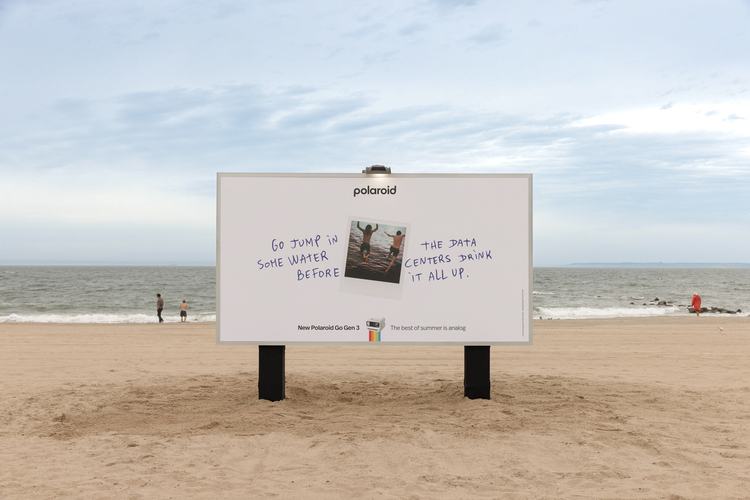
Analog camera company Polaroid, the standard-bearer for technologies that accept their outdatedness but frame it as honesty, paid to put up a billboard in Coney Island, New York City, in June of this year.
Right in the center of the billboard is a Polaroid picture of two people jumping towards a body of water, and on the sides of the picture is one sentence of copy:
“Go jump in some water before the data centers drink it all up,” it reads, in scrawly, all-caps font meant to resemble handwriting.
“There’ll come a day when the things we took for granted can never be taken again. Obviously, we’re being a bit cheeky with our line here, but still. Go take a swim. Go take a stroll. Go embrace the beautiful, simple, wild, analog stuff. That’s where the best of summer, and life, lives,” reads the company’s Instagram post featuring a version of the ad.
Worries about surveillance are preoccupied with what the purpose of building the data center is, rather than its immediate physical impacts.
“What kind of data is being stored in the centers?” asks Gary Baldwin, a member of the 84,000-strong public Facebook Group “Say NO to Data Centers.”
“Your personal data. They should be called surveillance centers,” someone responds.
“The Antichrist,” says someone else.
“Totalitarianism,” adds another.
Another post on the forum reads: “I wish more people could see and understand that they have been building our control grid piecemeal for many years. They had to do it this way so that we would not see what they were doing. The last step is going to be the build-out of the data centers, which connects everything into one operating octopus. They built out the legs first, and now they are building out the brain. When they are finished, our freedom is gone.”
Most extreme are conspiracy theorists whose worries are not tethered to concrete concerns at all. Their concerns are with eschatology, consciousness, and the coming of God.
Jiang Xueqin is a high school teacher whose YouTube channel, Predictive History, shot to fame after he correctly predicted that President Trump would attack Iran during his presidency.
Jiang also believes that the purpose of data centers is to provide the infrastructure for the creation of an AI hell-bent on killing everyone, and that the real power behind data centers is the Knights Templar, the Catholic military order best known for its involvement with the Crusades.
“People speculate that rather than disappear, the Knights Templars emerged as the Scottish Rite Freemasons… they conspired to create the American Revolution as well as the French Revolution. Basically, they create modernity itself,” says Jiang in a video lecture called “The Holy Empire of AI.”
“They came to control England and create the Bank of England, which created the modern financial system of today. Then they went on to create WWI, which led to WWII, and now they’re conspiring to create WWIII, which would then usher in a new world government. A one-world government based in Jerusalem, and it will be controlled by an AI civilian state. And that’s why we’re seeing data centers being built all around the world.”
In a previous video titled “The AI Apocalypse,” Jiang paints a picture of OpenAI executives as messianic figures who want to create God in the form of Artificial General Intelligence. Based on evidence that self-driving cars have killed people in the past, as well as recent reports about chatbots encouraging people to commit suicide, Jiang concludes that AI’s aim is to “kill everyone” in order to create a perfect world.

Data centers are the way that this future will be brought about. In attempting to parse the deeper meaning of Stargate, the data center infrastructure plan backed by OpenAI, Softbank, Oracle, and the US government, he draws a connection between Stargate, a 1994 science fiction film about portals called ‘Stargates’ that lead to other dimensions, and the Stargate Project, a discontinued CIA project that investigated whether it was possible to use “remote viewing” – the alleged ability to perceive a thing without the use of the senses, essentially telepathy – for military and espionage applications.
Other observers have concluded that the project is named after the movie because tech executives like to flaunt their sci-fi and fantasy bona fides because they remain nerds at heart. But Jiang asserts that Stargate is actually part of a plan to “kill everyone so you can save the world,” based on an ungenerous reading of an excerpt from Empire of AI, a book by reporter Karen Hao, which describes a conversation between OpenAI co-founder Ilya Sutskever and a researcher about the consequences of AGI.
Jiang also uses reporter Ronan Farrow’s New Yorker piece on Sam Altman to draw his conclusions. Farrow’s piece quotes a former OpenAI executive who says that “the truth of this is, we’re building portals from which we’re genuinely summoning aliens,” likely referring to the race to build AGI.
The executive adds that “the portals currently exist in the United States and China, and Sam has added one in the Middle East,” referring to Stargate UAE.
Jiang reads these statements literally, concluding that “these people are cultists. They understand the fundamental nature of reality. They understand that the source of reality is human consciousness. So, if you’re able to control human consciousness, you become God Himself.
“This is not a science project, guys. It’s an occult project. It’s designed to bring aliens, demons into this world,” he says.
Disengaged PR strategies
Combined, these videos have almost 2 million views. Clearly there is something about these theories that resonates with people. It is partially the product of a historically disengaged PR strategy on the part of data center companies, which relied on the assumed invisibility and irrelevance of data centers to the general public. The fact that the planning process contains, like many organs of the democratic state, anti-democratic and technocratic elements is undoubtedly a cause. But it is also reflective of a broader loss of trust in tech companies, which taints any attempt to paint data centers in a positive light as dishonest and withholding.
However, whether a concern is concrete or abstract is not necessarily determinative of its relationship to the truth.
Take, for instance, the claim that data centers have been correlated with cancer and miscarriage, which are concrete health issues. These trace back to a long-form piece published by The Rolling Stone, released in November 2025, titled “‘The Precedent is Flint’: How Oregon’s data center boom is supercharging a water crisis”.
The piece details how an AWS data center in the area was reliant on a system of water re-use that has been accused of causing health complications. This system takes wastewater and turns it into nitrogen-dense water, which is then used as irrigation for crops. Some of these nitrates have leached into aquifers, which has led to a higher incidence of cancer and miscarriage.
Heterodox takes on the water issue – which point out that data center water use as a percentage of total water use in the US are negligible and that muddy tap water is not necessarily generalizable to all other data center builds – and the electricity issue – which state that data centers are not solely responsible for rises in electricity prices, and that the addition of data centers in the grid system could actually reduce costs – also exist.
But for the moment, popular consensus in the US is set against data centers. Just how powerful this consensus is as a political force will make itself known when voters go to the polls next week.

Read the orginal article: https://www.datacenterdynamics.com/en/analysis/a-taxonomy-of-american-data-center-opposition-politics-misinformation-and-conspiracy-theories/


