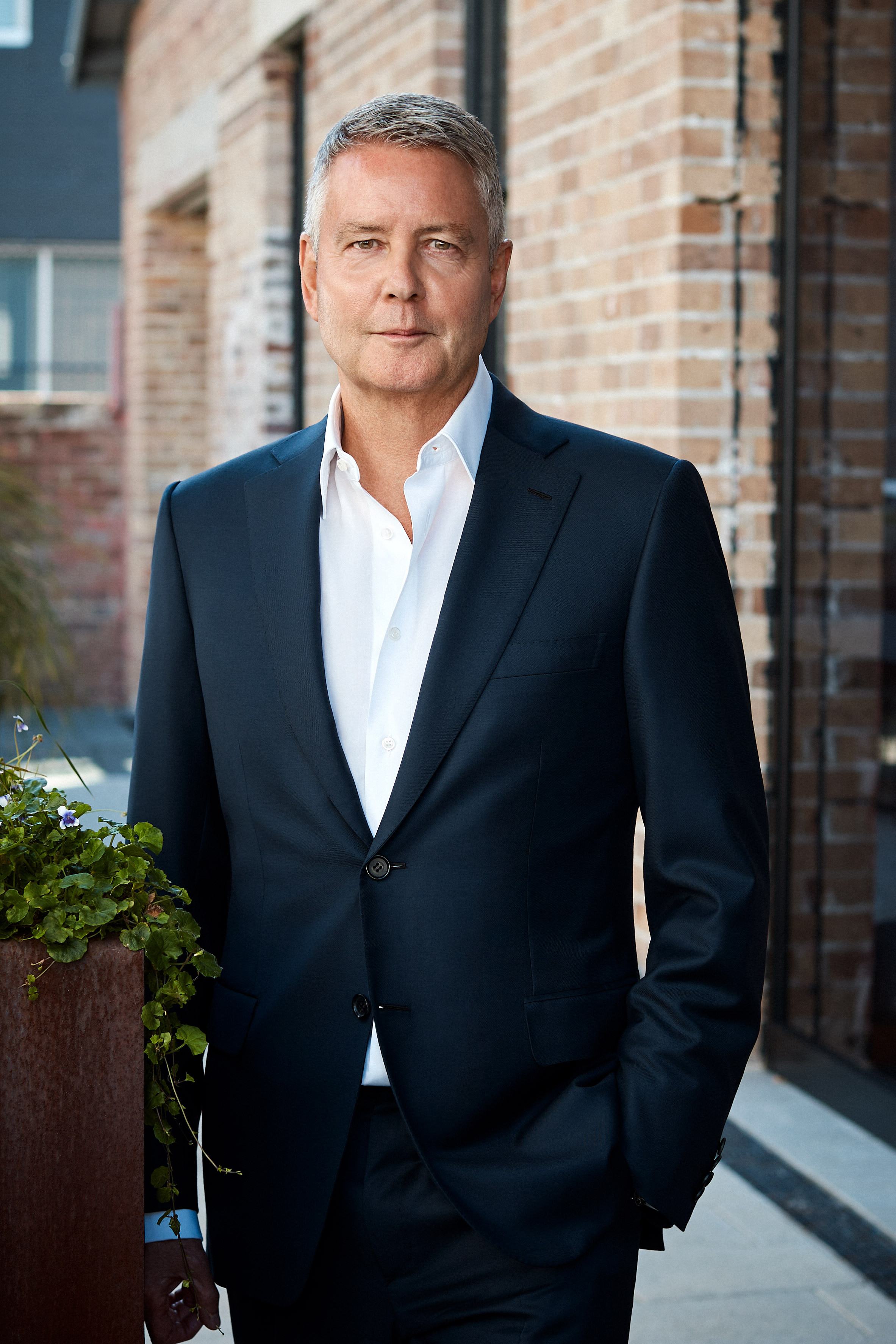
Greg Goodman resides in two parallel universes. The CEO and co-founder of Goodman Group is leading his company as it develops warehouses and data centers side-by-side.

DCD Magazine #61 – Life and death on a tower
The cell tower climbers risking it all to help us stay connected
Australia’s biggest commercial real estate firm, Goodman Group has seen its valuation soar in recent years as the AI boom has driven growth in its data center sector. The company now has its sights set on projects around the world, with digital infrastructure developments underway in the US and Europe, as well as down under and across Asia.
“The next ten years are going to be pretty exciting when it comes to compute,” Goodman tells DCD. “AI is already driving productivity in our warehouses, with AI software for supply chain, autonomous forklifts, and robotics. Within the fabric of what is effectively a ‘tin shed’, you’ve got all these highly mechanized systems, and they all need compute.
“Because of this, the ecosystems of e-commerce warehouses and data centers run in parallel. We’re building e-com for Amazon, and we do data centers for them too. It’s a parallel universe for us.”
Good beginnings
Goodman founded the company in 1989, paying AU$20 million (US$14.3m) for a property on Mitchell Road, in the Erskineville suburb of Sydney.
Initially focused on traditional industrial property – the aforementioned “tin sheds” – the business listed on the Australian Stock Exchange in 1995, and has been through various iterations since then, initially with the support of Australian investment giant Macquarie. It took its current name in 2007, when Macquarie Bank sold its remaining shares in the company.
Having navigated the global financial crisis (“we lived through it, but not particularly well,” Goodman admits), the cloud computing and AI booms have seen Goodman turn its hand to developing data centers. It is the latter that has been particularly transformative – Goodman Group’s market cap was AU$36.7 billion (US$26.3bn) in November 2022, when ChatGPT was first ushered into the world. Less than four years later, the company’s value has almost doubled, to AU$64.6 billion (US$43bn).
When it comes to data centers, Goodman Group’s most recent financial report, for Q3 2026, shows the company has a total power bank of 6.4GW for digital infrastructure projects, with 3.6GW of this power secured, and the rest at various stages of discussion. It notes it has already delivered 700MW of compute capacity, with a further 400MW of work in progress.
The breakdown of Goodman Group’s data center pipeline shows that its power bank is mostly concentrated in Australasia (2.1GW) and Europe (2.2GW), with 1.3GW in Japan, 500MW in Hong Kong, and 300MW in the US.
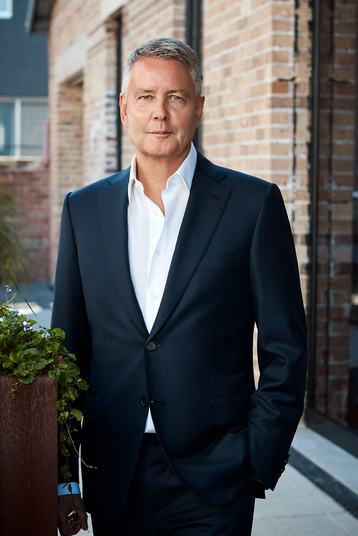
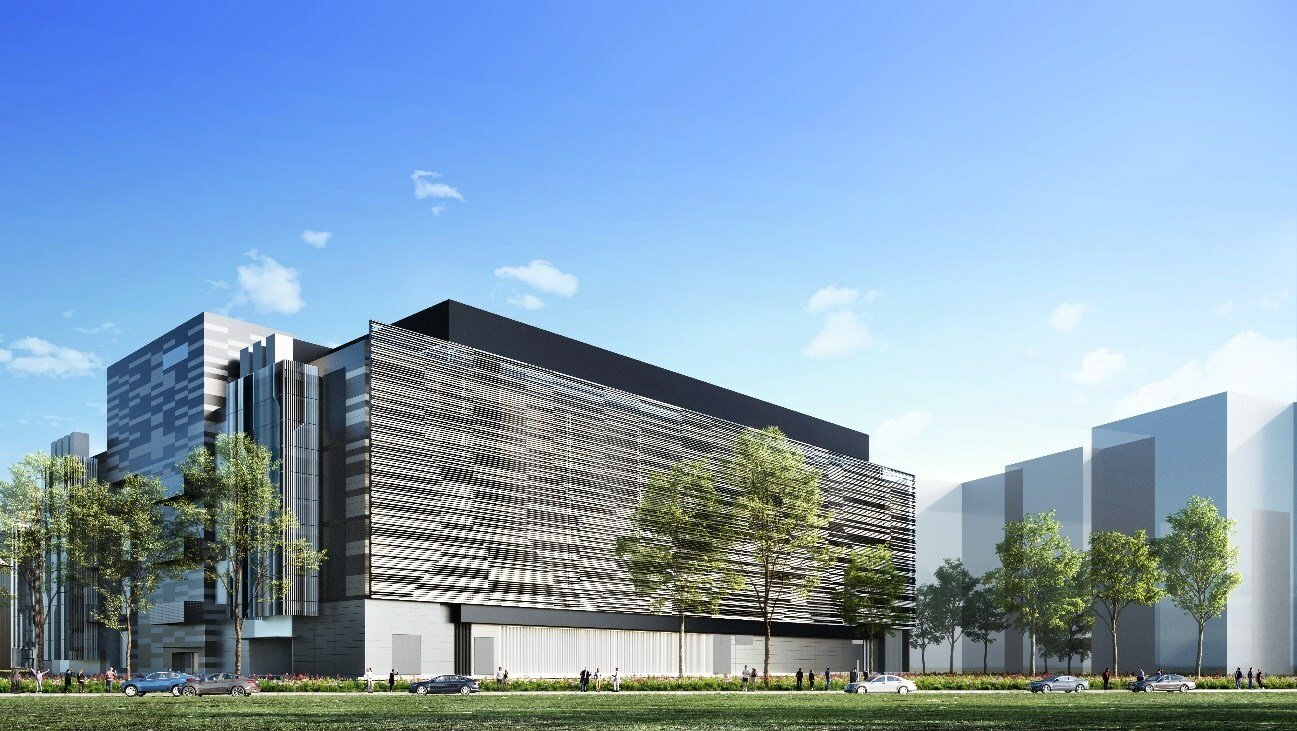
Completed sites include the Goodman Business Park in Tokyo, which offers 300MW, and the 225MW Tsuen Wan West facility in Hong Kong. Recently, Goodman Group announced it was joining forces with a coalition of local companies to deliver a data center in Sagamihara City, in Japan’s Kanagawa Prefecture. In the US, it has formed a joint venture (JV) with Databank for a 32MW data center in Vernon, California. And in December 2025, Goodman set up a JV with the Canada Pension Plan Investment Board to establish an €8 billion (US$9.4bn) European data center partnership, which will initially deliver facilities in Amsterdam, Frankfurt (where waste heat will supply the local district heating system), and Paris.
The company has plenty of other projects, not least those in Australia itself. Since this interview was originally published, it has secured planning permission for Project Apollo, a 135MW data center in northern Sydney.
Greg Goodman says building in established metro areas is key to ensuring his firm’s sites have longevity – and avoid too much risk of being negatively impacted in the event of the AI bubble bursting.
“You’re not going to see us building an LLM training data center in the middle of nowhere in the US, or in the north of England and whacking a nuclear power station in to drive it,” he says. “But owning a data center in Park Royal in London, or having a couple in Paris, works well for us. Most of the business we’re doing around the world is cloud-based, in markets that are under-supplied by two or three times at the moment. Demand for that basic compute product that we all use every day is growing and will continue to grow.”
Nonetheless, Goodman says the advent of AI has changed the time horizons for thinking about new facilities, with the hyperscalers, who he says are his firm’s main target customers, demanding that data centers be built faster than ever before.
“If you have a conversation with the hyperscalers today, they’re talking about starting in 2027, rather than in 2028 or 2029,” he says. “That’s different to how it was two or three years ago, where people were planning three years out. They’re not doing that anymore, and we’re building into that demand. We’re starting with shells with the ability to build through the MEP (mechanical, electrical, and plumbing) on the basis that we need to get the building as close to market as we can. Then we sit down with the hyperscaler and say ‘we can deliver a first phase in 12-18 months.’”
Goodman says this approach is not cheap. “It requires a lot of money, and you can’t use leverage when you don’t have pre-commitments,” he says. “We have about AU$6 billion (US$4.3bn) in liquidity that we’re using to forward fund the program, then we’ll bring in partners, such as sovereign wealth funds, and other people we do business with around the world, to keep the machine moving without using a lot of leverage.”
The main man
Working across so many different jurisdictions presents a challenge for Goodman, who, as CEO, has to knit all these projects together into a coherent package to keep his investors happy. He says having the right people in place is key to achieving this.
“You can’t run a global data center program from Sydney,” he says. “We’ve got good infrastructure in all the markets, with specialists and people who understand the individual markets.
“The needs of the European countries are very different to those of Japan, for example – in Tokyo, if you don’t have a Japanese team, you might as well not bother turning up, because you’re not doing any business.”
The level of involvement Goodman Group has in a project differs from country to country, and the CEO says he is “agnostic” as to whether his firm ends up running the facilities it builds. “We want to be the guys that are good at building global infrastructure, whether it’s industrial or data centers,” he says. “Delivering infrastructure is where our real expertise lies, and then if we end up operating it as well, we’ll do that. We’ve got an operating team in Europe because we think we’ll need it. The US? Not so much.”
Goodman himself says he spends a lot of time on planes, scoping out potential sites and visiting markets where his company needs to ramp up or down its operations to match demand. The group is not the only industrial property business to make the move into data centers, with rivals such as Prologis and Segro also eyeing digital infrastructure as a profitable market.
For Goodman, the move is an obvious one, and he believes there are plenty of opportunities for his firm and its rivals. “You’ve got to adapt,” he says. “There’s a massive strain on digital infrastructure that creates an opportunity for Goodman Group and the others. We have big landbanks, good people, and experience of complex buildings. Data centers are a bit of a natural habitat for us.”


Read the orginal article: https://www.datacenterdynamics.com/en/analysis/goodman-group-ceo-greg-goodman-data-center/