In June, the European Commission put data centers at the center of its plan to digitalize the energy system.
Its Strategic Roadmap for Digitalisation and AI in Energy, adopted on June 3, names data center electricity demand as a core decarbonization challenge and sets out a data center sustainability rating scheme, with the first labels due in 2027. Fourteen industry associations also signed a declaration of intent on integrating data centers into the energy system.
It is the right direction, but the roadmap is mostly about efficiency and grid connection. It says little about how operators actually buy their clean power, and that is where the highest costs and risks sit.
The contract that looks cheap on the cover
Faced with a renewable target and a power budget to defend, many European operators reach for the same instrument: A cross-border virtual Power Purchase Agreement (vPPA).
You contract with a solar project in Spain or a wind farm in Finland and retire its guarantees of origin against consumption elsewhere. Because the EU treats most of the continent as one certificate market, a guarantee issued in Spain can be matched to load in Frankfurt or Milan. The strike price is low, the contract templates are mature, and you can report 100 percent renewable almost immediately.
While this has been the most obvious, go-to PPA deal for many, the headline price doesn’t tell the full story.
Where the hidden gap opens
A vPPA only hedges your bill in the hours the asset generates, and only in the market where it settles. A Spanish solar contract pays out against Spanish midday prices; your data center pays its own French or German price around the clock. When those markets diverge, the contract stops protecting you. That gap, basis risk, widens exactly when you need cover most: a still Continental evening as Nordic wind fades, or a 2022-style gas shock that lifts every market but not in step.
Annual matching hides it. Cover your yearly volume with Spanish solar, and you can claim 100 percent renewable, even though your overnight, evening, and winter hours ran on the spot market the whole time. The yearly certificate math balances, but the hours you spent exposed never show up in it.
What ten years of price paths show
To test whether the cheap structure actually protects the bill, Renewabl’s analysis modeled a pan-European buyer with 100GWh of annual load split across France, Italy, Germany, and Spain, roughly the footprint of a small enterprise data center cluster. We used market data from Pexapark and ran four strategies through 1,000 ten-year price paths, including ones that repeat 2022-style shocks.
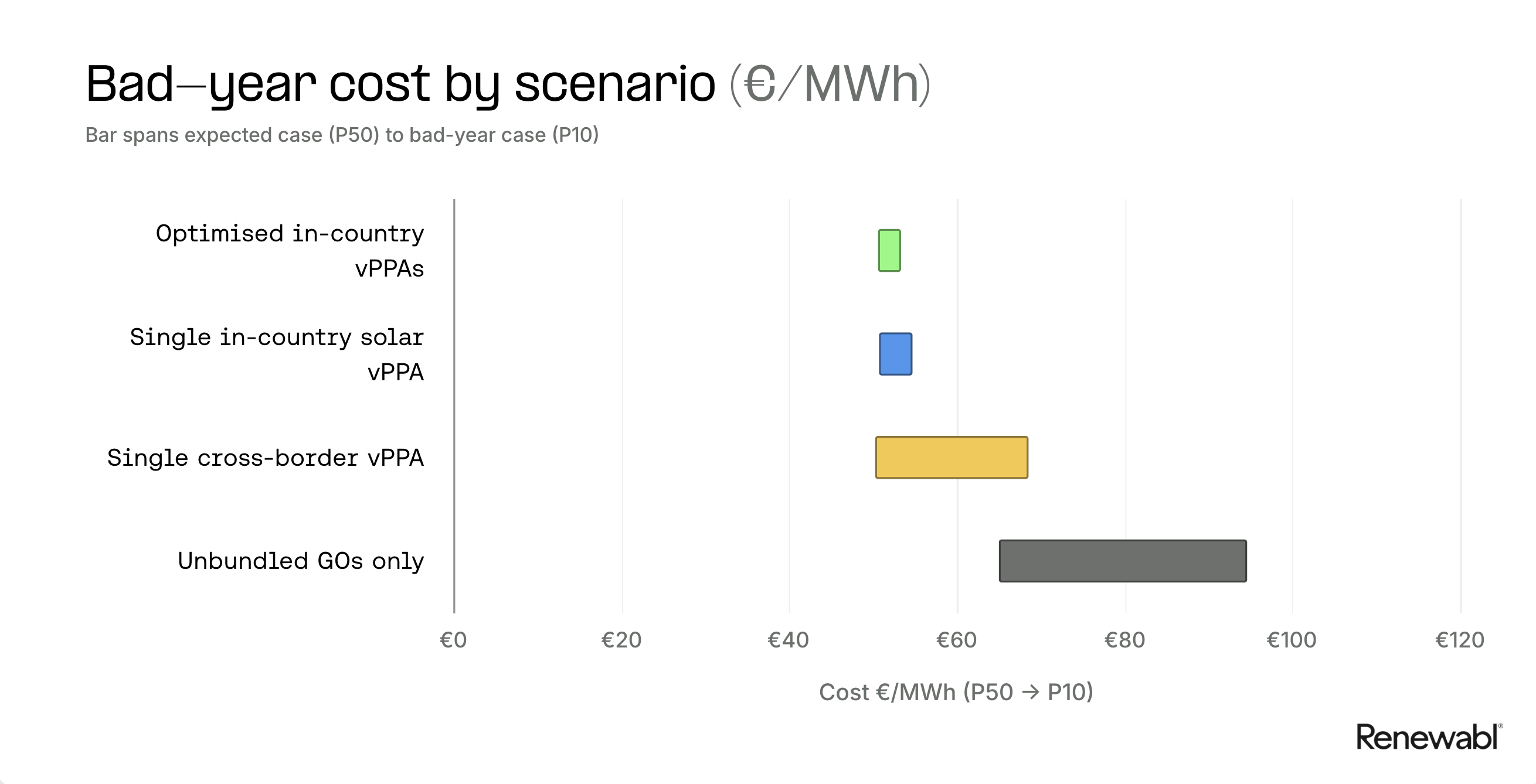
Two numbers describe each strategy. The expected cost is the median, the P50: half the paths come out cheaper, half dearer. The bad-year cost is the P10: an outcome bad enough that only one path in ten comes out worse. For a buyer hedging against shocks, the P10 is the number to plan around.
On expected cost, the three hedged strategies we tested were almost indistinguishable: the cross-border vPPA, a set of in-country solar contracts, and an optimized in-country wind-solar mix all landed within about €1/MWh ($1.14/MWh) of each other, around €50 ($57). In a calm year, the cheap contract and the carefully matched one look almost the same.
The difference shows up in the bad year. In-country procurement removed 85 percent to 91 percent of the ten-year price uncertainty a buyer would otherwise carry; the cross-border vPPA removed only about 40 percent. In the bad year, it cost roughly 29 percent more than the optimized in-country portfolio. The cheap contract stays competitive right up until the moment a hedge is supposed to earn its keep.
Where compliance and finance meet
The strategy that hedged best was also the one that matched generation to consumption best, hour by hour. The optimized in-country portfolio reached about 82 percent hourly matching against load; the cross-border vPPA reached about 14 percent.
Under today’s annual Scope 2 accounting, those two look equivalent: both can claim 100 percent renewable. Under the hourly accounting the GHG Protocol has proposed, they would not. In an earlier piece for DCD, I argued that hourly accounting raises the bar for what counts as 100 percent renewable; this is the other half of that story. An operator’s hourly-matching score is two things at once: how credible the clean-energy claim is, and how exposed the bill is to the next shock. Improve one, and you improve the other.
How this affects data centers
A data center draws power around the clock, which makes its load harder to cover with a single distant solar contract than almost any other: the exposed hours are the baseload itself.
The squeeze is tightening, too. Spain logged nearly 400 negative-price hours in the first quarter of 2026, up from fewer than 50 a year earlier, as solar floods the midday market it is meant to hedge (Bloomberg, OMIE data). The ranking held across every load profile we tested, but the round-the-clock operator has the most to gain from getting it right.
What to do before the 2027 labels land
None of this requires 24/7 carbon-free power tomorrow. It requires knowing where you stand and buying with the hours in mind. Three moves:
- Measure hourly coverage at each facility, not just annual volume. That baseline shows which hours are covered and which are still on the spot market, and it is the same number a future Scope 2 claim will rest on.
- Read the hourly-matching score as a procurement signal. It shows where storage or another contract buys the most hedge per euro.
- Consider in-country, technology-optimized procurement. Settling in your own market removes the basis risk; blending wind, solar, and storage to your load shape closes the timing gap. Pexapark and Finergreen both report a shift to domestic and hybrid portfolios in 2025, and the cost of firm, round-the-clock supply is falling as storage gets cheaper (IRENA).
The Commission’s roadmap and the rating labels will reward operators who integrate well with the grid. The ones who get ahead are treating renewable energy procurement as a financial decision as much as a sustainability one. The hour-by-hour view that proves the Scope 2 claim is the same view that protects the bill.
For an industry built on uptime, that is a familiar idea: you do not buy redundancy for the average day. You buy it for the bad one.
More in Critical Power


Read the orginal article: https://www.datacenterdynamics.com/en/opinions/the-renewable-energy-deal-that-looks-cheap-on-paper-can-leave-data-centers-most-exposed/