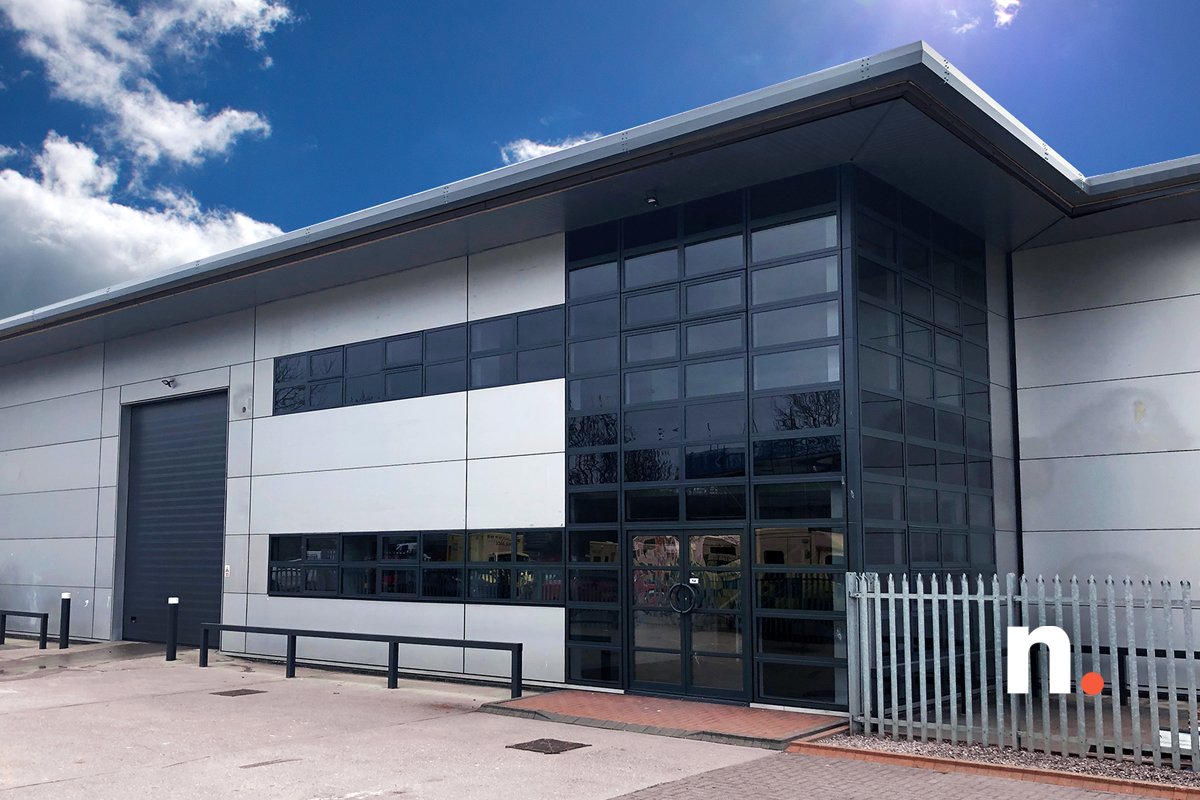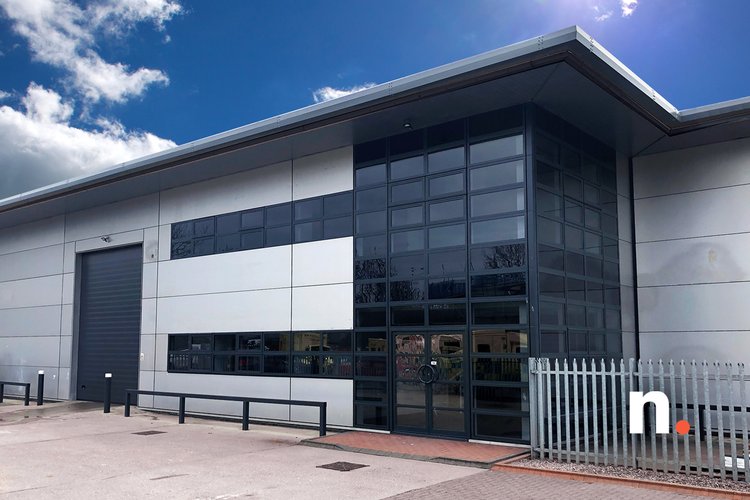

Walking through the Datapoint Business Park where Netwise’s East London data center is, the facility almost blends in with the other warehouse containers, set apart perhaps by its security features.
The building is not what immediately comes to mind when you think of a data center in 2026, and is a far cry from the huge AI campuses featuring futuristic architectural design being proposed by the hyperscalers. With headlines increasingly featuring large, AI-configured, high-tech data centers, it may even be easy to forget Edge colocation facilities like this exist.
With hyperscale facilities grasping significant attention, especially in the current era of AI growth, the importance of low-latency, small-scale, and low-power-density retail colocation data centers is often overlooked.
Yet, these facilities play a crucial role in the data center ecosystem. As Netwise co-founder and director Matt Seaton tells DCD during a tour of the London facility: “There’s a certain client profile that we work with that just want a quarter or a half rack.” As such, Edge facilities are critical for “businesses that want somewhere off-premises to house their critical infrastructure,” Seaton says, particularly when this enables low latency.
While AI data centers grab the headlines, many businesses and everyday data demands do not require these capabilities. Instead, they are looking for smaller-scale, and potentially more straightforward, computing that is closer to the end user. Edge facilities can provide this and are especially apt where low latency is the most important demand.
Looking at recent advancements in the industry, such as hyperscale data centers often exceeding one million sq ft (92,905 sqm), and the development of 1MW racks, it seems to be going only in one direction – bigger and more powerful. Nonetheless, smaller-scale Edge and retail colo will always be needed.
What’s more, as with any ecosystem, diversity within the industry is key. Large-scale and AI-configured data centers are important, but so are smaller-scale facilities like Netwise’s East London site. One size, one capacity, and one power density does not fit all: different customers require different data center configurations and computing capabilities. Importantly, this also changes as the industry evolves.
Hyper-focused on hyperscale
Synergy Research Group data shows that at the end of Q4 2025 there were 1,360 large data centers operated by hyperscale companies, with hyperscale facilities accounting for 48 percent of all data center capacity worldwide. Synergy data emphasises that this will increase, indicating that by 2031 hyperscale will account for 67 percent of all capacity. Comparatively, non-hyperscale colocation currently makes up 20 percent of total capacity.
Edge facilities like Netwise make up an even smaller proportion of non-hyperscale colocation within total data center capacity. Therefore, they are easily overlooked, especially when, as noted by Netwise’s Seaton, “if you were to do a top-level Google search of data centers now… it’s awash with hyperscale build story after hyperscale build story.”
Despite it seeming as though companies are, as Seaton suggests, “exclusively taking suites, halls, cages,” Netwise demonstrates that there’s still a whole other market that does not need this scale of computing. Some Netwise customers “simply require a reliable rack footprint with a fairly modest power commitment and transit commit,” he says. The East London data center caters to many clients whose priority is speed rather than large capacity.
The data center spans two units of the Datapoint Estate and has a third unit in development. Units Five and Six each provide 1.5MW of capacity, making up 3MW altogether, with Unit Seven set to have 3MW by itself, which, when completed, will bring Netwise’s total capacity to 6MW. The facility has four data halls online, with a fifth set to hopefully be live in 2027, and a sixth in construction. With the addition of Unit Seven, Netwise plans to add two more data halls.
In contrast to larger-scale colocation facilities, which often prefer to lease at cage, hall, and suite level, at Netwise the “sweet spot is often one to three racks,” according to Seaton, though there are clients with much larger footprints. Still, the Edge data center has a range of clients requiring different capacities, from partial racks to a client with a whole data hall. Seaton says such facilities pick up clients pushed out of other data centers, which have moved towards a larger-scale leasing model, and can offer better customer service.
In contrast, small-scale enterprise rack power densities are much lower. Netwise has a typical rack density of 3-4kW via air cooling, with some racks up to 7kW, and average halls hosting 160kW as a result.
While Netwise has an adiabatic air cooling system, AI-configured facilities must employ liquid cooling methods. Adiabatic cooling is, as Seaton emphasized, “incredibly efficient, so it uses about 10 percent of the energy of a traditional refrigerant system.” This facilitates a low Power Usage Effectiveness (PUE), with Netwise’s most recent annualized PUE at 1.14. Netwise is also trialling a new glycol cooling system.
The company is considering higher density racks, as Seaton has found “we’re definitely seeing people want more power in the rack. Now we’re quite frequently getting requests for eight, ten kilowatts,” but he doesn’t “think we will need or want to get to the more specialist 120 kilowatt plus per rack level in this facility.” Netwise may accommodate this within future planned developments at the London East site, to which Seaton says “plans are very much still developing and evolving in this area.”
Its customer base is made up of about 80 percent UK companies, with a leaning towards London. However, it does also have “some fairly big internationals that use us for their Europe hub.” Typically, customers are enterprise, such as cloud service providers, businesses, and tech companies.
Although Seaton acknowledges, “I think people sometimes forget that this more mature part of the market exists,” the retail colocation data center market is nonetheless a critical element of the data center ecosystem. Importantly, hyperscale-size wholesale capacities cater to one field of clients, while traditional retail colo and Edge are crucial for another.
It’s not all about AI (yet)
Hyperscale data centers are not the only focus of headlines and industry attention – AI also dominates. The two feed off of each other, with new hyperscale data centers increasingly built to accommodate the AI boom. Not only does the rapid development and growth in AI necessitate significant build-out of new capacity, but it also demands an increase in rack densities.
To sustain AI workloads, ever more power-dense racks are required. However, as a result, more energy as well as more and alternative cooling methods are required.
While average rack densities still hover around 15kW in colo environments, hyperscalers regularly operate racks north of 30kW, and AI rack densities can frequently total 100kW or more. Nvidia is going even further, and could release 1MW GPU rack systems as soon as 2028. Yet, such power-dense racks would only be required by a specific customer base and necessitate significant engineering changes. Most would never need to even think about such dense racks, and it’s hard to see smaller retail colo facilities looking to host those kinds of workloads.

In contrast, small-scale enterprise rack power densities are much lower. Netwise has a typical rack density of 3-4kW via air cooling, with some racks up to 7kW, and average halls hosting 160kW as a result.
While Netwise has an adiabatic air cooling system, AI-configured facilities must employ liquid cooling methods. Adiabatic cooling is, as Seaton emphasised, “incredibly efficient, so it uses about 10 percent of the energy of a traditional refrigerant system.” This facilitates a low Power Usage Effectiveness (PUE), with Netwise’s most recent annualized PUE at 1.14. Netwise is also trialling a new glycol cooling system.
The company is considering higher density racks, as Seaton has found “we’re definitely seeing people want more power in the rack. Now we’re quite frequently getting requests for eight, ten kilowatts,” but he doesn’t “think we will need or want to get to the more specialist 120 kilowatt plus per rack level in this facility.” Netwise may accommodate this within future planned developments at the London East site, to which Seaton says “plans are very much still developing and evolving in this area.”
AI is currently predominantly in the learning/training phase, housed in large-scale and high-density facilities. Inference, however, needs less power, with data centers likely to focus more on latency and efficiency. The industry may, as a result, see a shift towards smaller facilities closer to the user. If this occurs, that may be when facilities like Netwise get involved. Currently though, Seaton notes “large training models don’t generally need a prime location in the middle of London.”
Although presently most attention seems to be on hyperscale facilities and AI, demand for smaller-scale retail colo deployments, like Netwise, “hasn’t gone away.” But there could well be another shift towards smaller Edge facilities as AI transitions into inference.
There are many unknowns in what the future of AI may look like, what type of facilities will be best suited, and how the transition from training to inference will play out. Still, it seems likely that with the shift there will be an increase in AI Edge (as AI inference workloads require less power density and capacity, with low-latency also becoming more important). If this occurs, Edge data centers like Netwise “would be well-positioned to accommodate that side of the emerging sector,” according to Seaton. He hopes that by the time it comes to Netwise, the AI market will have “had its inevitable market correction, leaving behind the real long-term substance that’s presently mixed in with the investment foam.”
Centered on Edge
Smaller-scale retail colo and Edge facilities are a core data center market frequently missed by mainstream media (and potentially overlooked in industry development and innovation), yet will always be needed. For those who rely on more local facilities to store their servers and data, offering low-latency, high-speed computing efficiently at a smaller scale, the likes of Netwise can be a central focus.
The data center industry encounters transitions as it develops and evolves, such as the “significant migration away from owned physical deployments to cloud services back in 2012, 2013” that many operators, including Netwise, saw.
Seaton says, however, that more recently the data center company has “seen a considerable number of organisations that dove into cloud services come back to colo, whether that is in full or as hybrid, so they keep flexible loads in the cloud and put their more stable loads in their own racks, because… the costs are ramping up, and also a few things like data sovereignty can’t be guaranteed with some of the larger platform operators.”
Importantly, the transition to inference may see the emergence of AI Edge, catalysing renewed Edge importance, with attention away from hyperscale facilities instead towards the benefits of low-latency distributed data centers.
Walking away from Netwise East London, the importance of small-scale, potentially overlooked, occasionally almost forgotten, retail colocation Edge facilities feels particularly poignant, and the need for diversity to be maintained for the data center industry ecosystem to continue thriving is emphasised.




Read the orginal article: https://www.datacenterdynamics.com/en/analysis/retail-colo-in-the-age-of-ai-one-size-does-not-fit-all/