

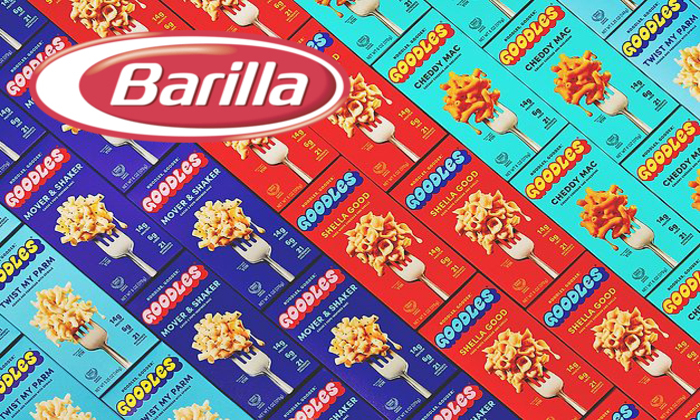
The Italian food company consolidates its presence in USA. through the acquisition of the California brand that in three years increased its domestic mac & cheese market share from 0.8% to 7.8%. Jennifer Zeszut will keep her ceo role while the company remains independent.
Iconic Italian food company Barilla signed an agreement for acquiring California’s Goodles, a start-up that reinvented traditional American mac and cheese as a ‘better-for-you’ version, enriching it with protein, fibre and nutrients (press release).
In September 2023, Goodles secured a Series A round of 13 million US Dollars that L Catterton led on the ground of an enterprise value of 88 million US Dollars (press release and SEC filing). The startup previously attracted 6.4 million US Dollars.
Jennifer Zeszut and Paul Earle funded Goodles in 2020 while Deb Luster, product developer Molly Michet and actress Gal Gadot joined the company at a later stage.
The firm also attracted the resources of show-business and sport celebrities like Christina Aguilera, Klay Thompson, Khris Middleton, DK Metcalf, as well as other investors in the consumer and entertainment sectors.
L Catterton and the other shareholders will now exit from Goodles that posted an exponential growth and achieved the profit break-even point with retail sales of 70 million US Dollars. Wall Street Journal quoted Numerator data saying that in the twelve months ending in June 2026, Goodles accounted for 7.8% of US consumer spending on long-life mac & cheese, compared with just 0.8% three years earlier. Over the same period, Kraft Mac & Cheese’s market share fell from 42.2% to 36.6%, and Velveeta’s from 21.6% to 18.9%. The US market for this category is worth a total of 2.1 – 2.3 billion US Dollars per year.
Barilla appointed Piper Sandler and Orbin & Company as financial advisors while Weil Gotshal & Manges and PedersoliGattai provided legal assistance. Goodles hired Centerview Partners and KO Law.
Goodles headquarter is in Santa Cruz, California. The ceo Zeszut will keep leading the firm and its current 73 workers and will handle products, recipes, ingredients, suppliers, and marketing in an independent way.
Goodles sells its product online and through grocery chains such as Target, Whole Foods, Walmart, Costco, Publix, H-E-B, Wegmans, and Sprouts.
Guido Barilla, the chairman of the eponymous company, said: “Today is an important day for our Group. We have been following Goodles closely for some time and the strength of its brand, the quality of its products and the momentum of its growth increasingly impressed us. As we got to know Jen Zeszut and the managers, we also appreciated how strong, united and forward-looking the organisation is. This combination convinced us that Goodles was the right choice and an extraordinary opportunity for the future.”.
The acquisition is part of a North American strategy that Barilla has been pursuing for over twenty years. The most recent major US transaction has been the 2023 acquisition of Back to Nature from B&G Foods, a brand specialising in non-GM plant-based snacks, through which the group had decided to build a stronger presence in the American bakery sector (see here a previous post by BeBeez). In 2025, Back to Nature continued to expand its distribution network, entering Target as well, whilst sales of the brand’s biscuits rose by 18% yoy.
In January 2021, Barilla paid 40 million GBP for acquiring the majority of London foodtech startup Pasta Evangelists, a D2C vendor of high – end fresh pasta and sauces (see here a previous post by BeBeez). In 2021, the Italian company also acquired Canada’s Catelli dry Pasta, the owner of brands Catelli, Lancia and Splendor. Barilla previously purchased Pavesi, Misko, Filiz, Wasa, Yemina, Vesta, Lieken, and Harrys.
In 2025, Barilla generated a turnover of 4.837 billion euros (4.883 billion in 2024), an ebitda of 579 million with a 12% margin (537 million, 11%), net profits of 233 million (142 million), and net cash of 230 million (210 million).
The financial statements also highlight that the company’s strong 2025 cash flow can support future investments and acquisitions. Barilla also has a revolving credit facility of 500 – 800 million euros that has not yet used.


