
What a difference six years made.
Back in 2020, Big Tech was swept up in a tidal wave of lofty climate pledges. Amazon would have net-zero carbon emissions by 2040, Microsoft will be carbon negative by 2030, and Google will operate on carbon-free energy “24 hours a day, seven days a week, 365 days a year – all by 2030.”
Two years later, the AI boom hit, and data center developers and cloud companies alike began fighting tooth and nail for just about every bit of resource our planet had to give.
Now in 2026, with the AI data center build-out in full swing and a US government more concerned with preserving the fossil fuel industry than protecting the planet, there is some doubt about whether these climate goals will be achieved.
Amazon shareholders have called for more information about how the cloud giant is meeting its sustainability goals while building out its footprint – including 3.G9W of capacity in 2025 – and the company’s board of directors is urging shareholders to vote against pursuing this line of questioning, arguing it already provides enough such information.
But the traditional hyperscalers are not the only companies building digital infrastructure for AI. The launch of OpenAI’s ChatGPT was also the catalyst for a new wave of cloud companies – the so-called neoclouds – focusing on offering AI and GPU-based compute capacity. Over the past few years, we have seen neoclouds growing at a rapid clip, taking up and bringing online large amounts of capacity, and forecasting growth in the gigawatts.
The neocloud market is at present much more dynamic and complex than that of the traditional cloud providers, but as a handful of these newcomers begin providing a significant chunk of the global data center capacity, the question of how this new era of cloud computing will operate sustainably remains unanswered.
What perhaps deserves some acknowledgment is that stating a goal is not the same thing as fulfilling it. Nidhi Chappell, president of AI infrastructure at AI cloud company Nscale, and formerly Microsoft’s head of Azure AI and HPC infrastructure, tells DCD that Nscale won’t be following the trend of early 2020.
“We will achieve the goals before we publish the goals,” Chappell says. “We aren’t a big corporation, we don’t go after lofty goals and then try to push them out.”
Instead, she says, Nscale’s approach is to have “sustainability in mind,” though she acknowledges that “as you start to scale like we are, you are going to have a portfolio of options, and some of that will be very much sustainable, but you will be balancing that.”
Nscale is one of the handful of neoclouds that has really gained strong market share. Recent research from Synergy suggests that neocloud revenue as a whole is set to exceed $25 billion for the year, with CoreWeave, Crusoe, Lambda, Nebius, and Nscale among the companies set to benefit.
But while these firms are similar in terms of their offerings and goals, their origins and operations vary, and this short list by no means encompasses the true scale and variety of players in the space.
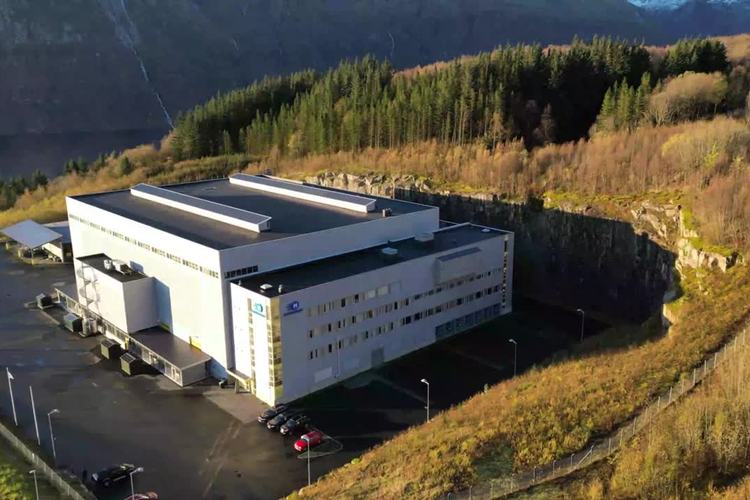
Nscale, like many neoclouds, has its roots in cryptomining, having been spun out of Arkon Energy. The company’s first AI cloud offering launched in May 2024 out of a data center in Glomfjord, Norway, powered by hydroelectric energy and using natural cooling.

AI clouds reshape the digital infrastructure landscape
Going Nordic
Operating out of the Nordics is something of a sustainability cheat code, and one that many neoclouds have taken advantage of.
Nscale has multiple data centers operating or under construction in the region, CoreWeave operates a site in Sweden, NexGen Cloud has sites in Norway and Sweden, and Nebius has multiple Nordic-based sites.
The Nordic countries – Norway, Sweden, Denmark, Finland, and Iceland – are widely considered global leaders in renewable energy, with more than 90 percent of their power coming from renewable and low-carbon sources.
There is also an economic benefit. In November 2025, CBRE said that of European neocloud capacity, 57 percent was based in the Nordics due to difficulties building in the top-tier FLAPD markets, along with the benefit of cheaper power.
NexGen Cloud’s chief product and technology officer, Cory Hawkvelt, argues his firm’s investment in sustainability is twofold: “One, it’s generally the right thing to do, and we have always believed in that, but two, it’s also usually the cheapest outcome, so it’s sort of a happy coincidence,” Hawkvelt says.
Nordic deployments also bring with them alternative opportunities for sustainability initiatives, such as heat reuse projects. Nebius, spun out of Russian tech giant Yandex, is something of an anomaly among the neoclouds, in that it already publishes an annual sustainability report.
At the time of writing, the 2024 report is available, though Nebius’ head of sustainability, Daria Mukhortova, tells DCD that the 2025 report will shortly be published. The annual report focuses only on operational data centers, and as of 2024, Nebius’ footprint was significantly smaller than it is today.
One of its operating data centers in 2024, however, was in Finland. In 2024, that data center saw more than 50GWh of heat reused, enough to heat 2,500 homes during that period. Located in Mäntsälä, Nebius’ contribution covered 72 percent of the heating demand of the district network that winter. Naturally, this benefits the local community, as Mukhortova tells DCD that the district saw electricity bills in 2025 decrease by 10 percent due to the heat from Nebius’ data center, but it also benefits Nebius as “we are in return using less power for cooling, because we are already exporting some of the heat out,” and thus does not need to cool the heat manually.
“These types of circularity solutions are embedded in our design, and they impact the PUE of sites and how that number behaves significantly.”
When asked if this would be rolled out to other sites, Mukhortova explains that Nebius’ cooling systems are all designed similarly, so they have the “potential for heat exchange,” but it depends on demand. “In Finland, there is district heating, but in some parts of the US, there is just no such thing. It’s definitely part of the conversation between the data center team and local partners, but it’s just about trying to understand if there is a demand.”
An American problem
But while neoclouds based in Europe can find sustainable power fairly easily, it is not so simple in other markets. The hunger for AI is a global phenomenon, and in the US, it is gnawing and insatiable. That hole will never be filled.
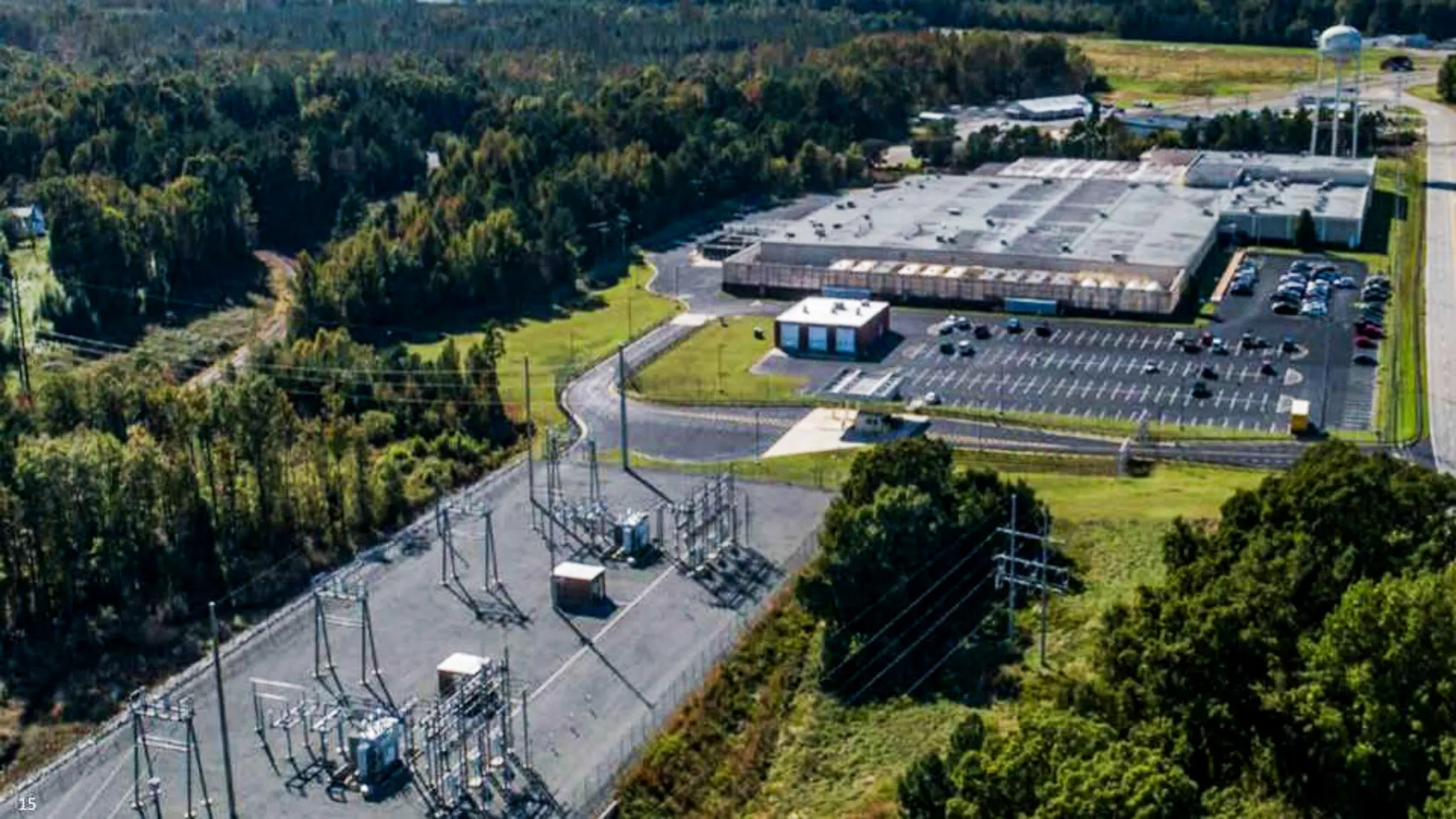
TensorWave is a neocloud that has found its niche in focusing solely on AMD hardware, and currently operates out of sites in the US, including Pennsylvania, Virginia, and Arizona, while it is also developing a location in Chile. The project in Pennsylvania is being developed by TecFusions, which previously told DCD it would be mostly natural gas powered.
TensorWave’s CEO, Darrick Horton, reiterated to DCD a common refrain: “The challenge in this space is access to power primarily. We think, for the foreseeable future, there will be a severe shortage of large-scale access to power.”
Horton thinks that in some ways this is a good thing, as it is “actually driving adoption of sustainable energy technologies,” citing increased discussion of on-site generation, microgrids, solar power, and nuclear energy. But, despite this, Horton says neoclouds “don’t actively seek out sites that are running on clean power, to be honest. That’s the sentiment I hear from a lot of providers.” He continues: “There is no such thing as seeking out a site with certain specifications anymore; this is very much a seller’s market, and when something becomes available – which is extremely rare – it gets immediately taken up.”
NexGen’s Hawkvelt similarly explains to DCD that their US deployment is not renewable-powered “because of geographic constraints,” unlike their other locations. But beyond the lack of options, it also isn’t currently a customer priority.
“We’re seeing significantly less pressure from customers around this,” Hawkvelt says. “Most customers aren’t too concerned, they’re really price-focused or looking for a particular product. My thinking with this is that, at scale, beggars can’t be choosers, and it’s a seller’s market. “You have to take what you can get, and usually that means sustainability and ESG targets are optional.”
In March 2026, Nscale hit headlines after the company acquired a massive 2,250 acres of land dubbed the “Monarch Compute Campus” in West Virginia, which could host up to 8GW of compute capacity. According to the Department of Energy, 1GW can power around 750,000 homes – meaning 8GW could power as many as six million homes, almost twice the number found in New York City.
This is a scale where, as Nscale’s Chappell explains, a “pragmatic approach” is needed. “We have a hub and spoke model, and we are bringing in large sites for training. If you want a location with 5GW+, well, there are only a few of them in the world,” she says. “You need to take a pragmatic approach, based on what the workload needs, the size required, while trying to have a minimal impact on the environment.”
Part of the draw of the Monarch Compute Campus is its proximity to the Appalachian Basin – the largest source of shale natural gas in the US.
“The power there is encapsulated and somewhat ‘stranded.’ If you look at the Appalachian Basin, there is a good source of natural gas there, but it’s not something that can be easily transferred to other places. It’s very much behind the meter, and in someways it is stranded power that we are using. It’s not on the grid, and it’s going to have a lower carbon intensity because it’s power that was there but not being used effectively,” says Chappell, noting that the basin also has a lower methane intensity and was “the best source of natural gas we could find in the US.”
Beyond needing a massive scale of power, the nature of AI training also means that you need reliable power, as “you can’t have spikes and variations because it’s a workload that is running continuously for months.” Natural gas is a bit of a grey area in the energy conversation. It isn’t renewable or carbon-free, but it isn’t “as bad as coal,” says Chappell.
Nscale will use Caterpillar-provided natural gas generator sets for at least the first 2GW, which is expected to be delivered by the first half of 2028. Rough estimates from the International Energy Agency put coal at between 740 and 1,689 gCO2e per kWh, while natural gas sits somewhere between 290 and 930 gCO2e per kWh – lower than coal but with methane leakage. One solution to this could be through emission offsetting efforts – signing physical or virtual PPAs, or via carbon capture and storage, though the latter’s efficacy is debated.
Hyperscaler cloud providers are some of the biggest proponents of these offsetting solutions. Amazon is the largest corporate buyer of renewable energy in Europe as of April 2026, and competes with Meta for the global title. Microsoft, meanwhile, is something of the king of carbon capture, having purchased more than 45 million tons of carbon removal credits, though it is reportedly slowing down its efforts in the area.
General attitude from neoclouds suggests openness to the option of PPAs, though carbon capture seems to gain less traction. CoreWeave, for example, told DCD in the summer of 2025 that it had a large-scale solar and wind PPA in Spain.
Mike Mattacola, CoreWeave’s former international general manager, explained at the time: “We have PPAs where we need them. In some regions, there’s just so much availability [of renewable energy] or prices are very stable, so we don’t necessarily need them. “In Spain, we have large-scale PPAs, for example, with the majority coming from renewables. We’ve got a new data center we’ll be launching in about 90 days, which will have a 100MW solar farm next to it. We’re doing everything we can to get creative around that. Literally, the opportunity for us to grow is driven by solving that problem.”
Nscale is not against the concept. Chappell says that they “would never rule anything out.”
“Our strategy is really driven market by market,” she says. “If you think about it, in some of the regions, long-term renewable supply agreements are the score of the market, it’s just how things are done in some locations.”
Nebius’ Mukhortova shared a similar sentiment. “Physical PPAs are a decarbonization instrument, and they are being discussed, but I would say we take it on a case-by-case basis as it is also market-linked. Not every market would have them immediately available, but it’s also probably about having a healthy mix of different instruments, including physical PPAs and other credible instruments,” she says. “It’s something we definitely discuss with individual sites – particularly where we are building and operating – but it’s quite different for the colocation sites because a partner is responsible for that.”
However, while being on the cards, Mukhortova is generally hesitant about relying too heavily on such “instruments.”
“The first step in our vision is always looking at how we build and how we can optimize that to the maximum level, and then of course treating energy sourcing very seriously,” she says. “But I would say that offsetting is probably the last thing we would look at.
“My personal vision is that offsetting doesn’t actually change the way you operate. It makes the carbon accounting look better on paper, and it’s still better than doing nothing, but if you have the opportunity to build efficiently and direct the resources there, then it should be the first focus.”
Operational efficiencies
It is in the day-to-day operations that the neoclouds really seek to draw attention. Rather than attempting to deny that, by their nature, AI workloads are very resource-intensive, the providers are seeking new ways to make the most of the resources they have. For some neoclouds, this has seen a focus on immersion cooling.
Australian vendor Firmus, for instance, started off specializing in high-performance computing with immersion cooling. Speaking to DCD at the 2025 Connect | APAC event, Firmus CTO Daniel Kearney explained that the company’s focus was on “building the most efficient AI infrastructure period. And one way we achieved that goal in Singapore was to use immersion cooling. Why? Because it removed air cooling and it removed chillers, and air cooling is actually one of the worst mediums.”
The company has 7MW of capacity installed in Singapore using this method and serving a hyperscale customer among others, and is working on a 1.6GW initiative in mainland Australia called “Project Southgate.”
The GPUs, as part of that effort, however, will instead use LiquidCore, CDC’s proprietary cooling technology. Firmus declined to conduct a follow-up interview with DCD to discuss ongoing sustainability efforts.
While air-cooling is often dubbed less energy-efficient than its liquid-based counterpart, this can depend on the environment where a data center is located. Nebius, for example, primarily uses free cooling for its data centers, with Mukhortova describing their systems design as being “geography-agnostic.”
Nebius designs all of its hardware from the ground up, and operates its servers up to 45 degrees, which means that “basically any sort of outside air would be sufficient for air cooling.” Beyond that, the company also uses closed-loop liquid cooling.
Beyond cooling, it is also about ensuring the GPUs and hardware are running efficiently and handling the workloads effectively. All of this goes into driving down the PUE of the data centers.
In 2024, Nebius had an average PUE of 1.3, but according to Mukhortova, it has been “even better” in 2025, and the best months at the company’s data center in Finland reached 1.15. This is itself even caveated, as Nebius draws the “boundary” of its facility not at the data hall, but for the whole property, meaning that construction works actually hit the PUE. If they just measure it from the data center, the Finland site would reach 1.1.
Nscale does not share its PUE figures publicly, a move that is common in the industry. Even AWS only shared its PUE data for the first time in late 2024. A PUE of 1.1 puts Nebius’ data centers on-par with many of the hyperscalers’ most efficient facilities, most of which are averaging between 1.1 and 1.2 globally. However, PUE as a metric is widely agreed in the industry to not be all-encompassing. For Mukhortova, this is not only in the sense that it fails to acknowledge water usage or carbon footprint, but is also unable to fully cater to the AI cloud operating model.
PUE measures how much power is directly delivered to compute. The closer to 1 the PUE number is, the more power is going toward the “money maker” of converting compute cycles into dollars, rather than cooling equipment. But, as Mukhortova explains, it doesn’t tell us how efficiently you then transform the power into useful AI output.
“It’s hard to measure, because then you have to define what a useful AI output is, but I think it should be the ambition of companies like Nebius to try and measure this,” she says. “One thing that we can look at is the number of like tokens per megawatt used by IT equipment. Then you can also try to evaluate the mean time before failure of your equipment. This is important because the period of time that your equipment was operational without interruption, means that you didn’t have to rerun any workload, because any rerun means drawing more power.”
Model efficiency can also play a part. “I think this discussion about the model is also a bit overlooked now, because the setup of the model basically defines how efficiently it then will run on your infrastructure,” Mukhortova says. “Our token factory now has a modal post-training optimization tool where they take the open source model, and in this post-training phase, we try to tune the model in a way that would perform best on the given infrastructure, meaning that it would actually draw less power.”
Operational efficiency, ultimately, benefits the neocloud’s bottom line, as does using cheaper power, which in many cases ends up being from renewable sources. But, as these operations seem to keep scaling up with no clear glass ceiling in place, barring a total global economic collapse, it can only be hoped that each company individually keeps seeking the most sustainable options available, and like the hyperscalers who have trodden the path before them, where sustainability isn’t an option, invest the cash to make it happen.
Regardless, while currently not covered by the EU’s Corporate Sustainability Reporting Directive (CSRD), by 2027, any neocloud of notable size with operations in the EU will be legally required to publicly report on its entire global value chain. If it is not operating sustainably, the world will know about it.


Read the orginal article: https://www.datacenterdynamics.com/en/analysis/the-neocloud-approach-to-sustainability/