

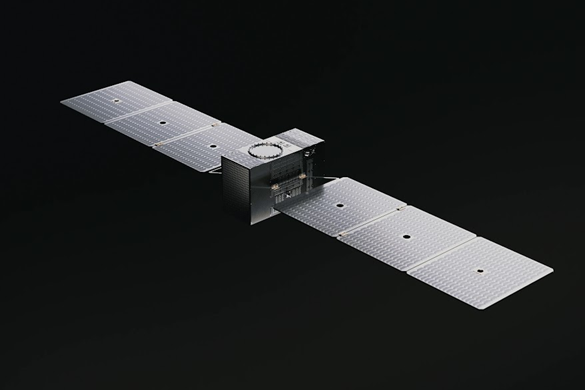
UK-based space startup NewOrbit has closed an $18.5m Series A funding round.
The money will fund the firm’s ambitions to orbit its 50 kg NEO-1 satellite in very low-Earth orbit (VLEO), between elevations of 200km and 300km, with a lifespan of up to five years, to make its first commercial launch in 2028.
Voyager Ventures led the round, which the company said was oversubscribed.

“I believe VLEO will become a critical layer of future space infrastructure, supporting both commercial and national security missions,” Sir Chris Deverell, former commander of UK Joint Forces, and member of NewOrbit’s advisory board, said in a statement “VLEO is one of the few genuinely new commercial categories remaining in space, and opening it requires a rare combination of engineering excellence and institutional discipline.”
Placing satellites in VLEO is not a new idea, with startups like Kreios Space announcing its work on an air-breathing electric propulsion (ABEP) system for VLEO satellites in 2022, Viridian Space Corporation, established in 2023 to build satellite air-scooping electric thrusters (ASET), alongside Albedo’s Clarity-1 satellite announced in 2024.
The theory is that these designs will stay in orbit by harvesting air from the upper atmosphere to use as a replenishable propellant. Scientific experiments in VLEO date back to the 1980s, with JAXA testing its Super Low Altitude Test Satellite “Tsubame” at 355km successfully in 2017.
While the lifespan of a LEO satellite is limited to a few years due to the strength of microgravity acting on it, NewOrbit said other satellites in VLEO often orbit the Earth for a matter of only weeks, as they corrode from exposure to atomic oxygen and the upper atmosphere blows them around.
NEO-1 is designed to stay in VLEO using its AURA, a propulsion system the company has worked on since 2021 to efficiently expend Xenon propellant, while its symmetrical geometry neutralizes aerodynamic torque. The company doesn’t mention a need for NEO-1 to refuel in order to sustain its five-year proposed lifespan. The company describes the craft as “the world’s first and only satellite capable of operation at very-low Earth orbits.”
NewOrbit emphasizes the higher throughput of lower orbits, alongside higher image qualities and LiDAR capability. It will use the cash to fund a new factory, the NEO Production Complex, due to open in Reading in 2027, and has assembled a team of engineers from SpaceX, NASA JPL, Rocket Lab, Tesla, Airbus, ESA, and Formula 1.
The Series A also included angel investors David Kirk (former chief scientist at Nvidia) and Lawrence Leuschner (co-founder and former CEO of Tier Mobility), the family office Custos, as well as continued backing from Atlantic.vc, Lifeline Ventures, LGF, and Illusian.
In January this year, Starlink announced it would lower its then 9,000+ satellite constellation from 550km to 480km over the course of the year, moving them out of the way of many others in LEO, and reducing the lifespan of its fleet. Today, trackers like Orbital Radar put the number of active satellites in the Starlink constellation at more than 10,400.
It is understood that Starlink satellites dip as low as 240 km as part of orbital maneuvers, but are not designed to stay there.
VLEO has attracted moderate interest from defense bodies in its history. While ASAT missile impacts in geostationary orbits have a real potential to render Earth’s orbits impassable for thousands of years through inducing Kessler Syndrome, trapping the human race on the planet for eons, blowing things up in VLEO is comparatively much safer, though it is still not recommended by experts.
More in Investment / M&A / Financing


Read the orginal article: https://www.datacenterdynamics.com/en/news/neworbit-raises-185m-to-build-a-satellite-to-survive-vleo-for-up-to-5-years/


