
Some 71 percent of the Earth’s surface is covered by water. At times, it feels like the remaining 29 percent is covered by data centers.
The AI boom has driven an unprecedented build-out of digital infrastructure, with new campuses springing up in droves all around the world. Competition for resources is fierce, with suitable land and available power often in short supply.
Meanwhile, communities are becoming increasingly wary of the negative impact that data centers can have in their localities, and the industry is facing more scrutiny than ever before.

DCD Magazine #62 – The coming wave
Will compute at sea sink or swim?
Faced with these challenges, it is perhaps no surprise that developers are looking out to sea. A growing number of companies have honed in on the ocean as a source of power or cooling for servers, or simply as a discrete and permit-free location to run compute away from the prying eyes of opponents.
Underwater and floating data centers are not a new concept, but the last year has seen a flood of new projects proposed, ranging from the basic to the barely believable.
Many of Silicon Valley’s power brokers feel these wannabe seafaring pioneers are onto something, with prominent investors offering millions of dollars to founders. Y Combinator, the tech incubator that launched the likes of Airbnb, DoorDash, and Stripe, is also on board, and in July put out a call for entrepreneurs working on ocean data centers to apply for its upcoming program, as part of a focus area it has dubbed Compute at Sea.
“AI is running out of compute, and the demand for data centers is insatiable,” said YC visiting partner Francois Chaubard, in a video to launch Compute at Sea. “It might sound crazy, but think part of the answer may be to move compute offshore. Think of them as compute flotillas – many standardized, modular vessels, operating together as a global cloud.
“While communities increasingly oppose the land, the water is open.”
DCD has spent the last year interviewing companies that agree with Chaubard’s thesis, to try and establish whether any of them is ready to make a splash.
This feature first appeared in Issue 62 of DCD Magazine. Register here to read the entire magazine, free of charge.
The sinking of Microsoft’s Project Natick
In 2013, Sean James, then of Microsoft, had an idea. That idea would give birth to the world’s first underwater data center.
Having enlisted in the US Navy after high school, James volunteered for the submarine fleet, where he served for three years. After leaving the Navy, he retrained as an electrician and got a job “in this weird building called a data center.” This was in the year 2000, when the Dotcom bubble was deflating rapidly, and the firm he worked for soon went bankrupt, with its team – and data center – acquired by Microsoft.
“Microsoft was basically the only tenant,” he says. “So it took over the building, and that was the start of a 25-year career designing and building data centers for them, with the last six or seven years focused on advanced designs.”
James penned a paper on submersible data centers as part of Microsoft’s Think Week, an event introduced by the company’s founder Bill Gates, where staff can take time away from their day jobs to read and think about new ideas.
“I talked about how it would be constructed and some of the benefits, leaning on my engineering training in the submarine fleet,” he says. “CEO Satya Nadella saw it, and said, ‘I want to build one of these’, so we worked with Microsoft Research and deployed a single rack submersible data center off the coast of California, and then we deployed a row of racks off the coast of the Orkney Islands up in Scotland.”

Known as Project Natick, the underwater data center in Scotland was submerged in 2018, with 855 servers installed in a cylindrical capsule filled with inert nitrogen gas and left to run unattended for 25 months and eight days at a depth of 36 meters (118 feet). A further 135 servers also formed part of the test, and were left to run in a couple of racks on dry land, alongside hardware running Microsoft’s Azure cloud, to compare and contrast.
DCD reported on the project in depth in Issue 38 of the magazine, after the data center had resurfaced. Only six of the 855 servers broke, compared to eight of the 135 on dry land. Despite this, we exclusively revealed in June 2024 that the project had been shuttered, with Noelle Walsh, head of Microsoft’s cloud operations and innovation division, stating: “I’m not building subsea data centers anywhere in the world.”
James describes Project Natick as a “jugular experiment” because “you had all these different branches of learning stemming from the original experiment.” He explains: “We were able to keep the temperature envelope really tight underwater, because the water temperature rarely changes. In an air-cooled data center on land, you have 10-15°C (50-59°F) temperature swings, which causes a lot of thermal expansion in servers.”
He says the use of nitrogen was also a big factor in the submerged servers having lower failure rates, with the relatively large nitrogen molecules helping prevent leaks, and the lack of oxygen meaning there was no corrosion of equipment. “The importance of air quality was a big lesson learned,” he adds. “So that meant beefing up the protection of components on the servers and creating data centers that aren’t constantly being flooded with outside air. But we figured out we could get these benefits on land, without the brain ache of deploying data centers underwater.”
Taking the Hi road to underwater data centers
While Microsoft ultimately decided to stay onshore, other companies claim to be running data centers below the ocean’s surface. The biggest deployment is in China, where HiCloud Technology is operating two separate underwater data centers.
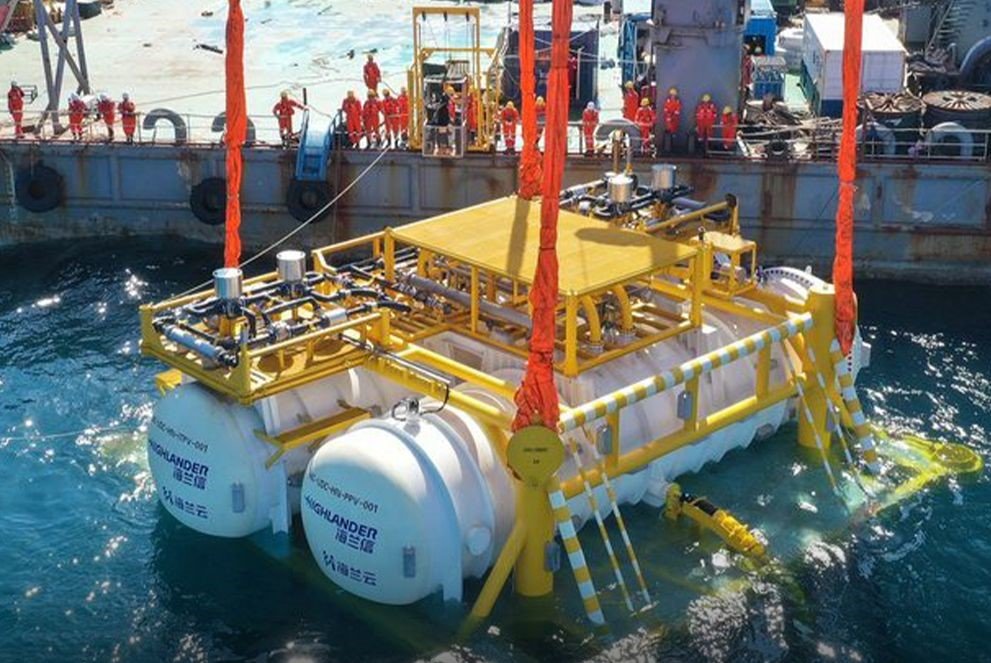
An offshoot of marine technology firm Highlander, HiCloud started work on its underwater data centers in 2021, launching its first commercial offering in late 2023. It now has two subsea data centers up and running. The first, off the coast of Hainan province, comprises a trio of 360kW pods anchored to the ocean floor, 100 meters (328 feet) below sea level, and powered by grid electricity. The second, near Shanghai, is tethered to a wind turbine, which provides it with power directly. This smaller installation has 48 racks of 12kW, giving a total capacity of 576kW. Further capacity is at various stages of commissioning and deployment, the company says, with the Shanghai data center capable of accommodating up to 2.3MW.
In an exclusive interview with DCD, the first the company has granted to an English-language publication, Su Yang, general manager of HiCloud Technology, says that while the battle for data center space on land is fierce, the ocean provides “a green treasure trove of computing resources that has long been underutilized.” Yang adds: “It provides natural cooling and, at the same time, its proximity to offshore wind power plants gives us a unique advantage.”
HiCloud tapped into Highlander’s existing marine engineering expertise to build its data center shells, Yang says, recruiting a team of digital infrastructure experts to work on the server rooms inside. The result is a modular compute unit that can be fitted into custom submersibles engineered for specific environments. While the Hainan capsules lie horizontally on the seabed, the Shanghai data center is vertical and features a hatch above the surface, allowing access for maintenance. Following Microsoft’s lead, the company fills its data centers with nitrogen to help boost reliability.
“We conducted an enormous number of experiments – hundreds – to address the complex influences in the underwater environment,” Yang says. “Ultimately, we achieved standardized, factory-prefabricated modules, so that equipment can be deployed and put into use immediately upon reaching the water.”
According to HiCloud, this means it can move quickly on construction, and Yang says it can have new modules up and running “in just 90 days from installation to commissioning.” He says the firm can cut “construction time by more than half compared to traditional onshore data centers, reducing the delivery cycle by nearly tenfold, and significantly lowering costs.”
HiCloud’s customers can also apparently save money on their cooling bills, with the data centers using the sea for free cooling, rather than deploying mechanical systems.
“Our cold source system uses seawater as the primary cooling medium for the entire system,” says Tu Feilong, HiCloud’s technology director. “In regions where the seawater temperature meets our cooling requirements, we use 100 percent free cooling.”
In other regions, Tu says, such as Guangdong, where sea temperatures are higher, HiCloud intends to incorporate an HVAC unit to provide additional cooling power. “Overall, the cooling system is relatively simple,” he says, adding that the data centers can achieve Power Usage Effectiveness (PUE) of 1.15.
Businesses with workloads running underwater include China Telecom, which uses HiCloud infrastructure for data annotation and AI model training. State-backed organizations Shanghai Yidian and Lingang Cross-Border are also customers, and Yang says the firm is in discussions with a number of other businesses, though whether the private sector shares the Chinese government’s enthusiasm for the facility is unclear. Highlander, HiCloud’s parent company, is not itself state-owned.
HiCloud certainly has big plans underwater, and is particularly excited by the opportunity of powering its facilities with offshore wind. The Shanghai data center is intended as the first part of a 500MW underwater data center park, and elsewhere in China, in Qinhuangdao, the company is planning a 7MW data pod, scalable to 100MW, with similar installations in the works for Zhoushan and Shantou, as well as other regions.
An international expansion could also be on the cards. Negotiations are “in the early stages,” Tu says, but adds: “In the not-too-distant future, we expect to build underwater data centers in waters around Abu Dhabi, Singapore, and other parts of Southeast Asia.”
Subsea Cloud is the only other company publicly claiming to offer live underwater data center services. The US-based vendor has been active for several years, initially marketing 1MW pods inside shipping containers that could be used as colocation space or for Edge computing. Its systems can apparently cut CO2 emissions by 40 percent, and costs by 70-80 percent, when compared to land-based equivalents. Subsea Cloud’s website says it can deliver 1MW of data center capacity for $1 million, compared to a cost of $7m on land.
The company is tight-lipped about the locations of its operating data centers, but says it runs servers in Asia, used primarily by gaming companies, and has previously talked about deployments in Houston, Texas, and Port Angeles, Washington. When DCD spoke to CEO Maxie Reynolds in January 2025, the firm was said to be on the verge of trialing AI infrastructure underwater in the UK and Norway, and since this feature was first published, has advertised Project Otto, a trial deployment in Norway that can handle up to 16 racks per underwater unit, with 150kW+ of power available.
Subsea Cloud this year opened an office in the Middle East to try and capitalize on interest in AI in the region, and struck a partnership with Deep/C Systems that could see it deploy underwater infrastructure for defense contractors.
Waves of new entrants are also joining the market. In Maine, DeepGreen [not to be confused with the UK company of the same name] has an ambitious plan to construct a 51MW tidal energy power project, which would feature universal docking cradles on the floor of the Western Passage, a stretch of water near the town of Eastport that connects to the Atlantic Ocean. These cradles would hold energy-generating turbines and pods containing AI infrastructure, with the turbines powering the GPUs and sending energy to nearby residents.
But the project, put forward by real estate developer Louis Wolfson, who appears to have no background in data centers, has faced pushback from residents in Eastport, and in August, councilors in the town voted for a 180-day moratorium on underwater data centers so that they could consider the merits of the proposal at length.
Floating data centers begin to surface
As work continues on underwater data centers, the surface of the water is attracting even more attention.
Floating data centers of all shapes and sizes have been proposed for seas, rivers, and lakes around the world. As befits the diverse and somewhat speculative nature of the digital infrastructure industry in 2026, these projects are being driven by an unlikely collection of people, ranging from experienced operators to complete data center novices, and including engineers, energy experts, students, and finance bros, all of whom think they have a potentially lucrative answer to AI’s seemingly insatiable demand for compute.
Houston-based Mousterian, also known as M3, has an advantage over many of its would-be competitors, as its team has built a floating data center before. Two of its founders, Chase Ott-Wick and Gabe Andrews, worked on a barge-based facility in Stockton, California, launched by Nautilus Technologies, which DCD visited in 2022. The 7MW facility was put up for sale by Nautilus in 2024 with a price tag of $45m, though the company confirmed that it still owns the data center.
Mousterian is working with Samsung Heavy Industries, the Korean tech giant’s maritime engineering division, to develop AI-ready infrastructure on barges that can be moored near a power plant or brownfield site where a power connection already exists.
“When we were procuring traditional land-based sites, we realized that 80 percent of all thermal power generated in the US is on water,” says Min Suh, M3’s CEO. “We kept coming across these huge factories, or steel mills, or actual power plants, and thought, ‘hang on, why are we joining a four-year queue to get a grid connection in the middle of Chicago, when we can just go right to the power plant’.”
M3 does not, in Suh’s words, intend to “rock the boat” with a novel floating product, but simply sees using the water as a way to bring compute online fast.
Andrews, the company’s technical and delivery lead partner, explains: “Floating enables speed to operation while multiple workstreams are underway. So remedial work can be carried out on the power plant or factory, and the floating data center can operate while that’s happening. We can deliver behind-the-meter power and have a data center operational in the blink of an eye.”
Under the partnership agreement, Samsung, which has stated separately that it intends to develop floating data centers for other clients, will design and manufacture modular floating units with capacity of up to 50MW, using its experience building offshore oil platforms. The barges are designed to withstand a category three hurricane (“when the Great Flood returns, Noah will come to us to make sure Netflix works on the Ark,” Andrews jokes) and have a 30-year lifespan. Overhead cables provide power and fiber connectivity from land.
M3 is in charge of sourcing sites and tenants, and managing the data center projects. The company is working with an unnamed and privately-owned power plant operator keen to redevelop eight sites in the US for data center use. “They are looking to activate these power assets, but these sites need remedial work and the data centers will take time to deliver,” Suh says. “We will be able to deploy our floating product very quickly, but in the long run we expect 20 percent of our IT capacity to be floating, and 80 percent on land.”
In Singapore, data center firm Keppel is also looking to get around a lack of space (Singapore operated under a data center moratorium for several years because of concerns over land and power availability) by floating a 25MW data center at 25 Loyang Crescent, a riverside industrial warehouse complex. Keppel first started exploring the idea of building its own floating data center park in 2019 and secured regulatory approval for the project in 2023. Work has started on the facility, which has already been pre-let to a hyperscaler, and is due to come online in 2028.
A rising tide
While M3 and Keppel will both rely on traditional sources to energize their servers, other floating data center firms are looking to harness the power of the ocean.
Panthalassa is developing Ocean-3, an autonomous, self-propelled platform designed to generate clean wave energy to power a modular AI data center. Earlier this year, it raised $140m in a Series B funding round led by PayPal and Palantir founder, Peter Thiel. “The future demands more compute than we can imagine,” Thiel said at the time. “Extra-terrestrial solutions are no longer science fiction. Panthalassa has opened the ocean frontier.”
It has since taken additional investment from South Korean cloud provider Naver, and is said to be raising more funds at a valuation of $2 billion. Having deployed two test craft, Ocean-1 and Ocean-2, in 2021 and 2024 respectively, the company hopes to launch Ocean-3 this year, with commercial deployments starting in 2027.

Scottish renewable energy firm Mocean has a similar idea. It has already developed and trialed a floating offshore energy generation system, Blue Star, aimed at powering equipment needed by the oil and gas industry. This is set to hit the market in 2027. The company has now launched Blue Core, a similar craft but with added compute.
“Blue Core is 70 percent the same technology as Blue Star, but scaled up,” says CEO Cameron McNatt. “That means making the structure bigger, and adding more power electronics modules, but from our perspective, we’ve already demonstrated 70 percent of the technology stack works, and now it’s about adding the data center piece on top of that.”
Power would come from the company’s wave energy generator, which McNatt describes as a “big hinge” that is moved back and forth by the motion of the ocean. He explains that this “powers a direct drive generator, which has a clever magnetic gearing” to account for the low-speed, high-torque motion of waves. This mechanical energy is then converted into electrical energy and stored in batteries. On-board solar panels help keep the batteries topped up.
McNatt envisages that Blue Core would be towed out to sea and anchored far offshore, with network connectivity coming via satellite. Each unit will be able to generate up to 1MW of power for compute, which will be sold on an in-demand basis, either by Mocean itself or through a partnership with a neocloud. The CEO believes that the vagaries of renewable energy generation lend themselves to this kind of business model, rather than trying to contract a set amount of data center space with a hyperscaler or enterprise client.
“We’re not looking to guarantee servers for Big Tech companies with 99.999 percent uptime,” he says. “But we will be able to say ‘we can have these servers on all the time’, and as we get more energy and power, we will be able to scale up the compute and provide more in the on-demand market.”
Mocean is seeking a partner to develop the data center infrastructure inside its craft, and is raising £5m ($6.82m) to enable it to build a demonstrator data center, which it hopes to have in the water before the end of the year.
Other vendors are following HiCloud’s lead and attaching data centers to existing ocean energy assets. German firm WindCores did this with small data centers inside turbines back in 2018, and San Francisco-based turbine firm Aikido is developing a more powerful offshore wind platform with a data center incorporated into its structure. The floating platform is expected to host a turbine with between 15 and 18MW of capacity, supporting 10-12MW of IT capacity. Each unit will include three prefabricated 3-4MW data halls directly within the platform’s steel hull.
Aikido CEO Sam Kanner explains: “Over the past year, as we watched the growing challenges around powering and cooling new data centers, we realized our platform already had ample power and effectively free cooling built in. It hit us like a ton of bricks.”
Unlike HiCloud, Aikido’s compute is above the waterline, within the columns of its floating platform. These columns are divided into three sections, with the top section containing the servers, the bottom part used for ballast, and a void in the middle. Fresh water, contained in the ballast tank, is pumped into the server room to cool the hardware, with the ocean being used to dissipate the rejected heat.
The columns are “11-12 meters (36-39 feet) in size”, according to Kanner, meaning they are capable of holding what he says is a fairly standard compute module. These will be manufactured separately from the rest of the platform and lowered into place before the turbine is installed at sea. Aikido hopes to have a demonstrator unit up and running later this year, and is targeting commercial deployments by 2028. While Kanner and his team believe they will soon be in a position to supply compute to its clients, including an AI orchestration platform that has signed a pre-agreement to lease server space at sea, other companies are taking a more long-term approach.
Thinking big
Growing up in Athens, Greece, Dimitris Koutentakis has always dreamed of the sea. Shipping accounts for some eight percent of the Mediterranean nation’s GDP, and Greece is home to the largest merchant maritime fleet in the world.
“Shipping is a main industry there, so I’ve always been close to that ecosystem,” says Koutentakis, an MIT graduate with a master’s in mechanical engineering, who is now setting out on a voyage of his own with his startup, Atomarine.
Teaming up with fellow MIT student Emile Germonpré, who is working on a PhD in nuclear engineering, Koutentakis co-founded Atomarine, which proposes putting small modular nuclear reactors (SMRs) on ships to power huge floating AI data centers.
“We started out working on a nuclear-for-shipping project – our idea was that our nuclear ship would sail alongside existing container ships to provide additional low-carbon power,” he says. “It would be a way to decarbonize the existing fleet without a lot of modifications, but after a year of research we saw that the industry was a decade away from needing this solution.”
Enter data centers, which need power much more quickly. The compute side of Atomarine’s proposal is fairly standard, comprising a large barge with shipping containers of servers installed upon it. The nuclear ship would be anchored next to the barge to provide 150MW of power, enough to cover two 75MW platforms.
Putting a nuclear reactor on a ship is not an outlandish concept – the US and other countries around the world use compact reactors, similar to SMRs, to power aircraft carriers and submarines. But one sizeable fly in the ointment for Atomarine is that commercially available SMRs don’t exist yet. While many vendors claim to have reactors on the brink of launch, none has received regulatory approval, let alone gone into production. This has not stopped data center operators across the US from hailing SMRs as the solution to the industry’s power woes and signing pre-emptive deals to procure them.
“We’ve been talking to some potential partners about getting access [to an SMR],” Koutentakis says. “But with the minor engineering changes that would be required and the regulatory timelines, we’re targeting a first deployment in 2031 or 2032.”
While it waits for this bright nuclear future, the company intends to turn to an old data center industry favorite, natural gas, and wants to install turbines on ships to energize its servers. Gas turbines (which themselves are increasingly difficult to procure) are very much not low carbon, but Koutentakis says they could provide a useful bridge to get its operation up and running.
With funding from Y Combinator, Atomarine is developing its proposition and is building out its team. Since this feature was first published, it has raised $19 million in seed funding, and hopes to use the proceeds from this round to build a proof-of-concept for its floating data center, with the all-important energy part following later.
An even more ambitious plan has emerged from another of the world’s largest shipping destinations, the US state of Maryland, which is home to Baltimore, the busiest cargo port in North America.
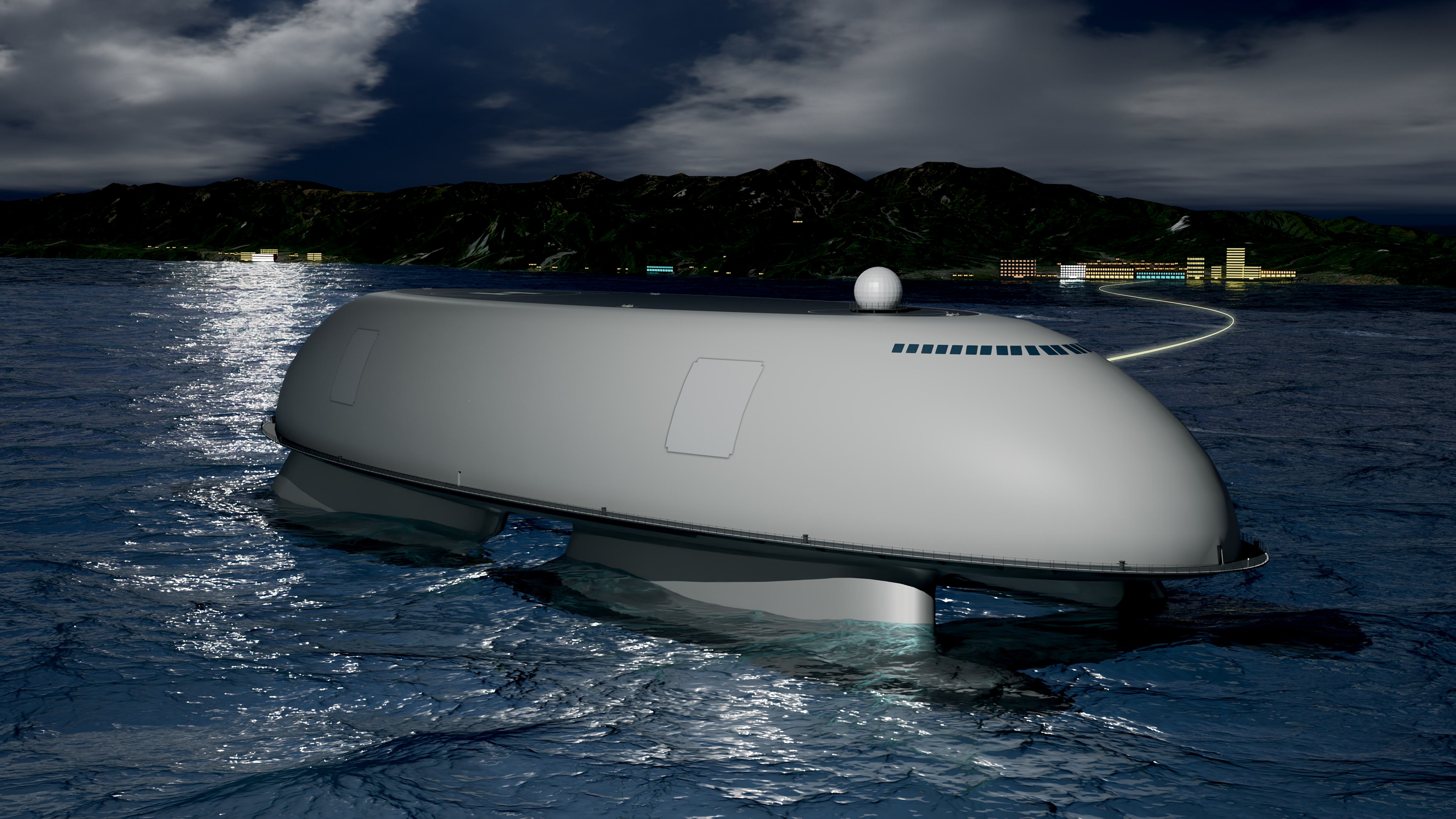
OptimalTransit, a newly formed joint venture between naval systems developer InMar Technologies and power technology firm OptiFuel, has unveiled its Kraaken range of floating data centers, which it says will offer capacity of between 10MW and 100MW, powered by renewable energy. A second iteration of the design offers a tantalizing proposition, adding power generation and water treatment capabilities, alongside 60MW of compute space. Optimal Transit says this will make it ideal for sailing to areas hit by natural disasters.
OptimalTransit is led by Scott Myers and Jeff Kline, former colleagues at aerospace contractor Lockheed Martin, who are building on work initially undertaken as part of research projects for legendary US innovation agency DARPA. Central to its proposition is Ocean Thermal Energy Conversion, more commonly known as OTEC, a renewable energy system that uses the temperature difference between the surface and depths of the ocean to run an engine that produces electricity.
While OTEC is an established technology, with the potential to produce up to 2TWh of power each year, according to some studies, its physical size and cost have so far limited its deployment. That could be about to change.
“We’ve been able to shrink OTEC’s size by 70 percent,” Kline says. “This makes it approximately 250 times more efficient, because it compacts things and lowers the capital costs, so you’ve suddenly got a payback period of three to four years. That’s not a science project anymore.”
The company is somewhat cagey about its system, much of which is proprietary, but says it can be built using off-the-shelf products commonly procured for shipping projects. It will, however, need a lot of money to bring its vision to life – Myers says $75m-$100m is required in the next year to build a digital twin of its system and get blueprints for its craft, which will be based on a small-waterplane-area twin hull design, finalized and certified. Getting a vessel actually built is likely to cost in the region of $400m, which, even in data center industry terms, is certainly not a drop in the ocean.
Compute at sea: Plain sailing ahead?
While there is no shortage of ambition among the companies looking to put compute at sea, how many of them will manage to turn their fancy AI-generated images of offshore data centers into reality remains to be seen.
In their favor is the fact that building in the ocean does not require the kind of complex permitting arrangements that hinder land-based data centers, which often involve navigating several layers of local authority approval, as well as opposition from neighbors.
Mocean CEO McNatt explains: “Permits are required at sea, but from our perspective it’s a lot less arduous and there’s going to be a lot less stakeholder pushback. The process is a lot faster than on land, and less expensive.”
Companies like HiCloud and Aikido, which are keen to utilize existing offshore renewable energy assets, may also be in luck, as the offshore wind industry, in particular, is looking for new revenue streams. Many wind farms are struggling for profitability amid rising costs, an uncertain regulatory and pricing environment, and a sometimes hostile political climate. US President Donald Trump, a long-time opponent of building turbines, has described wind as “bullshit” and stated – incorrectly – that offshore installations harm whales. Last year, the US government imposed a stop-work order on new offshore wind projects, citing potential national security concerns, leading to a number of projects being paused or cancelled.
With auctions for new turbines in several European countries failing, and build-outs falling behind schedule, data centers and AI could provide valuable income for operators.
“Offshore wind is in a bit of a pickle at the moment,” says Juergen Peterseim, partner in sustainable asset transformation at Deloitte. “There are many lower-cost options, such as onshore wind and solar, and I think the industry is about to stall in Europe if we don’t have an offtaker that needs a lot of capacity.
“Data centers could be that offtaker, and with the constraints we’re seeing on land, the industries could help each other to grow.”
While the natural cooling power of the sea is often hailed as an environmental benefit for offshore compute, discharging heat from servers into the ocean could have a negative impact on plants and wildlife. Aikido CEO Kanner said his company has calculated that the heat from its platform only raises the temperature of the sea within a two-meter radius. “It’s a very localized heat island,” he says.
Vendors will also need to convince their clients that putting expensive hardware on out in the ocean, where extreme weather and the corrosive nature of salt water can have unpredictable consequences, is a safe bet. There is also the cybersecurity element to consider. Undersea communications cables have been targeted as part of grey zone warfare operations carried out by Russian and Chinese forces, and floating or submersible data centers could be tempting targets, too.
“Some people would say a data center on land, with armed guards and a big fence around it, is the safest,” says Professor Paul Haskell-Dowland, professor of cyber security practice and associate dean in the School of Science at Australia’s Edith Cowan University. “You won’t have that at sea, though you may have things like proximity sensors to detect incursions. You could also see self-destruction mechanisms built into these pods in future, in case of a physical attack.”
The bigger risk, Professor Haskell-Dowland believes, is to the data flowing to and from the servers, particularly for those operators that propose to use cables. “The technology absolutely exists to tap into cables,” he says. “Being able to do that with an international cable is one thing, but being able to access the main feed going into a data center is another entirely. You could easily imagine a scenario where a state actor wants to access a specific data center underwater and might not get noticed if they attempted to do that two or three kilometers out to sea.”
Despite these concerns, Professor Haskell-Dowland, who has studied the issues around offshore compute, believes we are likely to see more deployments at sea in the coming years. “Things will change that will make it more attractive,” he says. “Our ability to put more stuff into a smaller space and make a consistent pod-based system, that takes racks of equipment in a consistent manner, much as we do with data centers on land, is going to improve.
“This probably won’t happen in the next few years, but over the next decade we’re going to see more use of the ocean, and it will become a more attractive option, particularly in areas where land values are rising to the point of unaffordability.”
HiCloud’s Yang argues the lower electricity costs his firm can achieve at sea will help it, and its competitors, grow.
“Customers ultimately care about the final price,” he says. “As long as the price is competitive, they’ll use whoever offers the best deal.
“Once you’ve built a computing cluster and made it available, whoever offers it cheapest wins. Electricity costs account for the vast majority of total computing costs – roughly 70 percent – so whoever has access to cheaper electricity has the ultimate competitive advantage.”
James, the architect of Project Natick, is less bullish on the long-term prospects of offshore data centers, particularly in the US market. “There are niche applications where they do make sense,” he says. “But I think there’s an enormous amount of empty space on dry land without having to move all data centers offshore.
“The reality is that a conventional data center is already hard to build, hard to maintain, hard to operate, and hard to retrofit later on. If you’re going to add a whole layer of complexity on top of that, you’d better have a really solid value proposition on the other side.”
Additional reporting by Jason Ma


Read the orginal article: https://www.datacenterdynamics.com/en/analysis/underwater-data-centers-floating-compute-at-sea-us-china/