

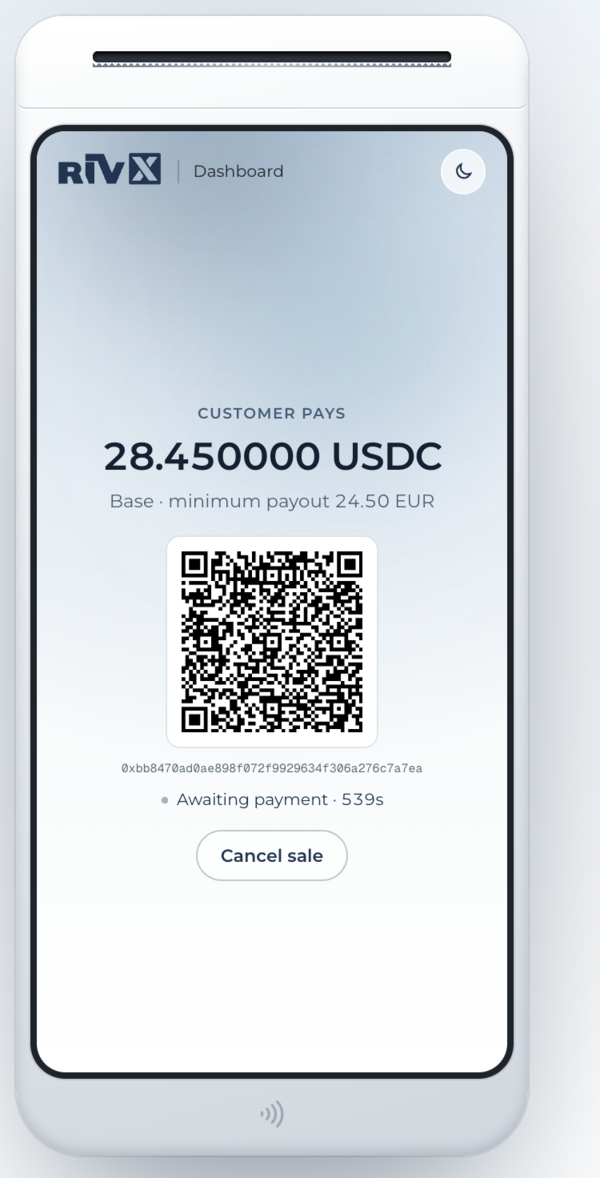
This marks the first commercial use of the solution developed for crypto-to-fiat exchange services authorized by Consob, in consultation with the Bank of Italy, under the European MiCAR regulation.
A British tourist walks into a pastry shop in Milan, orders a cappuccino and a croissant, and pays with his credit card: the merchant receives euros, while the British customer pays from his account in pounds sterling. Nothing new. Nothing unusual. An everyday transaction. Well, now the same thing is possible using stablecoins, provided you have the right tool.
The first transaction of this kind was completed in Italy, in Brescia, just a few days ago: a luxury watch, which according to BeBeez sources has a list price of €60,000, was purchased by a customer at the historic Gioielleria Fasoli, in Piazza della Loggia. The customer paid in USDC, a stablecoin cryptocurrency whose value is pegged 1:1 to the US dollar, using funds from their cryptocurrency wallet. At the end of the process, Fasoli received traditional currency directly into its bank account.
This marks the first commercial use of RIV-X, the crypto-asset exchange service for funds designed for merchants and developed by Italy’s RIV Digital srl, a subsidiary of RIV Capital Group, an investment holding company headquartered in Luxembourg with offices in Dubai, founded by Roberto Rivera. Last June, RIV Digital received authorization from Consob, following consultation with the Bank of Italy, to operate as a Crypto-Asset Service Provider (CASP) under the European MiCAR regulation (see here a previous BeBeez article). The software component of RIV-X is developed by RIV-Technologies, another group company, which is not a party to the exchange transaction but acts solely as a technology provider (see the press release).
Returning to the transaction, Gioielleria Fasoli accepted a payment in USDC, which it subsequently sold to RIV Digital through the RIV-X system. RIV Digital, in turn, purchased the USDC in its own name and on its own account, and transferred the equivalent amount in euros to the jewelry store’s bank account.
The service is designed for merchants who, in the course of their business, repeatedly encounter situations in which customers would like to transact in stablecoins, but the merchants themselves do not wish to hold those assets. By using RIV-X, these businesses can exchange stablecoins for euros easily, dealing with an authorized and supervised counterparty. This is precisely the case of Gioielleria Fasoli.
Founded in 1946, Fasoli is located in the heart of Brescia and is a well-established retailer of high-end watches. However, particularly in the luxury goods market, which also serves an international clientele, merchants may find themselves holding stablecoins, with all the associated implications and complications. They therefore need to exchange them immediately for euros through an authorized operator, in compliance with customer identification, transaction traceability and anti-money laundering requirements. This explains Fasoli’s decision to adopt RIV-X.
Alvise Di Stefano, CEO of RIV Digital, commented: “With this first transaction, we are launching RIV-X, our exchange product designed to support merchants. Technology alone is not enough: clear rules and appropriate safeguards are essential. A merchant who, without RIV-X, would find themselves holding stablecoins as part of their business can now exchange them for euros with an operator authorized under MiCAR, acting as a direct counterparty and applying the controls required by regulation.”
In essence, RIV-X can establish a genuine bridge between users’ digital wallets and merchants’ bank accounts, operating under MiCAR and within strictly defined regulatory boundaries.
As Guido Rocco, COO of RIV Technologies, explained to BeBeez in an interview published on March 30 as part of the Digital Finance Files by RIV series, the group’s role is that of a technology enabler: “We aim to act as a tech enabler to foster convergence between traditional finance and decentralized finance. It is a topic that is widely discussed, but which remains only partially explored in terms of concrete use cases.”
The RIV group is pursuing a strategy that combines technological infrastructure, digital instruments and regulated services to establish a connection between traditional finance and decentralized finance. Its activities are organized through several corporate entities, each operating within its respective regulatory framework. The technology component includes the development of tokenization systems, digital wallets and tools for integrating digital assets with financial services. Specifically, as mentioned, the RIV-X exchange service is provided by RIV Digital in its capacity as an authorized crypto-asset service provider.
On the regulatory front, RIV Digital obtained authorization on June 10, through Consob Resolution No. 24030, to operate as a crypto-asset service provider under MiCAR, EU Regulation 2023/1114 (see here a previous BeBeez article).
The authorization followed a review conducted by Consob, in consultation with the Bank of Italy on matters falling within the latter’s jurisdiction. It covers three categories of services: exchange of crypto-assets for funds, exchange of crypto-assets for other crypto-assets, and placing of crypto-assets. RIV-X falls within the first category: RIV Digital purchases stablecoins from merchants in its own name and on its own account, paying the corresponding amount in euros.
CASP authorization is important because it allows operators to provide the regulated services covered by their authorization in a market that, as of July 1, 2026, completed the transition in Italy from the previous national Virtual Asset Service Provider (VASP) regime to the European framework. RIV Digital was already registered in the VASP register maintained by the Organismo Agenti e Mediatori (OAM), Italy’s register of financial agents and credit intermediaries, but was required to comply with the new European regulatory requirements.
In a joint statement published on June 30, Consob and the Bank of Italy identified RIV Digital as one of eight operators authorized in Italy as CASPs, alongside one banking intermediary that had submitted the notification required to provide crypto-asset services. Authorized entities are entered in the European register maintained by ESMA and may extend their authorized services to other EU member states through the so-called European passporting regime, subject to the applicable procedures.
And it is precisely European passporting that gives RIV-X a reach extending well beyond the Brescia transaction. Thanks to this mechanism, the model successfully implemented by Fasoli can be offered to merchants in other European Union countries, once the procedures required under MiCAR have been completed.


