

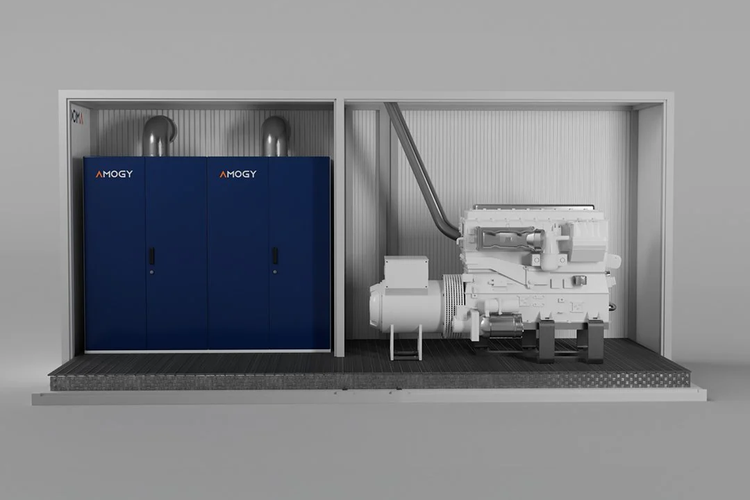
Hydrogen-cracking firm Amogy and German energy company 2G Energy have completed an ammonia-to-power test at Amogy’s Houston facility to evaluate the technology’s capacity to power data center infrastructure.

Are ammonia-to-power systems poised to power the data center sector?
The companies tested their AMMDrive solution, which pairs Amogy’s ammonia reformer with a 2G Agenitor 412 reciprocating engine-generator set. According to the partners, the unit is designed to generate power via either natural gas or ammonia, which they claim can support data centers in addressing immediate power needs while supporting longer-term decarbonization goals.
The companies said that during testing, Amogy’s reformer converted ammonia into a hydrogen-rich reformate fuel stream, which fueled the 2G engine to generate electricity at commercially viable levels.
According to the firms, the unit’s modular architecture would permit phased capacity expansion, which they claim will align power availability with the development of data center builds.
“This successful test is an important proof point for Amogy’s ammonia-to-power platform and for customers seeking flexible, reliable power,” said Seonghoon Woo, CEO of Amogy. “Customers need solutions that can meet today’s power constraints without limiting future opportunities. By integrating our reformer with 2G’s engine technology, we’re giving customers a practical way to meet immediate power needs while creating a pathway to incorporate ammonia to support longer-term decarbonization strategies.”
Following the tests, the partners will now seek to optimize the integration of the two technologies for future deployments.
“This collaboration demonstrates the adaptability of 2G’s engine platform and its ability to support a broad range of fuel pathways, including ammonia-derived hydrogen,” said Pablo Hofelich, CEO of 2G Energy. “Our modular engine technology is designed to deliver reliable power while adapting to evolving customer requirements. Together with Amogy, we’re expanding the potential for practical, fuel-flexible, lower-carbon power solutions across a range of commercial applications.”
2G is headquartered in Heek, Germany, and was founded in 1995. The company develops, produces, and installs CHP, large heat pumps, and peak-load gensets. In May, the firm reported that it had received an order to supply containerized power plants to data centers in North America.
Brooklyn-based Amogy has earmarked the data center sector as a crucial offtaker for its technology. For example, last year the company partnered with UK-based firm Kinetics, a subsidiary of Turkish firm Karpowerships, to develop integrated offshore platforms that combine power generation and data center infrastructure.
The company also has partnered with the Agency for Science, Technology, and Research (A*Star), a Singaporean public sector R&D agency, to explore the potential of ammonia-based technologies in powering the city-state’s data center sector.
Ammonia cracking is a chemical process that utilizes heat and a catalyst to break down ammonia into hydrogen and nitrogen. The hydrogen produced by the reaction can then be fed into fuel cells, blended with conventional fuels, or purified for industrial use. Proponents consider it one of the most efficient ways to transport and supply hydrogen energy.
However, the technology faces several challenges, namely its significant energy requirements, limited catalyst performance, and the risk of producing hydrogen that falls short of the purity required for sensitive applications.
There has not been much movement in the use of ammonia cracking technology within the data center sector as of yet. Back in 2022, Fujitsu said that it was possible that data centers in the future could be powered by ammonia, with the company reportedly working on a cleaner method to manufacture the caustic gas required for the cracking process.




Read the orginal article: https://www.datacenterdynamics.com/en/news/amogy-2g-energy-test-ammonia-to-power-system-for-data-center-use/


