

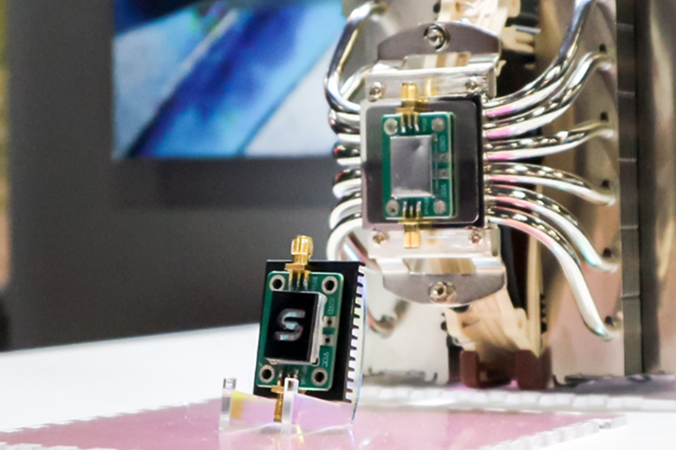

The year is 2023, and DCD is sitting across from Joshua Western, CEO of Space Forge, at the Space Wales booth at the Space-Comm conference, then still held in Farnborough. We’ve been directed to the powwow with the up-and-coming executive, who has just started integrating his company-branded jacket into his look – like a Jensen Huang of the stars.
You get your fill of cranks and kooks in this business, and Western, a composed and charismatic speaker, is giving neither, as he describes his company’s vision for making chip materials in orbit.
Doubtless, some of the numbers talked about, especially the earlier ones, won’t add up. Western casually mentions a 10-100 times improvement in semiconductor performance in 2023, a projection he seems to have stopped repeating in more recent years. But the idea of manufacturing semiconductor crystals in space remains an alluring prospect, and one that could soon become a reality.
Heating up in the Cold War
It was amid the hottest years of the Cold War when humanity first sought to grow crystal structures in the microgravity of space. The Skylab missions, conducted between 1973-1979, constituted some of NASA’s standout achievements in science, undertaking almost 300 discrete experiments at the cutting edge of physics, astronomy, life, and material sciences. It was aboard Skylab IV on January 24, 1974, that silver crystals were grown at one-gram and five-gram sizes through electrochemical reaction in orbit.

Building the chips to power quantum computers
Keenly observed by Col. Gerald Carr, commander of the Skylab IV mission, these spaceborne crystals possessed a more perfect microcrystalline structure, unlike Earth and centrifuge-grown alternatives. Carr was the first rookie astronaut to command a NASA mission since Neil Armstrong, and would go on to lend his enthusiastic support to ensuing research on the topic.
The experiment heralded the discovery of the deposition behaviors, convective currents, and buoyancy of forming crystals in microgravity, which were observed to result in a greater uniformity of size and structure. The report, published in 1976, spoke of the “uses for massive single crystals of semiconductors and optical materials,” though concluded that such science was “beyond the scope of the present study.”
This is the research often cited by Space Forge, recipient of Britain’s largest-ever Series A raise in spacetech, £22.6 million ($30.5m), led by the NATO Innovation Fund, including the World Fund, and the British Business Bank. Its first manufacturing satellite, ForgeStar-1, launched on June 23, 2025, and has since reported a number of successful milestones, including the successful generation of plasma in December that year.
Pressed on the feasibility of a semiconductor supply chain complemented with space crystals, company executives remind us that the science has been done.
“Since the 1970s and 1980s, there have been well over a hundred documented experiments conducted by US, Russian, European, and Chinese programs,” Dr. Andrew Griffiths, lead chemical vapor deposition engineer at Space Forge, tells DCD in 2026. So it must be easy, then?
The science of in-space manufacturing
In-space manufacturing is inarguably bleeding-edge. In the chaotic environment of space, even the simplest processes require engineering many times more elaborate and fault-tolerant than those on Earth.
The physics behind in-space manufacturing targeting crystal growth dictates that crystal formation in microgravity possesses a greater uniformity of size and structure, resulting in a “purer” crystal. When returned to Earth, these crystals seed about ten generations of new terrestrial crystals of superior quality. At the UK In-Orbit Servicing, Assembly, and Manufacturing conference 2025 in Belfast, Space Forge CEO Joshua Western extrapolated that this math could translate into “roughly 100 million chips per flight.”
“The impact space manufacturing has on compound semiconductors can sometimes garner a three-, four-, or even a five-fold improvement in the purity of the crystal, specifically the dislocation density – how well that crystal fits together,” Western told ISAM 2025. “The chips these semiconductors compose represent up to a 60 percent reduction in size, weight, and power constraints even at the end-system application.”
The delightful simplicity of it all almost borders on the Muskian.
Dave Barnhart, CEO and co-founder of Arkisys Inc., another in-space services company, agrees manufacturing sits on the more long-term end of orbital technologies, defining it as “still in its nascent experimental phase.” He defines the question as one of identifying which industries are looking for access to the extreme physics of space.
“The most realistic near-term beneficiaries are biological and pharmaceutical industries, where microgravity enables novel crystal growth, cell culture formation, and protein structuring that cannot be replicated on Earth,” he admits.
Indeed, space pharma specialist Varda has closed $329 million in total capital, including the participation of billionaire Peter Thiel, of PayPal and Palantir fame. Another, Orbital Medicine, has closed $270m in pursuit of these miraculous space crystals.
As eye-popping as the science sounds when translated into investor-speak, money talks. These unlikely initial steps may well upend the economics of materials science sooner than we think.
By their admission, Space Forge isn’t chasing the AI hype cycle to compete with Silicon CMOS, which they describe as extremely mature, and where process scaling, not crystal purity, matters.
“Where space manufacturing becomes genuinely disruptive is in compound and wide-bandgap semiconductors, where material purity still places hard limits on performance,” says Dr. Griffiths. “Space-grown crystals offer a step-change opportunity here. Even small volumes of ultra-high-quality material, like diamond, can have a huge impact because of its unmatched thermal properties.”
How does it get back down?
Much of the space economy contends with the bottleneck of logistics. While launch shortages are a conversation in their own right, the limitations of bringing things back down to Earth safely are even more strict.
“The major limiting factor [in space manufacturing] is downmass capability,” Barnhart says. “Today, downmass is limited to kilograms, with unresolved challenges around safe re-entry, landing, and cost. Until downmass capacity increases by an order of magnitude, high-volume orbital manufacturing will remain constrained.”
Luckily, the space crystals game is one of low quantity and high quality. The companies downmassing their quarry enlist heat-shielded capsules, some of them deploying cost-effective inflatable designs to mitigate the single-use cost. The near future may see this phase addressed by spaceplanes like Sierra Space’s Dream Chaser, but these are not yet ready to fly out of the Earth’s atmosphere.
Space Forge employs the Pridwen system, a novel heat shield named for the legendary shield of King Arthur, which radiates away the heat it accumulates instead of standard ablation techniques, and has seen microgravity testing aboard a parabolic flight.
That’s no moon. It’s a space factory
On December 31, Space Forge reported ForgeStar had successfully demonstrated autonomous plasma generation in orbit using a microwave plasma-enhanced chemical vapour deposition (CVD) system. This feat required fine control of microwave power, gas flow, chamber pressure, timing, exhaust, and replenishment, determined by an onboard computer and software managed by a payload controller.
“While striking plasma may sound simple in principle, doing so reliably inside a satellite is anything but,” Dr. Griffiths says. “Rather than sending long command sequences, we send high-level instructions – ‘run this specific program’ – and the satellite executes autonomously, returning diagnostic data on the next communication pass. This is important because it demonstrates maturity. This wasn’t just a lab experiment; it was a complete miniature factory in space, powered by solar arrays and batteries, capable of generating semiconductor-grade controlled microwave plasma in orbit – without human intervention.”

The company expects to bring its space crystals earthside later in 2026, releasing Pridwen during a scheduled pass following the conclusion of objective eight of the ForgeStar mission, underway at the time of writing. It hasn’t, however, promised working semiconductor prototypes in 2026.
When asked if Space Forge foresaw installing this operation into one of the upcoming commercial space stations like Axiom Station, Starlab, or Orbital Reef, the company stated its long-term vision is that of a dedicated orbital factory capable of accepting raw materials and churning out finished wafers for export without the need to accommodate the countless disadvantages of human presence that have long plagued industry.
Arkisys cites a similar goal in the establishment of their ‘Ports’ – uncrewed service-focused depots for any orbit or planet the customer desires. By 2030, the company expects to field a full station with three to five Port Modules, supporting a 90-day operational cadence and serving multiple orbital transfer vehicles (OTVs)
“Commercial viability will be proven not by demonstrations alone, but by the first sustained customer handoffs and service operations on a commercial platform, the moment when servicing becomes routine rather than experimental,” Barnhart says.
Both projects are some of the more advanced demonstrations of the technologies behind the fabled in-space economy, in which space drones zip between satellites and space stations, performing rendezvous, docking, refuelling, repositioning, and repair.
Arkisys’ Barnhart agrees the barrier to this marvellous giga-future is logistical – if it becomes cheaper and quicker to get to and from orbit, servicing and upgrading satellites makes more sense than building and orbiting new ones.
“Over the next ten years, servicing and logistics will mature; more speculative concepts, such as large-scale space industry cities, will remain in the realm of science fiction until much later in the century,” he says.
Fact and fiction
The razzle-dazzle of the space economy attracts frothy hype cycles. In 2015, the Obama administration in the US signed into law the US Commercial Space Launch Competitiveness Act, which, among other things, legalized the capacity for American companies to mine space resources. This bizarrely ambitious act of legislation convinced many that the nation was poised to import all manner of intergalactic treasures.
Start-ups Planetary Resources, Deep Space Industries, Offworld, and Kleos Space all boomed to life in the 2010s, but those that still exist 16 years later are quietly pivoting to technologies the market is buying, like propulsion. Time will tell how much of the in-orbit economy repeats this history.
The recent fad for space-based data centers certainly strikes a familiar refrain.
“[It’s] driven by two perceived advantages: abundant solar energy and the cold vacuum of space,” Barnhart tells DCD. “While these assumptions are physically correct, they mask enormous engineering challenges.”
Unearthly influxes of extreme temperature have not historically been very well utilized by spacecraft, quite the opposite. What’s more, the notion that space is cold in some movies doesn’t easily translate to cooling electronics.
“In orbit, heat dissipation is extremely difficult because convection, the primary cooling mechanism on Earth, does not work in a vacuum. Effective cooling would require massive radiator systems, potentially kilometers in scale. Maintaining and stabilizing structures of that size introduces serious technical and operational risks,” Barnhart explains.
Power generation is also “non-trivial,” Barnhart says. With current solar cell efficiencies of 30 to 40 percent, the required solar arrays would span multiple football fields. Additionally, he says, “long-term sustainability is rarely addressed.” Barnhart explains: “Electronics in orbit face higher radiation levels, and unlike terrestrial data centers, failed components cannot be easily replaced by human technicians. These factors significantly complicate the cost-benefit equation.”
But it’s not just data centers techno-optimists are hoping to see in space, but semiconductor fabs themselves, a truly byzantine feat of engineering that is easily critiqued. This riotous enthusiasm has led to assumptions that Space Forge made semiconductors themselves, not the crystals that make them, a notion Dr Griffiths explains has “no benefit” in a world where massive fabs already exist.
“We’re targeting specific steps in the process that benefit from space conditions and integrating them back into terrestrial manufacturing,” he tells DCD. “From that perspective, a space-based supply chain is absolutely realistic.”
Sovereignty questions
As a recipient of the NATO Innovation Fund, Space Forge has long been considered a company producing dual-use technology, a perception that certainly extends to in-orbit services and OTV drones.
“Globally, China has already demonstrated strong interest and investment in in-space servicing, achieving several notable firsts,” Barnhart remarks. “BRICS nations are also exploring these technologies as they recognize that servicing and logistics will be foundational to future space economies.”
He recommends governments start supporting the sector with service-based contracts for satellite refueling, transfer, and other logistics to give investors confidence in the technologies.
As for Space Forge, the company’s focus is now on building capability in space-enabled materials manufacturing. They are laid-back about whether this progress is sustained as an independent company or is acquired to continue as part of a larger commercial ecosystem.
“We are waiting with bated breath for the delayed defence plans. The backing and support of the NATO Innovation Fund for Space Forge is a testament to the criticality and need for what we are building,” reports Dr. Ed Smith, head of materials research at Space Forge.
More in Space






Read the orginal article: https://www.datacenterdynamics.com/en/analysis/can-you-really-make-chips-in-space/


