

Groove Quantum, a Delft-based quantum computing startup developing scalable germanium spin-qubit processors, has raised €16 million in combined funding and unveiled an 18-qubit semiconductor spin-qubit processor, which the company says is the largest of its kind ever built.
The round includes €10 million in equity co-led by Innovation Industries and 55 North, with participation from Verve Ventures and the European Innovation Council Fund. The remaining €6 million comes through grants from the EIC Accelerator programme and the EU Chips Act funding programme.
“Quantum computing will only have real impact if it can be engineered and manufactured at scale. With this funding and our 18-qubit prototype, we’ve shown that semiconductor spin qubits are not just a promising idea. They are ready to scale rapidly, and we believe our approach gives us the best shot at reaching the million-qubit systems that will change the world.
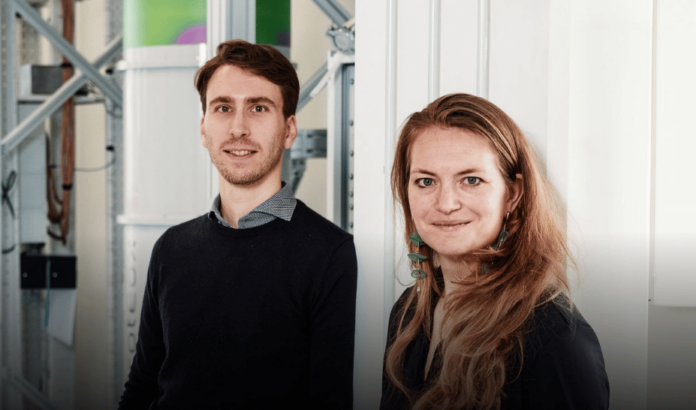
“We are building technology to be produced and deployed at global commercial scale, just as every substantial semiconductor technology before us,” says Dr Anne-Marije Zwerver, CEO and Co-founder of Groove Quantum.
A quick analysis of 2026 activity shows several comparable quantum and adjacent DeepTech funding announcements alongside Groove Quantum’s €16 million raise.
- Delft-based Orange Quantum Systems / OrangeQS raised €15 million to scale quantum chip testing infrastructure, making it the most directly comparable example by both geography and sector, as it is also based in Delft, Netherlands.
- Dublin-based Equal1 closed a €51 million round to scale silicon-based quantum computing
- Espoo-based IQM Quantum Computers secured €50 million to support quantum technology development and market expansion.
In adjacent quantum-enabling hardware:
- Münster-based Pixel Photonics raised €13.5 million to accelerate market entry for superconducting single-photon detector technology
- Lausanne-based Rhonexum raised €867.5k to advance cryogenic electronics for scalable quantum computing
- Tampere-based Vexlum raised €10 million to scale semiconductor laser manufacturing for quantum and space applications.
- Paris- and Boston-based Alice & Bob also secured €3.4 million for quantum computing work linked to rare-earth-free magnets
- Leeds-based Optalysys raised €26.4 million to commercialise photonic chip technology.
Together, these EU-Startups 2026 announcements represent over €170 million in disclosed funding.
The same-country comparison is particularly clear in Delft, where OrangeQS is also developing infrastructure for quantum chip development and validation. Larger rounds for Equal1 and IQM Quantum Computers indicate continued investor attention on scalable quantum computing platforms, while smaller specialist financings for Rhonexum, Pixel Photonics and Vexlum point to funding for enabling hardware.
Groove’s germanium spin-qubit approach therefore fits into a broader European funding picture focused not only on quantum computing systems, but also on the industrial infrastructure required to test, manufacture and scale them.
“The quantum industry remains in its early innings, focusing on short term monetisation opportunities for very specific use-cases. Groove has the potential to leapfrog the competition, scaling quantum computing to the level where it unlocks meaningful real-world applications across health, energy, security and beyond,” adds Vincent Kamphorst, Investment Director at Innovation Industries.
Founded in 2024 as a QuTech spin-out, Groove Quantum is led by Dr Anne-Marije Zwerver and Dr Nico Hendrickx. Zwerver previously pioneered the first quantum dot qubits manufactured in Intel’s industrial cleanroom, while Hendrickx is an innovator in germanium quantum computing and the primary architect behind Groove’s foundational technology.
The company builds on research by Prof Menno Veldhorst, Dr Giordano Scappucci, and Prof Lieven Vandersypen, who remain involved as Scientific Advisors.
Groove is targeting one of quantum computing’s central bottlenecks: scalability. Quantum computers could eventually help solve complex problems that are impractical for even the most powerful classical supercomputers, including drug discovery and advanced materials design for renewable energy.
However, reaching that point will require systems with very large numbers of reliable qubits.
The company’s approach is based on germanium, a semiconductor material that Groove says offers a practical middle ground for quantum hardware. Its qubits are large enough to be controlled and connected reliably, yet small enough, at a few hundred nanometres, to be densely packed together on a chip.
The architecture is also designed to be extendible, using repeatable unit cells that can be operated in parallel and tiled into larger systems.
A key part of Groove’s strategy is compatibility with CMOS semiconductor manufacturing, the same industrial foundation used to produce modern CPUs and GPUs. This could allow the company to use existing chip infrastructure and established semiconductor foundries, rather than relying on specialised production routes. According to Groove, this gives its platform a route towards industrial-grade quantum processor manufacturing.
The newly demonstrated 18-qubit processor marks a step beyond small laboratory prototypes. Groove says the milestone was achieved in under two years and at a fraction of the expected cost.
With the new funding, the startup plans to scale from 18 to 100 qubits by developing a unit cell containing the architectural elements needed for further exponential scaling.
“Groove’s founders are globally recognised leaders in spin-qubit research. Their contributions have shaped the field and laid the groundwork for scalable semiconductor quantum processors. We see Groove as uniquely positioned to translate world-class science into manufacturable hardware at the speed and scale necessary to capture quantum computing’s commercial promise,” adds Kai M Hudek, Partner at 55 North.
The funding will also support team expansion and the start of industrial-grade manufacturing at leading semiconductor foundries. For Groove, the goal is to align quantum computing development with one of the world’s most mature and scalable manufacturing ecosystems.
The startup is entering the market at a time when different quantum hardware approaches are competing to overcome scale, fidelity, and manufacturing challenges.
Superconducting qubits, trapped ions, and silicon-based spin qubits each offer different advantages, but Groove is betting that germanium can combine reliable control with compact design and industrial compatibility.


