

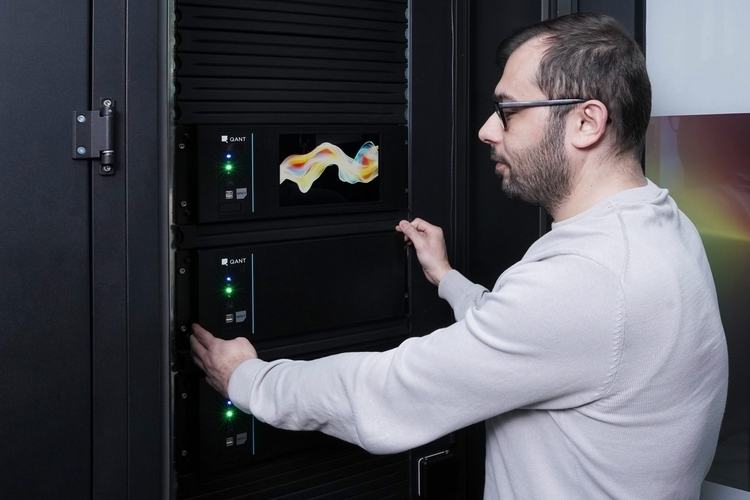
Photonic chip company Q.ANT has deployed its second-generation photonic processors at the Leibniz Supercomputing Center (LRZ) in Stuttgart, Germany.
The project is funded by the German Federal Ministry of Research, Technology, and Space and will support research into hybrid digital-analog architectures for future HPC environments.

Q.ANT first announced plans to deliver its Native Processing Units (NPUs) to LRZ in July 2025, stating at the time that the move would represent the first-ever deployment of an analog photonic co-processor in a live HPC environment.
Building on its first-generation deployment at LRZ, Q.ANT said its second-generation NPUs deliver higher computational throughput and improved energy efficiency. The hardware is installed via standard PCIe interfaces, and the processors integrate into existing HPC systems, allowing them to operate alongside CPUs and GPUs under AI and scientific simulation workloads.
LRZ is using the Q.ANT NPUs to establish new benchmarks and use cases for applications such as climate modeling, real-time medical imaging, or materials simulation for fusion research. In evaluations already undertaken at LRZ, Q.ANT’s second-generation architecture has already demonstrated “significant improvements” over its first-generation NPUs, the company said. This includes more than 50x higher throughput of matrix multiplications and 6x lower energy consumption for typical workloads.
“Adding more digital hardware no longer solves the compute scaling problem in AI,” said Dr. Michael Förtsch, CEO of Q.ANT. “If we continue to scale with brute-force transistor logic, we simply turn electricity into heat. At LRZ, we’re proving that light-based co-processing can integrate with today’s infrastructure and deliver measurable efficiency gains under real workloads. This is how AI can continue to scale without scaling its energy footprint.”
Prof. Dr. Dieter Kranzlmüller, chairman of the board of directors of LRZ, added: “This deployment highlights the technological progress from the first to the second generation of Q.ANT’s processors. Our evaluation is conducted under real production workloads and operational requirements. Photonic co-processing represents a promising approach to addressing the performance and energy challenges increasingly defining modern high-performance computing.”
Based in Stuttgart, Germany, and founded in 2018 as a spin-off from industrial firm TRUMPF, Q.ANT has been developing photonic chips built on Thin-Film Lithium Niobate (TFLN). The processors work by executing mathematical operations directly in the optical domain using photonic integrated circuits, which Q.ANT says eliminates on-chip heat generation and cooling requirements.
In July 2025, the company raised €62 million ($72m) in a Series A funding round co-led by Cherry Ventures, UVC Partners, and imec.xpand.






Read the orginal article: https://www.datacenterdynamics.com/en/news/photonic-chip-company-qant-deploys-second-gen-photonic-processors-at-germanys-lrz/


