


Kevin O’Leary is a man who wears many hats. Not content with taking the world of TV by storm on hit US show Shark Tank, the businessman and investor now has his sights on silver screen stardom, playing alongside Timothée Chalamet in the recent movie Marty Supreme.

The small nuclear revolution coming for data centers
O’Leary assumes the role of wealthy businessman Milton Rockwell in the film, which sees Chalamet’s character embark on a self-destructive journey to table tennis glory, and has already garnered a slew of positive reviews since its release during the Christmas holiday season.
Whether it will be the start of a long and glorious film career for O’Leary remains to be seen (“the writers told me ‘we need a real asshole, and you’re it’,” he revealed to TMZ in a recent interview about how he landed the role), but away from the world of showbiz, the man known as Mr Wonderful has plenty of other interests, one of which is data centers.
O’Leary is an investor in Bitzero, the Canadian cryptominer now turning its hand to AI and High-Performance Computing (HPC), which recently went public in a bid to boost its expansion plans.
“The value of what Bitzero has has risen dramatically, and I think over time the market will recognize that,” O’Leary says.
A Bit of alright
Founded in 2021, Vancouver-based Bitzero operates data centers around the world, and claims to select locations based on their cool climate so as to cut the carbon footprint of its servers.
Its Norway 1 facility, in Namsskogan, Norway, offers 40MW capacity across 14,000 cryptomining rigs. Bitzero says this is currently being expanded to 110MW. It has also leased a 5MW site in nearby Røyrvik, known as Norway 2.
In Finland, Bitzero is operating out of a facility in Kokemäki, which offers 10MW. In December, it broke ground on a 100-acre expansion of the site, which could eventually take its capacity up to 1GW.
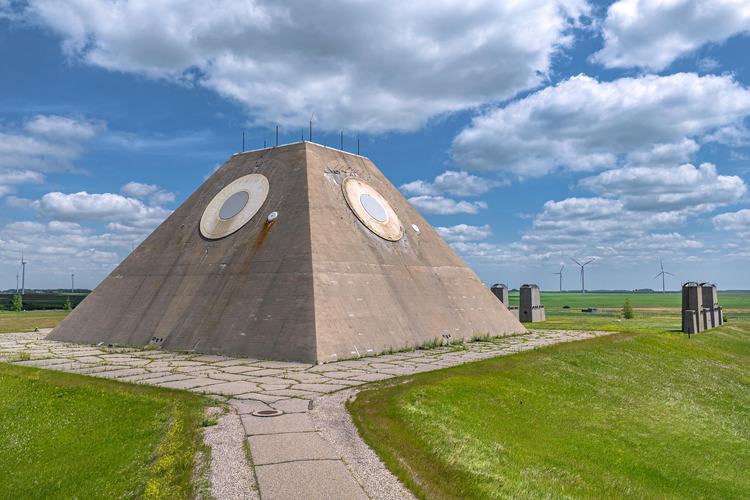
Meanwhile, in North Dakota, US, the company purchased a former missile base, the Stanley R. Mickelsen Safeguard Complex at Nekoma, commonly known as “The Pyramid,” in 2022, and now runs a 2.5MW data center on the site, with 30MW of capacity “prepped for rapid deployment.” The 184-acre site could eventually offer up to 300MW.

CEO and president Mo Bakhashwain is a crypto consultant with a background in real estate, and says he started the company because he “wanted to connect the tangibility of real estate with the upside of crypto.”
At its Scandinavian sites, the firm benefits from the region’s plentiful low-carbon power, with both its Norway sites served predominantly by hydro power, and the Finnish facility taking advantage of a mix of hydro, nuclear, solar, and wind energy. The picture is less green in the US, where Bitzero says it will deploy a mixture of wind, natural gas, and grid power in North Dakota.
Nonetheless, the firm says it has the power secured and available to deliver large campuses in Europe, and that it can do this at a low price, so it’s no surprise it is looking to take advantage of the seemingly insatiable demand for AI-ready compute. The crypto-to-AI pivot (covered in-depth in DCD Magazine #55) is a well-trodden path at this point, but unlike erstwhile rivals CoreWeave and Iren, which have abandoned Bitcoin entirely in favor of AI, Bitzero intends to try and marry the two worlds.
“We see a really big opportunity in HPC,” Bakhashwain says. “We have a great engineering team, the same people who have worked with Microsoft and [neocloud] Nscale on their deployments in Norway, so we have the expertise to deliver what the industry needs, as well as the power and land.”
But, he says, his firm “is not going to neglect Bitcoin mining,” explaining: “We’re hoping to get the best of both worlds – the long-term, investment grade, cash flows from HPC and AI, while having exposure to the speculative upside of Bitcoin. I don’t actually see [Bitcoin] as speculative, because if you study the network enough, you realize it usually evens out from a return-on-cash point of view.”
Many would agree with Bakhashwain’s initial assessment of the unpredictable nature of Bitcoin, but the fact remains big money can potentially be made from cryptocurrencies, and the combination with AI is likely to be an alluring one for investors. Bitzero has already garnered more than $100 million (“we’ve spent it on hard infrastructure,” Bakhashwain says) from private backers, including O’Leary, and listed on the Canadian Stock Exchange in December to try and boost its coffers.
Bakhashwain says Bitzero is targeting the hyperscalers and potential “sovereign AI deployments” as end users for its AI data centers, but is coy about how far discussions have progressed with future customers. He argues that the combination of AI and cryptomining can have an environmental benefit, with power dedicated to crypto rigs that can be redirected for use as backup power for AI servers in the event of an outage.
“Backup power is needed in any AI compute cluster or traditional data center,” he says. “This is a minimum of 30 percent, so why pay for 30 percent idle energy when you can cover the costs by using it to mine Bitcoin. I would call it an ESG play, because the mining helps not waste energy that is already reserved and paid for as redundancy.”
For his part, O’Leary initially invested in Bitzero as part of a wider interest in cryptocurrencies, but tells DCD his view on what the company can offer has changed in light of the AI boom and the impact this has had on the data center market.
He says: “I don’t really consider it a Bitcoin miner anymore, I consider it a real estate power company. What it has is sub-six cents per kWh power, with land, permits, and water, which is something that’s incredibly hard to find anywhere in the world.”
Wonderland
O’Leary’s data center interests extend beyond Bitzero. His firm, O’Leary Ventures, has partnered with the Municipal District of Greenview to build an off-grid natural gas and geothermal project that will power an undisclosed AI data center in Alberta, Canada.
Dubbed “Wonder Valley,” it is hoped the project will provide an initial 1.4GW of power, rising to 7.5GW in a five-to-ten-year period. Since this interview was conducted, O’Leary’s company has proposed a second Wonder Valley, in Utah, US, which would be powered by natural gas. This could also eventually reach 7.5GW in capacity, according to the ambitious plans.
But in other areas, he is skeptical that many of the large data center projects announced over recent months will come to fruition, despite the hefty returns investors who back digital infrastructure schemes can reap.
“I’m involved in investing in many different jurisdictions around building data centers, and I’ve had a chance to meet with many state governors in the US and Canada,” O’Leary says. “I’ve been a real estate investor my whole life, and right now the returns are penciling out at anywhere from 14-20 percent on data centers. But the scarcity of power is causing a major problem.
“When you go and look at opportunities in the US, I would say 50 percent or more of the data centers that have been announced won’t be built because there is no power on the grid.”
Local opposition to data centers, and the power infrastructure required to run them, is likely to hamper any efforts to improve this situation, O’Leary argues.
“Data center is now a dirty word in every township and city in America,” he says. “The reason is simple, because every time you propose a capex expansion on the grid, you’re talking about a 12-30 percent increase in electricity costs for the local hospital, library, or care home. The chance of that being approved is zero.”
Many developers are turning to natural gas as a way to access the power they need, but are running into difficulties sourcing turbines, with waiting lists for new machines running to several years. Accessing stranded natural gas is also an expensive business, O’Leary says, even though it’s something America has in abundance. “You’re talking about $2 billion to get a gigawatt set up,” he says. “And that’s even if you can get a contract on a pipeline somewhere. That’s why many of these sites are collapsing under the burden of getting financed.”
Though some in the sector tout nuclear energy as the answer to this problem, O’Leary does not expect to see new reactors popping up across the US. “Maybe that’ll work in 20 years if you can get a permit for it,” he says. “Find me one township in America that wants a nuclear facility, large or small, in its backyard? I love all this stuff, but I also live in reality.”
For O’Leary, part of this reality is that AI is here to stay. Recent months have been characterized by stories about the AI bubble being on the verge of bursting, with companies including GPU giant Nvidia and ChatGPT-maker OpenAI signing a series of what appear to be circular deals.
These agreements have caused concerns in the financial markets, most notably from Michael Burry of ‘The Big Short’ fame, who says he is shorting Nvidia because the company’s accounting of stock-based compensation was inaccurate and that the AI market was in a bubble. Nvidia denied these claims in a note sent to analysts.
O’Leary does not share Burry’s concerns. “There’s an error in the thinking that draws an analogy between what’s happening now and the early days of the Internet in the 1990s, when Pets.com and all that crap came and went,” he says. Amazon-backed online pet shop Pets.com was one of the highest-profile victims of the dotcom bubble, going into liquidation in November 2000, just nine months after an IPO that raised $82.5 million.
What’s different about AI is that “all 11 sectors of the economy are using it for margin enhancement and productivity gains,” O’Leary says. He continues: “I don’t care if you’re in financial services, real estate, consumer, or pharma – every single one of these industries has a use case and is implementing AI models now.
“They’re not building AI themselves, they’re leasing the tools from the four or five behemoths who are spending billions setting up the infrastructure to develop it.”
O’Leary adds: “Even in my small portfolio, which is focused on content generation, AI expenditure is up about 40 percent a quarter right now. The demand for this stuff is insatiable.”



Read the orginal article: https://www.datacenterdynamics.com/en/analysis/shark-tanks-kevin-oleary-on-bitzero-data-centers-and-the-ai-revolution/


