

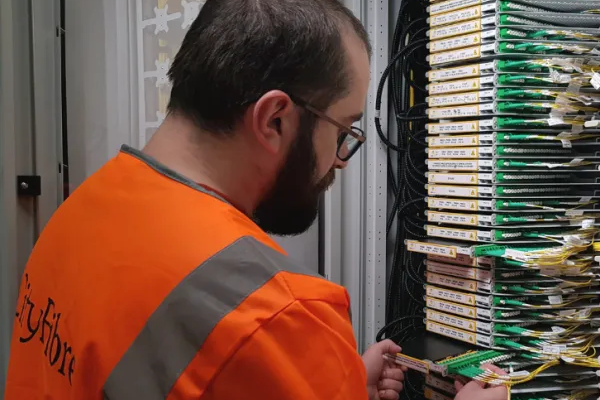
As the UK approaches the shutdown of its legacy copper communications network, thousands of telephone exchanges (also known as central offices) are also due to be closed. Led by BT and Openreach, the move is set to impact hundreds of communications providers and, in turn, their millions of end-user customers.
BT’s wholesale infrastructure subsidiary Openreach currently operates some 5,600 telephone exchanges across the UK; most of those are for copper and other legacy services, with the company operating its fiber service from around 1,000 newer exchanges, known as Openreach Handover Points (OHPs).
Openreach aims to close more than 100 legacy exchanges by December 2030, with a total of 4,600 closing by the early 2030s. Each exchange exit is expected to take four to seven years, depending on the size and complexity of each facility.

Issue 58 – The UK's copper switch off
How BT and Openreach are approaching the end of copper
The first of three pilot exchanges – in Deddington, Oxfordshire – closed in early December 2025. After some 26 months, around 1,800 copper lines were upgraded to fiber and now served and managed from the nearby Banbury exchange.
Openreach was set to close two more – Ballyclare in Northern Ireland and Kenton Road in London – the same month but pushed the shutdown date back after some ISPs had failed to migrate their customers in time.
Work to exit another 12 exchanges is due to start in April 2026. These include Staines, Thames Ditton, Baynard, Wraysbury, Nazeing, Langford, Allestree Park, Beacon, Childwall, Lundin Links, Carrickfergus, and Glengormley.
DCD has spoken to Openreach about the hows and whys and ins and outs of its campaign to exit these facilities, and looked at what might happen to these historic buildings once they’re no longer in use. But it’s also important to consider the hundreds of companies that offer services to millions of users from these sites, and how this mass migration will impact the nation’s Internet Service Providers (ISPs).
ISPs prepare for the great migration
Like any data center migration, each exchange exit is a multi-step process that involves multiple parties. Openreach is a wholesale B2B firm serving more than 600 communications companies, but leaves the migration of the end user customers (whether consumer or business) to the ISP (known as communications providers or CPs) it serves. The scale of the exit at each exchange will vary depending on the CP in question.
BT, via Openreach, has a near-total monopoly on exchanges within the UK, meaning the shutdown will have a major impact on hundreds of communications providers (CPs) across the UK. Customers using the firm’s wholesale line rental and Local Loop Unbundling services, both of which are copper-based, will need to move clients elsewhere, ideally to fiber offerings from remaining OHPs.
The move is designed in part to reduce BT’s overall costs – the company hasn’t shared how much it will be spending on the exchange exit program – but will likely lead to increased costs for many ISPs. While Openreach has offered incentives, CPs are on the hook for the costs of equipment relocation and reorganization of backhaul links, as well as dealing with customers.
Openreach has spoken to DCD about the efforts it is making with its CP customers – and some of the frustrations both sides can face during the exit process. But few operators were willing to comment on the copper network switch-off, and fewer still about efforts around exchange exits. Even BT itself largely declined to comment to DCD about its own ongoing efforts as an ISP to exit its own exchanges.
Vodafone, however, said it has “already made significant progress with our customers migrating to new fiber technologies.”
The telecoms firm told DCD in a statement: “We want BT to ensure that [its] copper network switch-off in early 2027 is carried out responsibly and comprehensively. It is vital that BT continues to work closely with broadband providers to support customers as that date draws closer.
It’s all about the customers
Zen is one of the original ISPs in the UK, launching back in 1995. Today, the company offers both copper services via Openreach infrastructure as well as fiber services via networks owned by Openreach, ITS, CityFibre, FreedomFibre, MS3, Sky, and Trooli. It doesn’t own any of its own fiber, opting instead for an aggregation model relying on partners’ infrastructure.
“We’re decades into that partnership [with BT/Openreach] now,” says Dean Burdon, service management Director at Zen Internet. “We’re multi-decade partners and have a great working relationship.”
Zen has points of presence in around 700 Openreach exchanges UK-wide. The company had unbundled and placed equipment in 400 exchanges by 2019, growing to 700 sites by late 2023. At the time of our conversation, the company said it had some 38,000 lines providing copper-based services.

Burdon notes that Openreach “played a big part” in the company’s network build-out program, and Zen has only started diversifing away from that in recent times through partnership with altnets, including CityFibre.
Zen also offers colocation services, providing space in its own core data center at its Sanbrook House HQ in Rochdale, Greater Manchester. Opened in 2012, a Sudlows case study suggests the facility was originally designed to host 270 racks across 1,350 sqm (14,531 sq ft) and offer 2MW of capacity.

The exchange exit program is closely tied to the UK’s copper-based Public Switched Telephone Network (PSTN) and Integrated Services Digital Network (ISDN) shutdown, which is scheduled for 2027. Between the 2027 switch off and exchange exits, Openreach will continue to provide copper services to ISPs from closing exchanges via interim metallic path facilities – copper-based services for providing broadband and voice services – and SOTAP, a copper broadband and IP voice service to replace ADSL in areas where fiber alternatives aren’t available.
“If you’re inside an ISP, I think you fully understand why it needs to be done,” says Burdon. “No network lasts forever. Copper has done a fantastic job for many decades, but I think all of us could see that its time was served. It was inevitable.”
Migration challenges for customers
For many ISPs, however, getting end-user customers to shift off copper-based connectivity and communication solutions has been a slow and challenging endeavor. Unless they are deemed critical, many companies may find themselves caught short and shut off if they haven’t migrated out of closing exchanges and off legacy copper solutions in time.
A 2024 Zen survey suggested that 44 percent of UK businesses didn’t yet have a fiber solution in place ahead of the 2027 switch off – with only 18 percent of small and 26 percent of large businesses having an all-IP solution at the time.
Zen’s Burdon says Zen is working to make sure the transition for customers is as “seamless” as possible, and much of the work is around the education aspect of why this is happening at all.
“A customer knows very little about it. To them, everything seems to work fine. Even though we’re switching off an entire network, the majority of the effort is in educating customers and businesses as to how it needs to happen. And you can’t underestimate how much effort that actually takes.”
He notes that the pushback of the PSTN switch-off – it was originally due to close in 2025 – means some businesses have more reluctant to bother making plans to switch, possibly in the belief the final day will never come. But that is now changing as the final shutdown dates approach.
“We’re still at the point where a business would tend to look at a drop-dead date as the last date that they need to do something,” he says. “We’re going through that education process with businesses, and getting them ahead of those dates so that they’re not impacted by any big spikes in migrations.”
“You’ll be amazed how many CTOs don’t know what’s on the end of those connections,” he adds. “This whole program is definitely some of that flushing out, and we’re having to step through with businesses to make sure that we’re their new circuits fit perfectly in their new network.”
ISPs like Zen often have to sit down with companies to map out what connections a company has and understand how they will be impacted by these shutdowns, which can take time. Burdon says the company works with a lot of airports, which throw up a lot of “interesting” connectivity pieces, but is “grateful” he doesn’t have to deal with some of the critical national infrastructure challenges BT might have to deal with more directly.
The consumer/residential migration might be a simpler move in terms of networks and endpoints, but ISPs have a duty of care not to leave vulnerable people disconnected, especially if they rely on that phone line for healthcare services, which can slow down switchovers.
Zen is still in the voluntary discussions phase with many companies, encouraging customers to move with the carrot of better services rather than the stick of non-voluntary termination dates. It is better to get businesses to want to act now rather than wait until the window is about to close.
“If the entire country doesn’t do anything until they drop dead, there will not be enough engineers in this country to deliver everything that needs to be delivered,” Burdon warns.
He is “very confident”, however, that the company is on the right path to a “clean, solid” path to migration, with actual migration work starting shortly at the time of our conversation.
Altnets look for alternative options
Despite not using copper services, some of the UK’s alternative network (altnet) providers – a collective term for upstart fiber firms attempting to compete with Openreach/BT and Virgin Media – have been vocal about Openreach’s exchange exits and how it might affect them.
As well as copper offerings, many exchanges offer Ethernet, dark fiber (DFX), and PIA (access to existing cable ducts and poles) solutions. Companies that aren’t using Openreach’s copper networks might still have fiber equipment in exchanges and use other Openreach infrastructure impacted by the exit program.

Many operators also use these facilities for backhaul to other locations and host network gear in the facilities’ white space, known as multi-user areas (MUAs). The 20 or so fiber-serving OHPs that are closing will see fiber services relocated to enduring exchanges, meaning equipment needs to be moved.
Many companies also rent duct and pole space from Openreach (a service known as Physical Infrastructure Access, or PIA) to save building out their own. Companies using this service may well have to re-route their fiber due to the closure of certain exchanges.
Neos Networks was willing to dig into the topic a little more with us. The company has been very vocal about the potential impact the copper switch-off could have on ISPs in the UK.
“Like a lot of connectivity providers, we rely on Openreach infrastructure,” says Matt Rees, chief technology & operating officer at Neos. “The exchange closure program will have a material impact on Neos and on our customers, many of whom have services terminating in closing sites.”
He said the company has unbundled more than 500 exchanges in order to deliver Ethernet, DIA, and optical services from the sites. The company also makes use of PIA, using Openreach poles, ducts, and other infrastructure. The SSE and Infracapital-owned company completed the unbundling (placing of its hardware) in those 500 exchanges in 2021, and at the time suggested it might expand to some 700 in the future.
Of the initial 108 exchanges, Neos has a presence in 65. The company has identified the impacted exchanges and will be running a proof-of-concept bulk migration with Openreach soon. The aim is to test both companies’ processes so that when the first phase begins in earnest, Neos can be sure it has a “refined approach that minimizes disruption for customers.”
“We’re now planning carefully how we migrate services to enduring exchanges with as little disruption as possible,” says Rees. “We serve thousands of customers, some with hundreds of circuits, so each will be impacted differently depending on the exchanges their services run through.”
He adds: “We don’t expect we’re the only provider they’ll face this issue with, which is why our focus is on putting customers first; creating clear rules and well-tested processes that make migrations as seamless as possible for our base. This is an industry-wide issue, and its impact will depend heavily on how well Openreach manages the process.”
A 2025 survey by Neos suggested re-routing networks due to exchange closures will cost impacted companies an average of £1.4m ($1.88m).
Rees says, however, that the figure was specific to altnets, but believes the true cost will be “significantly higher” across the wider industry.
“Openreach has put in place some measures to support the cost of moving customer services, but those measures do not address the cost to connectivity providers of having to re-engineer their networks,” he explains. “In many cases, the distance between enduring exchanges will be too great to maintain network integrity without upgrading hardware at neighboring sites, or even creating new midpoint locations at which to amplify. Those are substantial costs that fall outside the scope of Openreach’s current support model.”
Altnets plan ahead
CityFibre bills itself as the UK’s largest independent wholesale infrastructure platform. The company tells DCD that it has designed and built its network and fiber exchanges (FEXs) to operate independently of BT/Openreach’s network and exchanges.
The company told DCD it has “minimal equipment” in BT/Openreach exchanges. “Our main presence is some legacy acquired Internet services and recently acquired network assets, all of which are already being migrated into our own FEXs,” a company spokesperson said.

The company does, however, still rely on Openreach’s PIA service, using Openreach poles and ducts to run its own fiber. A CityFibre spokesperson said that the company only lays its own fiber ducts or erects poles if PIA is unsuitable or not available. They said this ‘PIA first’ approach helps the company build faster and minimizes disruption to the communities.
“Our direct exposure to BT/Openreach’s exchange exit program is low with any outlying impacts already being managed under ‘business as usual’,” the spokesperson said.
AllPointsFibre (APFN), another UK fiber altnet, tells DCD it has equipment in multiple Openreach exchanges, but was very selective in which sites it used.
“We were very aware of the migration challenge when we first engaged with Openreach exchange deployments, and hence we always planned only to install our equipment in the circa 1,000 enduring exchanges,” Ronan Kelly, APFN MD, says.
APFN was originally formed around 2023 through the consolidation of three Fern Trading-backed alternative broadband networks and ISPs: Giganet, Swish Fibre, and Jurassic Fibre. APFN last year launched its own wholesale fiber network that integrates Openreach, CityFibre, and APFN’s own infrastructure into a single platform.
Kelly notes the exchange exit is a “massive distraction” for some operators and that there is “no question” this is going to present challenges and require significant capital investment for many companies operating in non-enduring exchanges. The company “intentionally built” its networks within “hand-selected” data centers and enduring fiber exchanges in order to provide customers the reassurance that its deployment plans and roadmap commitments would “not be compromised by exchange exit distractions,” according to the MD.
Netomnia, another altnet fiber provider, tells DCD the company operates equipment in around 150 Openreach exchanges and describes itself as “one of the UK’s heaviest users of PIA for fiber builds.”
However, like APFN, the company should be largely safe from exchange closures. The company said the closing of the initial 108 exchanges should have “no direct impact,” with only 14 exchanges on the long-term closure list.
“We are not currently executing any relocation projects, as none of our sites are due to close soon,” says Steve Glendinning, Netonmia group CTO. “We have, however, completed high-level planning and feasibility checks, exploring options such as moving to nearby enduring exchanges or deploying cabinets. Openreach’s three-year notice period gives us ample time to plan controlled moves, keeping any impact minimal.”
Netomnia was formed in 2019 and has ambitions to roll out fiber to 5 million premises by 2027: it offers wholesale services and ISP services via its YouFibre brand. The company merged with Brsk, another fiber firm, in 2024. Investors include Advencap, DigitalBridge, and Soho Square Capital. Virgin Media was reportedly in talks to acquire the company in late 2025.
When asked about the £1.4m relocation and re-routing costs Neos has suggested, Glendinning says his company’s modeling predicts a more modest figure of around £100,000-200,000 per exchange.

Moving exchanges
Beyond the actual act of exiting a closing exchange, concerns remain amongst some ISPs about the enduring exchange sites.
On average, each OHP is set to replace four to five traditional exchanges, with some OHPs replacing ten or more in some inner city locations. All communications providers present in closing exchanges will be offered equivalent space and power in other OHPs by Openreach, but some worry if there’s enough room to accommodate everyone.
A report from the Independent Networks Co-operative Association (INCA), which represents UK ISPs, has warned that the exchange exit could cause problems for the altnet fiber providers, both directly and indirectly.
One issue highlighted as a concern was a potential shortage of space and power at enduring exchanges as companies with equipment in closing exchanges relocate to enduring sites.
Neos’ Rees said this is a “known issue” in certain exchanges, and one that the company is watching closely.
“Ensuring sufficient space and power at enduring sites will be critical if migrations are to succeed,” he says.
Openreach is aware of the issue and previously told DCD that some enduring exchanges will likely need a power upgrade to accommodate all the new equipment being moved in by customers. Few further details have been shared on OHP upgrade plans, however.
APFN’s Kelly says that Openreach has been “exceptionally pragmatic” during the company’s roll-out to existing exchanges, but that the altnet still has some concerns around available space and power and has to identify “alternative solutions” where space is tight.
“For instance, if we’re unable to install multiple racks in a single location, we’ll consider a split configuration—placing two racks side by side and linking them to another pair via an overhead basket,” he explains.
Neos’ Rees adds that there are some worries around the absence of dark fiber between exchanges.
“As enduring exchanges get further apart, the lack of dark fiber forces providers into costly workarounds. Ofcom should be requiring Openreach to provide a dark fiber solution so operators can avoid these, and continue building and maintaining resilient, cost-effective national networks as the closure program accelerates.”

The future
The UK is still at the early stages of actually shutting down its copper network and closing the vast majority of its legacy telephone exchanges. While the shutdown is certain to happen, how smooth the transition will be is still an open question.
“The scale of this program makes it a huge undertaking for Openreach,” warns Neos’ Rees. “Our proof-of-concept will tell us a lot about how well the bulk migration process works in practice. But while they might handle the POC with us well, the real test will be how effectively the migration is delivered across the industry, at a national scale.”
APFN’s Kelly is more upbeat, noting that while the exit program is “demanding,” his company’s experience with Openreach has been “positive” and he was confident the company’s high standards of service will continue.
“The exchange exit program is a pivotal moment for the sector, and while Openreach’s role in enabling a smooth and coordinated migration will be essential, equally, the knowledge and capacity of the impacted operators will be vital to its overall success.”
Zen Internet’s Burdon notes that Openreach and BT have been building and taking apart networks for decades and are well-versed on that side of things.
“That’s not going to be the difficult part of the journey,” he says. “Convincing customers who have used that service for 20 years without having a problem that it needs to change is always going to be the challenge.”





Read the orginal article: https://www.datacenterdynamics.com/en/analysis/uk-isps-and-altnets-on-openreachs-telephone-exchange-exits/


