

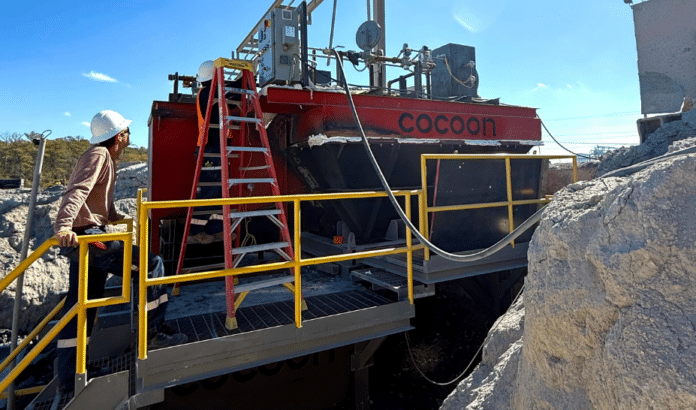
Cocoon Carbon, a UK company developing a scalable supply of cement substitutes, known as supplementary cementitious materials (SCMs), today announced the closing of a €13 million ($15 million) Series A round.
The investment was co-led by 2150 and Brick & Mortar Ventures. The round included participation from TVC (The Venture Collective) and continued support from existing investors Wireframe Ventures, Celsius Industries, Gigascale Capital, and SOSV.
“The SCM market is facing a structural deficit at exactly the moment infrastructure demand is rising,” said Eliot Brooks, CEO and Co-Founder of Cocoon Carbon. “We’re focused on delivering a plug-and-play solution that gives concrete producers access to affordable, local materials – while improving the economics of electric steelmaking. Expanding supply is the fastest way to stabilize costs and lower carbon in concrete.”
Cocoon Carbon’s Series A comes amid a growing body of investment into low-carbon construction materials and cement decarbonisation technologies across Europe.
Recent examples include Carbonaide, a Helsinki-based startup that raised €3.7 million to scale carbon-curing technology for concrete; Co-reactive, which secured €6.5 million to advance CO₂ mineralisation processes; 011h, a Barcelona-based company that raised €20 million for low-carbon construction systems; and Converge, a London-based firm that raised €19.4 million to optimise concrete through AI.
Together, these rounds represent over €49 million in recent funding activity in adjacent segments.
Within this landscape, Cocoon Carbon’s approach – focused on scaling supplementary cementitious materials (SCMs) from steel slag – positions it at the materials supply layer, complementing other approaches such as carbon capture, mineralisation, and digital optimisation.
“Concrete is one of the biggest value streams on the planet, providing the foundation of our civilisation, from buildings to infrastructure to data centers. It consumes orders of magnitude more energy than AI and emits more CO2 than any other sector,” says Jacob Bro, partner and co-founder of 2150. “Cocoon stands out in the innovation landscape with a product that is better and cheaper than cement and delivers a true drop-in replacement product for the industry.”
Founded in 2023 and led by co-founders Eliot Brooks, Will Knapp, and Freddie Scott, Cocoon looks to provide a scalable supply of a cost-competitive cement replacement – helping producers meet rising infrastructure demand quickly without raising costs.
As data center construction booms and global infrastructure doubles over the next 40 years, the widening supply gap of widely-used, low-cost supplementary cementitious materials has made it a critical material.
Cocoon’s low-capex, modular process converts electric arc furnace byproducts from growing, clean steel production into a reportedly cost-competitive cement replacement that lowers the carbon intensity of concrete production.
SCMs have historically come from heavily polluting coal plants and iron blast furnaces. As those industrial processes are retired across the U.S. and Europe, the company says SCM supply is shrinking and incumbents are consolidating to lock in supply.
At the same time, SCM demand is growing at approximately 6–7% per year, and in several markets, SCM prices have already doubled since 2017 as supply tightens.
Cocoon provides a new source of SCMs by converting an underutilised and robust supply of steel slag, a byproduct of electric arc furnaces (EAFs), into a low-cost, high-performance cement replacement. EAFs re-melt scrap using electricity, compared to coal powered blast furnaces that turn iron ore into pig iron.
With tens of millions of tons of steel slag produced annually in the U.S.and Europe, and EAF steelmaking projected to double by 2050, Cocoon expands the domestic supply base concrete producers rely on to keep costs stable.
Cocoon’s new product allegedly matches the performance of traditional SCMs while reducing the embodied CO2 of concrete by up to 40%.
Unlike other emerging alternatives to cement, Cocoon’s product is cost competitive and doesn’t demand a prohibitive “green premium” that has historically limited uptake of new solutions in the market.
Rather than developing a standalone production process from the ground up, Cocoon developed a rapid cooling technology that retrofits directly into existing EAF steel waste handling processes. Cocoon captures molten slag straight out of production and cools it 100x faster than existing technologies to produce a reliable SCM supply.
By working within existing systems, Cocoon says they operate without high energy inputs, high capital expenditure, operational disruption, or safety compromises. Co-located at steel mills in areas of heavy industry, transportation costs (a significant component of SCM’s delivered price) are minimised and the need for new logistics infrastructure is negated.
The Series A funding will support deployment of Cocoon’s first commercial demonstration facility in the United States. This project will validate performance at industrial scale and establish the operating track record needed to finance a broader rollout across more than 50 steel plants in the U.S. and Europe, with Cocoon’s plug-and-play approach allowing for faster deployment.
The company has already piloted its technology at a major steel mill and completed third-party validation of its material in concrete applications. Over the past year, Cocoon has built out its R&D facility and concrete testing lab in London.
Cocoon is doubling the team size with the hiring of process engineers, materials scientists, and commercial team members in the UK, as well as plant operators and technical staff in the United States to support deployment of the demo facility.
Read the orginal article: https://www.eu-startups.com/2026/03/data-centre-boom-fuels-need-for-cement-substitutes-as-londons-cocoon-carbon-lands-e13-million/


