

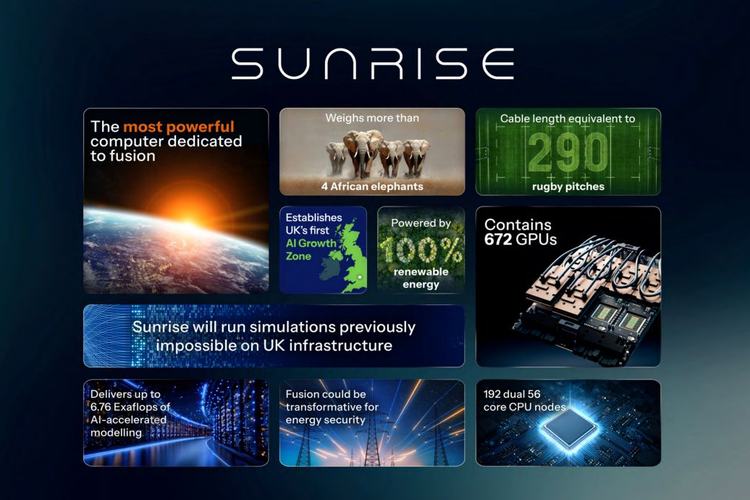
The UK government will invest £4.5 million ($6 million) in a supercomputer dubbed Sunrise, dedicated to fusion energy.
The 1.4MW system is expected to be operational from June 2026 and will be housed at the UK Atomic Energy Authority’s (UKAEA) Culham Campus in Oxfordshire, where the government plans to establish the UK’s first AI Growth Zone.

Sunrise will tackle key fusion energy challenges in areas such as plasma turbulence, materials development, and tritium fuel breeding, the government said in a statement, noting that the supercomputer will also deliver “spillover benefits” to other clean energy technologies, helping to support the UK’s wider net zero ambitions.
The announcement comes two months after the UK government detailed plans to invest £36m ($49m) to boost the supercomputing capacity at the AI Research Resource (AIRR) in Cambridge sixfold by spring 2026.
The Sunrise system will be powered by 192 AMD Epyc CPUs and 672 AMD Instinct GPUs, built on the Dell PowerEdge platform to deliver 6.76 exaflops of AI compute power. No information about which generation of AMD hardware will power Sunrise has been disclosed, but DCD has reached out to AMD for clarification.
In addition to AMD and Dell, the Department for Science, Innovation and Technology (DSIT) will also collaborate with the Department for Energy Security and Net Zero (DESNZ), Intel, UKAEA, the University of Cambridge, and WEKA on the project.
“We can be proud that Britain will lead the way on research, innovation, and skills for a future of limitless fusion energy,” said Lord Patrick Vallance, Minister for Science, Innovation, Research, and Nuclear. “By backing our fusion industry, we are not only securing our future energy independence, but from innovation and research to engineers, we are also providing the skilled clean energy jobs of the future for British people.”
Dr. Rob Akers, UKAEA’s director for Computing Programmes, added: “UKAEA is taking lessons from the Apollo program: we learn fastest when we can test, iterate, and improve safely in the virtual world before we commit to our real-world mission. Sunrise will bring that capability to fusion by combining high-fidelity simulation with physics-informed AI to develop predictive digital twins that reduce the cost, risk, and time of learning that would otherwise require expensive and time-consuming physical testing.”
Fusion energy aims to generate electricity through the heat released by fusion reactors, but remains under development, with many not expecting a breakthrough for the next decade or longer. Outside of the UK, several major hyperscalers, including Microsoft and Google, are investing in fusion energy as a potential future energy source for data centers.
More in HPC & Quantum





Read the orginal article: https://www.datacenterdynamics.com/en/news/uk-govt-to-invest-45m-in-sunrise-supercomputer-to-accelerate-advancements-in-fusion-energy/


