

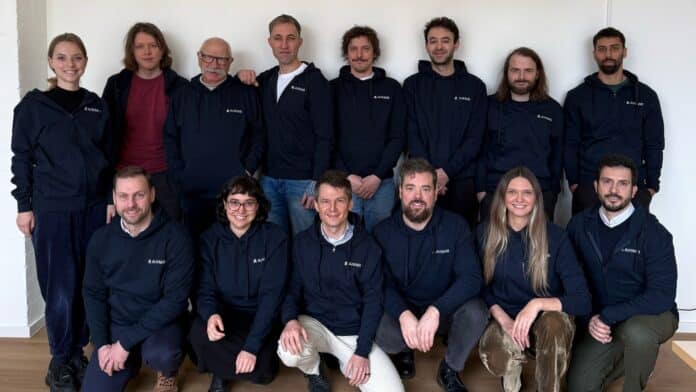
AIRMO, a Berlin and Luxembourg-based SpaceTech startup developing the world’s most advanced greenhouse gas monitoring system, has today announced a €5 million Seed funding round to fuel the launch of its first satellite mission in 2027 and expand its airborne coverage.
The round was led by Ananda Impact Ventures, alongside Unconventional Ventures, kopa ventures, Desai Ventures, Hypernova / New Venture Securities and two EQT Partners acting as strategic investors (Matthias Fackler and Francesco Starace). Existing investors, including Antler, Findus Ventures, E2MC and Pilabs, also participated in this round.
“AIRMO has a simple mission: to help operators find and stop greenhouse gas losses, starting with methane. We have developed this unique instrument to achieve this goal. With this funding, we are moving beyond validation into continuous monitoring that will solve this problem. And launching our first satellite mission is a major step towards realising our ambition to monitor 12 million energy assets worldwide,” said Daria Stepanova, CEO of AIRMO.
AIRMO was founded in 2022 by Daria Stepanova, a rocket scientist and serial entrepreneur who has already completed 12 successful satellite launches. The company designs, builds, and operates proprietary methane monitoring tools.
Some of its offerings include drone-based methane monitoring for targeted leak detection for site-level precision, aircraft-mounted methane monitoring system for wide-area methane mapping at scale, Optical Gas Imaging (OGI) for real-time thermal visual leak detection, Flame Ionisation Detector (FID) for high-sensitivity methane verification, and Continuous Methane Monitoring System (CMS) for fixed-site, real-time methane surveillance.
Backed by the European Space Agency, the company has built the world’s first active spaceborne greenhouse gas monitoring instrument, combining a Short-wave infrared (SWIR) imager with micro-LiDAR (Light Detection and Ranging). AIRMO claims that this is the first time such a high-powered sensor has been miniaturised to fit a small satellite. The technology is twice as accurate as any existing systems – in practice, this means the ability to detect a methane leak the size of a car from 500 km in space.
According to the company, methane emissions are responsible for 30% of the Earth’s warming, yet 70% of leaks remain unreported.
It states that methane leaks also pose a major challenge for energy companies, costing the industry around €86.6 billion ($100 billion) annually. This is equivalent to 15% of upstream oil and gas investment. This includes €25.9 billion ($30 billion) in direct revenue loss.
AIRMO technology is already being used in commercial operations on drones and aeroplanes for monitoring missions in Europe, Central Asia and MENA. Its existing customers include leading energy companies, such as Uniper, Total and ESCE.
“Methane leakage reduction is the most effective way to decarbonise the energy industry today. AIRMO’s ability to quantify GHG emissions from space with such high precision is a game-changer, finally solving a significant transparency problem for the energy sector. Having backed the team since inception, we are proud to continue supporting their journey as they move toward their first satellite launch,” said Alina Bassi, Principal at Ananda Impact Ventures.
The company plans to use this fresh capital to move itself from successful pilots to scaled commercial operations. AIRMO will be launching its first satellites into space in 2027 to begin operational data delivery. It will be scaling airborne monitoring campaigns across Europe, MENA, and Central Asia, moving into routine operational monitoring and funding full payload-satellite integration. The funding will also be used to drive international expansion, with AIRMO establishing a local presence in MENA.
In 2023, the company announced a Pre-Seed round of €5.2 million from leading space and impact investors, as well as a large contract by the European Space Agency.
Read the orginal article: https://www.eu-startups.com/2026/03/germanys-airmo-raises-e5-million-to-detect-methane-leaks-from-space-with-satellite-launch-planned-for-2027/


