

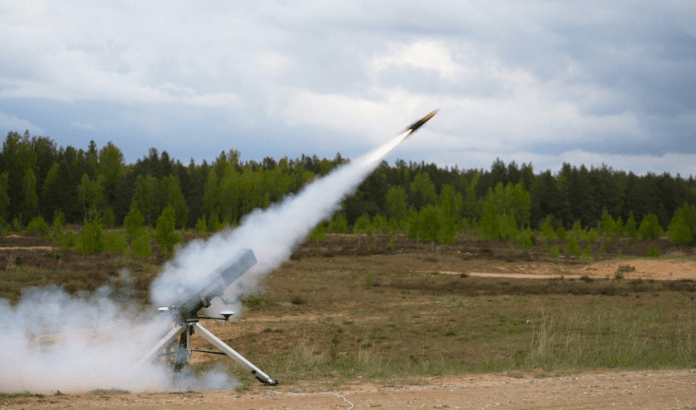
Frankenburg Technologies, a Tallinn-based missile defence startup focused on affordable, mass-manufacturable missile systems and sovereign production capacity, has raised €30 million in Series A funding to build tangible, sovereign missile-manufacturing capacity in Europe, with a clear focus on production, resilience and regeneration.
The round was led by Plural and followed by SmartCap. This brings Frankenburg’s total funding to €40 million and will support the company’s expansion from its first operational systems to a broader, full-spectrum missile portfolio.
Frankenburg was also included in our 10 Estonian startups to keep an eye on in 2026 and beyond! listicle.
Taavi Madiberk, Founder and Chairman of Frankenburg Technologies, says: “For too long, Europe outsourced strength. That must end. I founded Frankenburg because Europe needs a SpaceX-style shift in defence missiles: build fast, move faster, and win on cost and performance.
“We are sharply focused on counter-drone missiles today, but this is only the first step. Long-term, we are building a global missile leader, delivering lower costs and aiming for higher performance than US or Chinese incumbents across all key missile categories.”
Frankenburg Technologies’ €30 million Series A reflects a wider acceleration of defence-focused investment across Europe in 2025 and 2026.
In the UK, London-based Arondite raised over €10.5 million to develop AI-enabled interoperability and autonomous defence systems. The Netherlands-headquartered Destinus secured an additional €50 million in bank financing, bringing its total capital raised close to €400 million to scale high-performance autonomous systems. In Poland, Warsaw-based Orbotix raised €6.5 million to advance modular autonomous defence technologies, including drone swarming capabilities. Germany’s Project Q secured €7.5 million to expand its Internet of Defence (IoD) interoperability platform, while drone specialist Quantum Systems obtained a €150 million financing package to support expansion amid growing European drone demand.
Taken together, these rounds amount to over €224 million in disclosed financing across adjacent defence and autonomy segments. Compared with these raises, Frankenburg’s €30 million Series A highlights investor interest not only in autonomous and drone technologies, but increasingly in sovereign missile manufacturing capacity and scalable interceptor production within Europe.
Kusti Salm, CEO of Frankenburg Technologies, adds: “Europe’s deterrence problem is not just about budgets, it’s about availability. You cannot deter with systems that are too scarce, too slow to replace, or too expensive to use at scale. Frankenburg was built to restore speed, scale and sustainability to missile defence. This funding allows us to put real industrial capacity behind that mission and build missile systems Europe can actually afford to fire and produce at scale.”
Founded in 2024 by serial deep-tech entrepreneurs Taavi Madiberk (Chairman) and Marko Virkebau (Board Member), Frankenburg Technologies was created to respond to a structural shift in Europe’s security environment: modern aerial threats can now be produced cheaply and at scale, while missile manufacturing has historically prioritised performance over speed, cost and regeneration.
Led by CEO Kusti Salm, former Permanent Secretary of Estonia’s Ministry of Defence, Frankenburg brings together senior defence leaders and missile engineers with experience across leading European and allied missile programmes, including IRIS-T, SPEAR3, Storm Shadow and Brimstone.
The company is being built as a new European missile house with sovereign production infrastructure, delivering low-cost, precision-guided systems across air, surface and maritime domains at scale.
Large-scale aerial threats, from low-cost unmanned systems to more complex cruise-missile-like targets, have become a persistent feature of Europe’s security landscape. While such threats can be produced quickly and in large numbers, the company explains that interceptors are often expensive, slow to manufacture and available only in limited quantities.
Frankenburg was founded to change this equation. Its missile systems are designed from the outset for affordability, mass manufacturability and integration, enabling armed forces to field interceptors that are an order of magnitude cheaper to use than traditional approaches, while remaining compatible with existing sensors, command-and-control systems and layered air-defence architectures.
Sten Tamkivi, Partner at Plural, says: “In a world where an adversary can deploy tens of thousands of autonomous attack drones, staying safe is not rocket science: defence must be cheap, fast and count in millions of units available. Frankenburg is tackling one of Europe’s most urgent defence challenges by building credible deterrence with missiles, at startup speed.
“The team combines deep defence expertise with a fundamentally different manufacturing mindset, and we believe this approach can have a lasting impact on Europe’s security and industrial resilience.”
In just 13 months, the company has taken its first interceptor, the Mark I short-range air-defence missile, from concept to advanced testing and industrialisation. Mark I was intentionally designed with constrained requirements to enable speed, scale and affordability, and to be produced using Frankenburg’s containerised, modular manufacturing concept, allowing missile production to be localised close to the point of need.
Key priorities include:
Standing up two EU-based mass-production sites, designed for full-rate output and rapid scaling, with production capacity from 100 missiles per day per site
Securing long-lead components and early production stock, ensuring schedule certainty and resilience in crisis scenarios
Establishing dedicated rocket motor and warhead production capabilities within the EU, providing vertical control over critical energetics
Expanding Frankenburg Missile hubs in the UK and Germany, supporting next-generation missile development, prototyping and cross-site integration
Growing engineering, safety, quality and export-control teams, ensuring systems are production-ready and deployable for European and allied customers
Frankenburg now operates across eight countries, including Estonia, Latvia, Lithuania, Germany, the United Kingdom, Denmark, Poland and Ukraine, with teams focused on engineering, industrialisation and a growing network of industrial collaborations across land, air and maritime domains with European and allied partners.
The company’s model is built around manufacturing where systems are used: keeping supply chains short, creating skilled industrial jobs, and ensuring that defence spending strengthens national economies rather than exporting dependence.
By combining modular manufacturing, commercially available components and rapid qualification cycles, Frankenburg aims to give European nations a credible path to sustained air-defence readiness, even under prolonged stress or wartime conditions.
While Mark I addresses the most immediate air-defence needs, future programmes will expand beyond counter-UAS and short-range air defence into additional air- and surface-launched precision capabilities, built using the same industrialised, scalable manufacturing model.
Read the orginal article: https://www.eu-startups.com/2026/02/european-missile-manufacturing-push-gains-momentum-as-frankenburg-closes-e30-million-funding-round/


