

Local land planning meetings about data centers are a febrile source of content for news publications looking to get a human angle on AI.
At these meetings, one can expect citizens of all ages, always impassioned and sometimes articulate, to deliver a speech about utility rates, the environment, NDAs, or some other common grievance relating to a new data center development. The rhetoric is captivating and unmistakably moral, with some going as far as to invoke God.

The small nuclear revolution coming for data centers
But on Wednesday October 22, as a government-led inquiry into a data center project in Slough moved into its seventh day of proceedings, only two of the chairs in Slough Borough Council’s meeting room were occupied: one by DCD, and the other by an employee of JLL, a prominent real estate consultancy.
As the inquiry concluded on October 24 – which, in the words of a Council representative, was supposed to contain the inquiry’s “juicy bits” – the number of people in the audience had dwindled to one.
The people, both literally and metaphorically, were nowhere to be found.
In the US, meetings concerning data center projects often require extra seating, and some hearings are rescheduled because a new venue is required to accommodate all interested parties. But such was the dearth of public interest that the council concluded that there was no point in even live-streaming the proceedings.
The commonly accepted narrative of data center opposition pits the aggrieved citizen against Big Tech and the venal officials that help grease its path. But in this instance, opposition to the project seemed only to come from the council itself.
Slough gives a glimpse of what the dynamics of data center development could look like if the world becomes used to data centers, just as it has become used to bridges, roads, or factories. When compared with the more politically active counties in northern Virginia, Slough feels like an alternative future where data center opposition becomes technocratic, professional, and high-strung, with that familiar, scrappy, grassroots flavor rinsed out and rendered undetectable.

The inquiry
It follows that the inquiry for the data center project, which lasted eight working days from October 14 to October 24, was altogether unexceptional.
In December 2024, a company called Manor Farm Propco submitted an application for the construction of a 147MW data center, a Battery Energy Storage System (BESS), a substation, offices, backup generators, and other related infrastructure.
Manor Farm Propco intended for this to occupy a 74-acre land parcel called Manor Farm. This parcel is constituted by two parts – a northern piece, home to a former logistics hub, and a southern piece, the majority of which is green space – and it wraps around another parcel called Poyle Farm. This is located in between Slough’s town center and London’s Heathrow Airport in an area called Colnbrook.
Manor Farm Propco spent £70 million ($92m) buying the land from a company called the Airport Industrial Property Unit Trust. But both companies are actually subsidiaries of a Real Estate Investment Trust (REIT) called Tritax Big Box. Although Tritax deals primarily in the sale, purchase, lease, and management of warehouses and logistics facilities, they have since dipped their toes into data center business.
After the council received the application, they emailed Manor Farm Propco asking if it would be alright for the council to postpone its decision-making date from April 3 to April 30, giving it more time to consider the application in full. Manor Farm Propco did not respond, and a decision was not issued by April 3.
Suspecting that the project was going to be denied, in May, Manor Farm Propco filed an appeal asking the Planning Inspectorate, a national body responsible for dealing with planning appeals in the UK, to consider an inquiry process.
A month later, the Inspectorate said that it considered an inquiry to be suitable, meaning that the council and Tritax would have to present their case to an individual appointed by the Inspectorate – an inspector – who would decide whether the proposal could move forward.
In August, the then-Secretary of State for Housing, Communities and Local Government, Angela Rayner, “called in” the appeal, giving herself the final say in the project. Rayner has since resigned after admitting to underpaying stamp duty on one of her flats, so it will be her successor, Steve Reed, that makes a decision based on a report written by the inspector.
This level of government involvement is unusual. Planning decisions are typically left in the hands of the council. But LSE’s Emeritus Professor of Economic Geography Paul Cheshire says that over the past ten years, the government has become more willing to intervene in projects that are deemed to be nationally important.
And in the eyes of the UK government, nothing seems to be more important than data centers.
When Rayner was in charge, the government was happy to intervene in data center proposals across the UK, “calling in” and approving three projects in Hertfordshire and Buckinghamshire despite protests from local councils and residents.
Support for data centers has also become a matter of national policy. The current Labour government, facing down an electoral threat from the right in the form of Nigel Farage’s Reform Party and the threat of being left behind in the AI boom, is betting that data centers can help revitalize an economy beset by slow growth and deindustrialization.
In September 2024, the government designated data centers as Critical National Infrastructure, giving the sector access to more support in the case of an emergency.
In January of this year, the government announced that it would establish ‘AI growth zones’ that would provide data center operators with access to faster planning permission and power. At time of writing, four such zones have been announced.
In September, a state visit by US President Donald Trump brought with it a series of data center-related investments both new and repackaged, including a £5bn ($6.9bn) Google deal, a $678m BlackRock venture, a new Vantage facility, OpenAI’s Stargate UK, a £1.5bn ($2bn) investment from CoreWeave, and a $15bn commitment from Microsoft.
In November, Home Secretary Shabana Mahmood was set to approve legislation that would allow operators to request their data centers be considered a “nationally significant infrastructure project,” a designation traditionally reserved for utility and transport projects that would further speed up the planning process.
One sees in the UK a repeat of the story that is occurring across the world. The demands of AI training and inference are much more energy intensive than typical cloud and colo workloads, pushing data center operators beyond their typical stomping grounds and into communities with little experience and understanding of digital infrastructure.
Slough and data centers
In this way, Slough is at once a vision of the past and the future.
Slough has long been the home of the country’s cloud and colo workloads, but the construction frenzy soon to sweep the UK will be driven by data centers built specifically for AI usage.
At the same time, Slough’s attitude and approach to data centers is a glimpse into what the dynamics of data center development could look like in the next few decades. When compared with the more politically active counties in northern Virginia, Slough feels like an alternative future where data center opposition becomes technocratic, professional, and at times soporific, with that familiar, scrappy, grassroots flavor rinsed out and rendered undetectable.
The town is rather fond of data centers. Slough Borough Council itself proudly advertises that Slough is “Europe’s largest data center cluster,” openly touting the fact that its 32 data centers, located in the Slough Trading Estate, constitute the world’s second largest cluster behind Northern Virginia’s Data Center Alley.
Operators were originally attracted to the Slough Trading Estate because of its fiber connections, its easy access to power, and its location next to London.
Segro, the company which operates the estate, has said that it is prepared to deliver 4.3 million sq ft (400,000 sqm) of additional data center accommodation over the next seven years. For context, in the past five years, the estate welcomed 14 data centers totaling two million sq ft (185,000 sqm) – a bit of back-of-a-handkerchief math would mean that the estate stands ready to accommodate around 28 more data centers of the same size.
The local planning authority has also approved a series of Simplified Planning Zones for the trading estate, meaning that data center developers looking to build there do not require further planning approval so long as they comply with less onerous supplementary requirements and stipulations.
One of Slough’s councillors, Dexter Smith, said that “the general attitude is that residents are relatively happy to see continued development, particularly given that most of these data centers are on brownfield sites.”
Smith says: “They’d rather see something there than nothing, because as is the nature of industrialization, you get a new technology that comes along, and then it becomes established, and then other people come along and they do it more cheaply somewhere else, and your old technology becomes uncompetitive, and you’re left, you know, just with an empty shell.”
In keeping with this logic, at the start of December, Slough Borough Council approved an Equinix data center project located at a former factory operated by paint manufacturer AkzoNobel.
So why was a Council historically welcoming of data centers rejecting this one?
Firstly, Manor Farm is located on the Green Belt, which is a British planning designation established in 1955 that, in the words of Professor Cheshire, has “almost entirely prevented any development.”
The designation was invented by planners to do three things: stop urban sprawl around big cities, to prevent neighboring towns from merging into one another, and to preserve the setting and special character of historic towns. On maps, it appears as a giant ring surrounding all of the UK’s largest metropolitan areas. Within the country, the largest by far is the Metropolitan Green Belt, which occupies 513,860 hectares around Greater London and other neighbouring counties.
However, the election of the current Labour government brought with it a new planning designation – grey belt – which refers to Green Belt land that can be developed on. To be considered grey belt, the land has to be a brownfield site that does not “strongly contribute” to any of the Green Belt’s purposes.

But Professor Cheshire says that the vagueness of the definition means that “it’s up to local authorities to decide for themselves whether any particular piece of land is Green Belt or grey belt.”
Tritax contends that the land should be considered grey belt, and that the national importance of data centers justifies the use of the land as a data center. The council disagrees, stating that Tritax could not demonstrate that the data center had to be built in Manor Farm.
There was the simple suggestion that Tritax could have considered another, more suitable piece of land. The Council argued that Segro had made way for data centers on the Slough Trading Estate, and a data center in Manor Farm would require the construction of additional infrastructure like wires and fiber cables in order to connect it to existing power and fiber wires.
Tritax, for its part, is adamant that this land parcel be used as a data center because it has already secured a private write connection with the nearby electrical substations in Iver and Laleham, enabling it to bring the data center online as soon as 2027.
Second, the Council argued that the land parcel is also located in the Strategic Gap – land that is designated as a gap to separate Heathrow from the rest of Slough – and the Colne Valley Regional Park, which is a series of parks and green spaces along the River Colne.
Third, the site could potentially be used as a location for freight forwarding as part of the expansion of Heathrow Airport, and the Council went as far as to suggest that the facility would “deprive the expansion of essential freight facilities and/or to saddle [Heathrow] with enormous unquantified compensation costs as a result of granting this permission.”
But by the time the hearing concluded, the government had not decided whether it would support Heathrow’s own plans for expansion or an alternative plan proposed by construction company Arora Group. The former included Manor Farm as part of its proposal, but the latter does not, and Tritax argued that the site’s inclusion as part of the expansion was not necessarily a foregone conclusion.
The government has since chosen Heathrow’s proposal, and this will likely factor into the Secretary of State’s eventual decision. Tritax has said that it has not yet received any formal notification regarding planning consent from the Secretary, and the Secretary’s decision is unlikely to arrive until 2026.
As the meeting drew to a close, heads were nodded, hands were shaken, and compliments were traded. Representatives of the council were happy to offer the opposing side some biscuits that someone had brought in.
Although the council and Tritax were opponents, the pair shared an understanding that more data centers were necessary. They squabbled about scope, definitions, and numbers – there was an extended digression over the methodologies used by both sides to estimate data center demand in the UK – but no one ever challenged the basic assumption that data centers needed to be built.

If AI is here to stay, it is reasonable to assume that data centers will become normal. Choosing where to build a data center will no longer be a moral question, but a technocratic one.
It certainly seemed normal to those who were sitting in that meeting room in Slough Borough Council. After all, they were just doing their jobs. Little could be found of the passion and acrimony that many have come to expect from a data center hearing. No one was fighting for re-election, and the proceedings contained little trace of ego or self.
It is possible that this is a vision of the future that is already past. Maybe the more intensive and speedy buildout of hyperscale facilities will create development dynamics that render Slough’s experience entirely irrelevant.
But it seemed clear that it was business, not politics, that had been done here.
The house
Manor Farm and the surrounding area is designed mainly for transport, making it difficult to get to the site on foot. The sidewalks leading up to Manor Farm are narrow and in some cases non-existent, requiring one to walk on grass and soil as cars, lorries, and planes zip past at a regular cadence.
Almost everything around you is moving or meant to be moving. Just across the road is the Poyle Industrial Estate, home to various courier and freight forwarding companies that service Heathrow Airport, and directly north of the land is the clunkily named Hilton London Heathrow Airport Terminal 5 hotel.
The houses that sit on the edge of the Poyle Industrial Estate are occupied by businesses, not people. One such property hosts two recruitment agencies, and when asked if they knew anything about the possibility of a data center becoming their future neighbour, the receptionist simply shrugged and said: “I don’t know anything. We’re a recruitment agency.”
There are exceptions. There is a stretch of houses in an area called Colnbrook, which is further north of the Hilton hotel, and in the immediate vicinity of Manor Farm are two residential properties. One of them juts directly into the southern portion of Manor Farm’s greenfield land, and the other sits right at the entrance of the former logistics hub.

The latter seemed uninhabited. The stiff, plastic buttons on the buzzer have not been used in a while, and pressing them only elicits the faintest of noises from inside the house.
But the door opens, and out walks Pete and Alan, aged 67 and 65. Alan is hunched over, his center of gravity bent forwards as he leans his weight on a pair of grey crutches. Black tape is wrapped around the area just below the handholds.
Pete has been living there for 30 years, Alan has been there for six. They say they are the only ones still living in the house, and everyone else has since moved. When asked for their thoughts on the new data center project potentially coming to their home, I am greeted with a blank stare.
When asked if they want to comment, they say no. But they go on to say that their house is set to be demolished as part of the new project. They say they are waiting for the Council to issue an eviction notice after being told to leave in March by Tritax. Everyone else in the house has left, but they say that if they left, they’d just be making themselves homeless.
It seems obvious that this was the sort of person that should have been occupying the empty seats in the planning meeting. But when asked why they did not show up, they shrugged their shoulders and simply said:
“Well, we can’t do anything about it.”
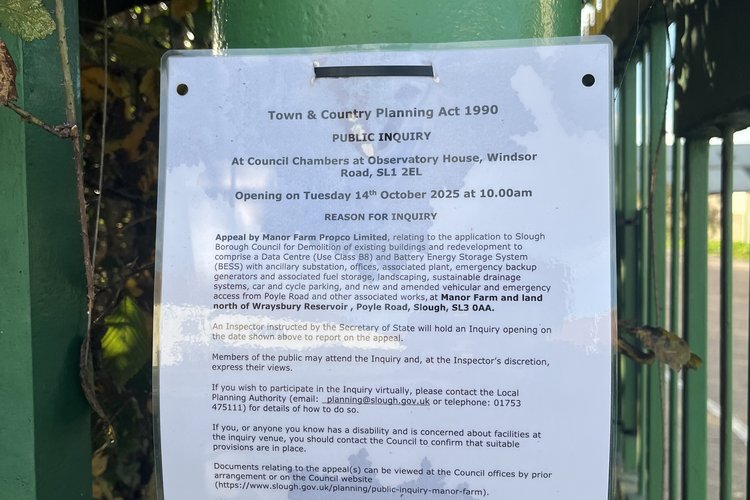
It seems like few either saw or cared enough about the sign placed at the gate of Manor Farm, just a few steps away from Pete and Alan’s house. Printed and laminated, one line on the notice stands out:
“Members of the public may attend the Inquiry and, at the Inspector’s discretion, express their views.”


More in Construction & Site Selection



Episode
Keeping AI data centers adaptive
Read the orginal article: https://www.datacenterdynamics.com/en/analysis/the-data-center-public-hearing-almost-no-one-showed-up-to/


