

Energy is the very foundation of all computation, yet it has become the major bottleneck for AI. AI’s demand for computing power – projected to grow more than a hundredfold by 2030 – will hit a hard stop in potential if the constraint of electrical energy is not addressed.
Henceforth, the data center, which we know as a colossal energy consumer, faces a fundamental challenge. The pace of computing power growth is out of sync with the development of power infrastructure, where chips evolve on cycles of years (or even months) while grid infrastructure requires five to ten years for planning, approval, and construction. David Luo, senior director of product at HiTHIUM, explains:
“This mismatch creates a bottleneck where computing power must wait for electrical power to catch up, leaving many to face the dilemma of ‘having the chips but no power to run them.”

Microsoft has AI GPUs “sitting in inventory” because it lacks the power necessary to install them
Speaking on the Bg2 Pod, Microsoft CEO Satya Nadella said power, not compute, is biggest data center constraint
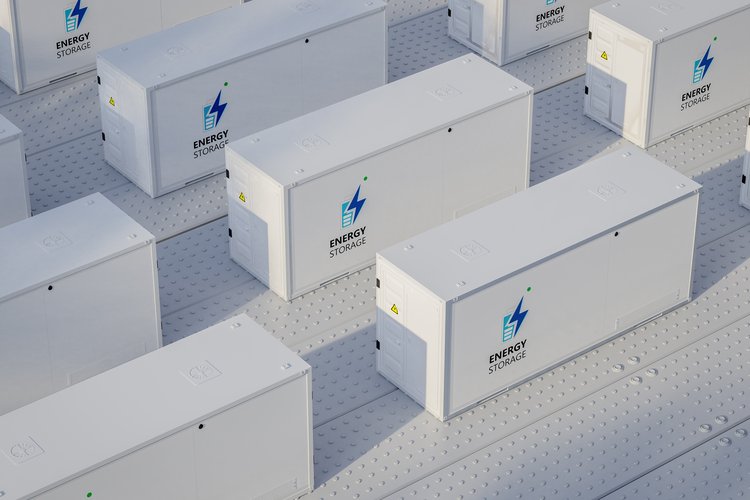
This highlights a pressing and widespread issue that is occurring today – not just something to consider in the future. Enter, energy storage. Although energy storage deployment typically lags behind AI data center construction by one to two years, the demand is already locked in.
Behind AI’s biggest bottleneck
At every level of the AI stack – whether considering token generation, individual data centers, national capacity, or grid infrastructure – the underlying constraint is energy consumed over time, not instantaneous power capacity alone. Where power (watts, kilowatts, gigawatts) describes how fast electricity is used in a moment, energy (watt-hours, kWh, GWh) is how much electricity actually has to be generated, transmitted, and paid for. It is the energy demand over time – the conserved quantity – that links activity at the token level to real-world impact on the grid.
As model size and hardware efficiency vary, total power consumption during token generation scales with throughput. At the facility level, this translates into large AI data centers operating thousands of high-performance GPUs, as Luo explains:
“A large AI data center operating 3,000 to 5,000 high-performance GPUs may require hundreds of megawatts of peak electrical capacity and consume about 200 million kWh of electricity per year.”
To put this into perspective, that means a single large AI data center already consumes roughly 0.2TWh of electricity annually – comparable to a medium-sized town (like Watford, UK) or small city (like Jackson, Wyoming). Luo continues:
“At the national level, in the next five years, US data center operators have requested around 46GW of new grid interconnection capacity, much of it driven by AI workloads.”
While these figures represent peak capacity rather than continuous draw, sustained utilization at scale could add hundreds of terawatt-hours of annual electricity demand by the end of the decade.
At that scale, the problem stops being ‘can we connect enough megawatts?’ and becomes ‘can we deliver this energy continuously over time?’ This is where storage becomes essential.
Where data centers demand near-perfect uptime and draw power with highly correlated load patterns, alternative power generation methods, such as solar, wind, and other renewables, produce intermittent energy. So, energy is available, but not always when the data center needs it.
Storage exists precisely to bridge this gap by shifting energy through time. When estimates suggest the US may require close to 150GWh of storage, this is not a claim about backup power, but about the volume of electricity that must be time-shifted so energy is available when large-scale AI computation actually runs – making sustained AI data center growth both physically and economically viable.
Policy and economics of scaled deployment
As AI data center demand grows, policy and trade dynamics are increasingly impacting deployment. Factors like tariffs, trade barriers, and localization requirements determine where and how infrastructure can be built, making risk assessments invaluable. Yet, the most immediate structural question is whether sufficient power is even available. Luo explains:
“In the US and Europe, many grids still operate at 30- to 50-year-old standards, with limited capacity and stability.”
At the same time, the rapid expansion of computing power conflicts with global carbon neutrality goals. AI data centers require electricity that is simultaneously green, stable, reliable, and economical – a combination that existing grid architectures often cannot deliver without significant upgrades.
“If we imagine global data centers as a ‘digital nation,’ by 2030 their annual electricity consumption will exceed 1,500TWh, making them the fourth-largest electricity consumer in the world,” Nazar Yi, board member and vice president at HiTHIUM, notes.
If this electricity comes primarily from fossil fuels, annual emissions could surpass 580 million tons of carbon dioxide – comparable to the combined emissions of the UK and France, two large industrialized nations.
This severely emphasizes that AI infrastructure planning is no longer just a computing challenge, but a fundamental energy problem, requiring new energy architecture rather than incremental grid expansion.
The key, Nazar argues, is building energy systems that are agile to deploy and low-carbon by design. Hithium addresses this by offering a coordinated, end-to-end approach that spans energy generation, storage, and load-side consumption. Nazar explains:
“By coupling long-duration energy storage with renewable resources such as solar and wind, and managing them through intelligent coordination, we shorten the development cycle of energy infrastructure from five to ten years down to just one to two years – an acceleration of more than 80 percent.”
In parallel, Hithium emphasizes localized manufacturing and service networks as a strategic approach to managing policy, trade, and supply chain risk. Local production reduces exposure to tariffs and regulatory uncertainty, while regional service hubs support reliable delivery, long-term operations, and talent development, building resilience in a shifting regulatory environment.
Engineering the ‘Energy Awakening’
AI data centers introduce a type of impact load that the grid has never experienced before. They can generate rapid, sharp power fluctuations – sometimes reaching 70 percent within tens of milliseconds – like a fleet of supercars repeatedly slamming on the brakes and flooring the accelerator on an already crowded power highway.
These sudden shocks are highly disruptive, threatening both grid stability and the operational continuity of the data centers themselves. In this sense, AI data centers are not merely a new application scenario – they are massive industrial electricity consumers that fundamentally reshape how power systems must be engineered.
As a result, a second line of defense on the load side is essential. With AI power demand growing exponentially, the electricity system must be designed for industrial-grade reliability, capable of absorbing shocks as well as supplying steady-state power.
This places very specific technical demands on energy storage, far beyond the requirements of traditional backup or renewable integration systems.
AI data center storage must simultaneously deliver millisecond-level power response, tolerate frequent high-rate cycling, operate with near-perfect availability, and do so at a cost and scale compatible with multi-hundred-megawatt facilities. According to Hithium’s Chairman, Jeff Wu, the foundation of a high-performance, cost-competitive storage solution rests on four pillars:
- Developing ultra-large, high-safety, long-life cells: Advancing ultra-large cell technologies to achieve an optimal balance between intrinsic safety, long cycle life, and energy storage economics.
- Building safer, more integrated, and more efficient systems: Continuously improving system efficiency and cost performance through integrated design, AI-enabled optimization, and software-hardware co-development.
- Advancing intelligent manufacturing: Setting new benchmarks in lithium battery manufacturing through high-capacity, low-cost, and highly intelligent production lines.
- Delivering fully integrated energy storage solutions: Providing end-to-end energy storage solutions supported by a resilient global supply chain, ensuring safety, reliability, and cost competitiveness.
Hithium’s approach extends beyond lithium-ion storage alone, with the development of an innovative lithium-sodium hybrid architecture. This is because while lithium is suited for storing and supplying large amounts of energy over long periods, sodium-ion technology excels at delivering fast, repeated power bursts in milliseconds. Luo adds:
“By combining lithium for energy and sodium for power, we can meet the dual requirements of grid-side stability and load-side rapid response in AI data center campuses.”
For example, Nazar illustrates that for a 100MW AI data center, a hybrid configuration of 35MWh sodium-ion paired with 200MWh lithium-ion systems can smooth load fluctuations by up to 70 percent, respond five times faster than conventional equipment, and reduce lifecycle backup costs by more than 20 percent.
“The high-rate sodium-ion system acts as a ‘millisecond-level precision stabilizer,’ forming the first dynamic ‘electromagnetic shield’ for both the grid and the data center,” Nazar explains.
Hithium’s self-developed sodium-ion cells deliver more than 25 years of service life, and boost system efficiency by over three percent, achieving the perfect balance between instantaneous power response and long-term durability. In tandem, the long-duration lithium system serves as the ‘reliable reserve force.’
Although this represents a transformative upgrade to traditional backup power, focusing on performance alone is no longer sufficient. Engineering safety and responsibility into these HVDC systems should be a core, indispensable priority. Hithium begins with rigorous, scenario-based testing across cells, modules, and full systems, covering thermal behavior, AC interactions, grid disturbances, and pulse voltages.
“We apply three-layer protection – at the system-level, pack-level, and cell-level – to ensure safety and reliability under all operating conditions,” says Luo.

Furthermore, as Tier 1 markets reach saturation, AI infrastructure will increasingly have to be deployed in less conventional locations, including areas with extreme temperatures or weaker grid infrastructure. These areas still require stable operation and long system lifetimes to support activity and advance digital equity.
This trend demands storage solutions engineered for extreme conditions. Hithium’s ‘Desert Eagle’ solution, designed for the Middle East, is built to withstand high temperatures and sandstorms. Similar design principles are applied to regions with extreme cold, high-altitude, or other challenging conditions worldwide.
Broader sustainability impact and vision
The AI era is counting on a new energy foundation. Energy storage – with full-duration, intelligent engineering – has evolved beyond a backup role to become the central scheduling hub that enables AI data centers to operate reliably, economically, and with a lower carbon footprint.
Over the next three to five years, you can expect to see Hithium focused on reducing the levelized cost of storage (LCOS) while continuing to develop storage solutions that align with wind and solar in both lifespan and cost efficiency. By advancing these technologies, Hithium is emerging as a trusted partner for the AI era and the energy challenges that lie beyond it.
To find out more, please visit hithium.com.
Read the orginal article: https://www.datacenterdynamics.com/en/marketwatch/storage-hunters-behind-every-bit-lies-a-watt/


