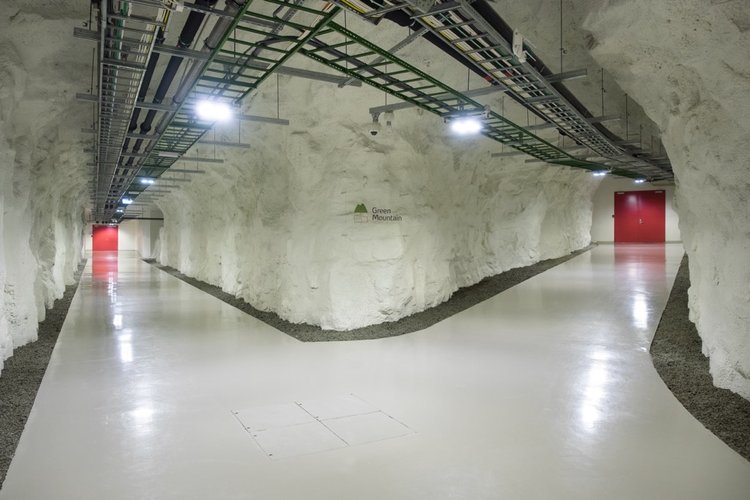
Over the last three decades, Cold War bunkers around the world have been repurposed as ultra-secure data centers. Nuclear fallout centers beneath the streets of Paris, RAF command and control stations in the United Kingdom, civil defense shelters in Germany, and government communications bunkers in the Midwestern United States have all found afterlives as subterranean data storage facilities for cloud computing companies.

When data centers go underground
I’ve been following the growing popularity of the data bunker boom with interest. I’m an anthropologist whose work focuses on extreme data storage and disaster preparedness for data loss. My fieldwork typically involves working with data center providers, corporate actors, and business continuity professionals to improve infrastructure resilience.
During my fieldwork, I’ve had the chance to visit a number of bunkered data centers, ranging from Cyberfort in the UK to Bahnhof in Stockholm. By approaching these buildings as anthropological field sites, we can learn a lot about our own culture and how we make sense of the world – a process in which data and IT are increasingly central. From an anthropological perspective, data bunkers reveal a deep transformation in how human beings relate to data and the future of digital culture.
Data Loss Dread
Architecture is often described as a ‘mirror of life’ because the buildings we construct reflect our society’s values, culture, priorities, and social organization.
Bunkers are mirrors of human anxieties. During the Cold War, nuclear bunkers embodied fears of atomic annihilation. They were constructed to ensure critical infrastructure and key personnel could survive a potential nuclear strike, ensuring the continuity of government amid apocalyptic chaos.
Today, repurposed as data centers, these bunkers reveal a different kind of existential dread: the fear of data loss that haunts digital societies.
Most of us have experienced that harrowing moment when our computer crashes or we drop our mobile phone, and we lose unsaved documents or precious photos we forgot to back up. For governments, corporations, and businesses, a severe data loss event can significantly impact operations or even cause their collapse.
As the value of the global big data market grows, so too does the impact of data loss. Organizations and businesses are increasingly structured around a dependence on digital data. If, for any reason, access to this data is lost, even for a few seconds, it can lead to cascading failures and considerable societal disruption. We’ve seen this first-hand in recent years. Major Internet outages are getting bigger and occurring more often, as highlighted by the CrowdStrike outage in July 2024 (described by Elon Musk as the ‘Biggest IT fail ever’), the Meta outage in October 2021, and the Fastly outage in June 2021, among others.
Digital data loss has now emerged in the collective imagination of catastrophic futures. The plots of films like Blade Runner 2049 (2017), TV shows like Mr Robot (2015–2019), and graphic novels like Enki Bilal’s Bug (2017) all pivot around large-scale data erasure events that lead to widespread societal collapse. In other equally dystopian data visions, since the mid-1990s, digital archivists have uttered warnings about the prospect of a ‘Digital Dark Age’: an epoch in which digitized human knowledge and history are lost due to the rapid speed with which digital storage media become obsolete, rendering their data corrupt or inaccessible.
The bunkered data center reflects this growing cultural awareness that data loss has become a doomsday scenario.
Rise of the data bunkers
The data bunker trend began in the mid-1990s, as post-industrial societies became increasingly reliant on computing systems. Major terrorist attacks – such as the London Stock Exchange in 1990, the London financial district in 1992 and 1993, the World Trade Center in 1993, and the Oklahoma City bombing in 1995 – led to growing concerns that urban centers were unsafe locations for data centers.
In 1995, a Dutch entrepreneur purchased the shell of an ex-NATO military bunker in the south-western region of the Netherlands. The facility was redeveloped as a subterranean data center named ‘CyberBunker’ and offered ‘bulletproof’ web hosting for sites that often contained illicit material. In 1996, the Swiss-based IT security solutions provider, Mount10, converted two ‘nuke-proof’ bunkers located beneath the Swiss Alps into data centers. The data bunker complex was nicknamed the ‘Swiss Fort Knox’, a play on the name of the famous US bullion depository, highlighting the security-centric focus of the operation while also alluding to the value of data as akin to gold. In 1998, a London-based Internet security firm converted a former air traffic control bunker in Southeast England into a data center.
Today, the site is operated by the Cyberfort Group, a cybersecurity services provider.
In contrast to many data centers that were quickly built to capitalize on the dot-com boom, these data bunkers promised greater physical security.
The terror attacks on the World Trade Center in September 2001 further highlighted the high-risk nature of urban centers. The collapsing twin towers destroyed several mission-critical data centers in lower Manhattan, leading to IT downtime and data loss for banks and businesses. The fantasy of ‘cyberspace’ as an electronic ether was crumbling. The vulnerable physical reality of data infrastructure was becoming increasingly clear to many corporate actors.
The post-9/11 securityscape saw more firms move their IT systems to decentralized webs of ‘hardened’ data centers located outside of high-risk city center zones. Some firms began to move their servers underground, as bunkers were gradually reconfigured into data centers. Other subterranean spaces were also repurposed as ultra-secure sites for sequestering data. Abandoned mines, limestone caverns, and mountain caves were reengineered as digital data repositories.
Disaster-proof data storage
It would be incorrect to claim that the data bunker dramatically departs from the original use of Cold War bunkers. These structures were built to securely house hi-tech equipment and valuable information that governments or organizations deemed vital to their continuity.
Some Cold War-era storage companies, like US-based Iron Mountain, naturally transitioned into the data center business. In the early 1950s, Iron Mountain began operating secure storage vaults in a former iron ore mine in upstate New York. The firm preserved paper, microfilm, and magnetic records for banks and insurance companies to ensure that even a nuclear apocalypse would not wipe consumer credit records.

One difference between the Cold War bunker and the cloud computing bunker is the proliferating array of threats to which these sites are now oriented. Today, thermonuclear warfare has been joined by an ever-growing accumulation of disaster scenarios, from global terrorism to climate change to cyberattacks, that fracture our attention. The future is imagined as a timespace of constant threats that must be anticipated in the present.
Subterranean data shelters promise to protect data from the usual cyber-threats that plague the IT industry. In addition, however, data bunkers also offer protection from a range of physical threats that could destroy above-ground data centers, such as tornadoes, bomb attacks, or collapsing structures like nearby trees or buildings.
Media Spectacles
During the Cold War, these defensive installations strived to remain hidden and secret. Repurposed as commercial data bunkers, however, these sites have become some of the most visible data centers.
Due to their spectacular setting, data bunkers have attracted considerable media interest. An array of news articles, photo essays, films, and scholarly studies has now explored these architectural curiosities. Often, the focus is on the striking dissonance between the brute materiality of the bunker and the promise of ethereal immateriality conjured by the ‘cloud’ metaphor.
During my fieldwork, I’ve found that bunkered data center providers are happy for the myth of the cloud to be dispelled. If bunkered data storage is to be sold, potential clients need to know first that the cloud is physical infrastructure, that this infrastructure is vulnerable to physical threats, and that, naturally, their data would therefore be safer in a bunker. As such, data bunkers are not just innocent ‘reflections’ of the threatening times we live in. They play an active role in communicating the threats against which their structure can offer protection. Managing the contradictory imperatives of security and marketing is continuous work.
Specific types of data center, such as those operated by governments or intelligence agencies, certainly attempt to remain hidden. But for commercial data centers retrofitted inside nuclear bunkers, the security promised by the spectacular setting is a unique selling point. Some data bunker operators even design their subterranean data centers to look like science fiction film sets, complete with atmospheric lighting, jungle plants, and water features.
Return of the Nation-State
Data bunkers remind us that the networked flows of the digital world remain entangled with nation-state power. During the Cold War, these fortified spaces were meant to enable nation-states to survive in a post-nuclear world. In the aftermath of nuclear devastation, where severed communications would have made centralized governance impossible, state sovereignty would have been divided across regional bunkered spaces. Local commissioners would have been empowered to make sovereign decisions from within these autonomous regional centers of subterranean control.

The physical fortification of the data center industry that we encounter in the data bunker is reflective of an increasingly territorialized Internet. In the 1990s, the Internet was widely celebrated as a technology that transcended the territorial borders imposed by nation-states. In 1996, cyberlibertarian John Perry Barlow famously declared: “Governments of the industrial world… I come from cyberspace… On behalf of the future, I ask you of the past to leave us alone. You are not welcome among us. You have no sovereignty where we gather… cyberspace does not lie within your borders.”
Today, data sovereignty regulations reinforce nation-state borders in the cloud. Far from early emancipatory visions of the Internet as a virtual ‘cyberspace’ that transcends geography and physical reality, the data bunker serves as a stark reminder that the Internet is becoming increasingly fortified and territorialized.
The fragility of digital civilization
As architectures of preparedness, these structures invite us to reflect on the fragility of societies built around a dependence on digital data. Bunkered data centers. highlight that the ‘cloud’ is far from a weightless, ethereal realm – it is grounded in geopolitics and depends on fragile, physical infrastructure. The increasing number of data bunkers since the turn of the millennium suggests that more organizations are increasingly aware that cloud data is stored on physical servers located amidst the hazardous turmoil of the real world.
While data bunkers promise to protect our precious data from an array of threats, they also reveal that perhaps the most dangerous threat is our dependence on fragile digital infrastructure. Sociologists of risk have long argued that the greatest threats to modern societies come less from external malicious actors and more from an internal reliance on increasingly complex and failure-prone infrastructure. The Internet now relies on such a complex ecosystem of interdependencies that it is a black box to most network professionals, and we are experiencing larger and longer-lasting downtime events.
As a site of anthropological enquiry, the data bunker continues the ancient human practice of storing precious relics beneath the earth. Excavations of tumuli and burial mounds have shown that our ancestors were often buried alongside objects of cultural value – gold, coins, tools, and other tokens of meaning. Let’s hope our subterranean servers are not future fossils in a data tomb.
This feature first appeared in the DCD Subterranean Supplement. Register here to read the whole supplement free of charge.
More in Construction & Site Selection



Read the orginal article: https://www.datacenterdynamics.com/en/analysis/from-the-mushroom-cloud-to-cloud-computing-the-allure-of-extreme-data-storage/