

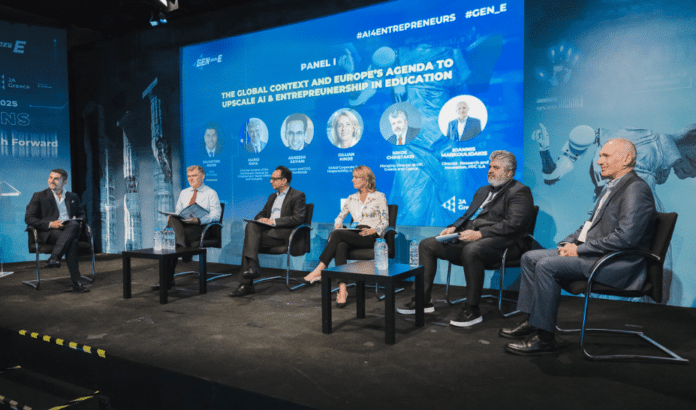
As Europe accelerates the deployment of AI across its economy, the gap between labour-market demand and available AI skills is becoming a structural constraint on growth. While most national strategies still focus on higher education and adult reskilling, a quieter shift is now happening much earlier in the talent pipeline: AI entrepreneurship is moving into secondary school classrooms across Europe.
In 10 European countries, students are already building applied AI projects through AI-ENTR4YOUTH, a three-year programme coordinated by JA Europe and supported by Intel and the European Commission. Initially piloted in Italy, Portugal, and Spain, the initiative has expanded to Albania, Bulgaria, the Czech Republic, France, Greece, Romania, and Ukraine. Through a partnership with EIT Food, part of the programme focuses specifically on AI in agrifood systems. The World Economic Forum has listed it among its leading global initiatives in AI education.
“We are helping young people turn AI from a mystery into a meaningful tool for creation and inclusion. Europe’s strength will come from the imagination of its youth, from classrooms to startups, learning not only to live with AI, but to lead with it. AI-ENTR4YOUTH has proven that young people can do more than use AI; they can build with it, question it, and apply it for the public good,” says Salvatore Nigro, CEO of JA Europe
A skills gap that is already constraining the market
According to an analysis referenced by the European Commission, more than 60% of European workers will require additional training to adapt to the impact of AI, either immediately or within the next year. On the employer side, an EY survey shows that 77% of European companies struggle to attract AI-skilled talent.
Among students, expectations already exceed preparation. A 2024 study of 7,000 young people aged 12–17 found that 74% expect AI to strongly influence their future careers, yet only 46% feel their schools currently prepare them for this reality.
This mismatch is one of the main reasons why AI education is now being pushed down into earlier stages of schooling.
From classroom exercises to early-stage startup thinking

Unlike traditional digital literacy courses, AI-ENTR4YOUTH is structured around project-based learning. Students work in teams to define real-world problems, build AI-based solutions, test them, and develop basic business models around their ideas. The curriculum spans data literacy, AI ethics, no-code AI tools, computer vision, Python programming, mathematics for AI, data exploration, modelling, deployment, prototyping, and user testing, alongside pitching and business model development.
In practice, many projects now resemble early-stage startup initiatives rather than school assignments.
In Spain, one student team developed WaterScreen, a sensor-based system installed on school water lines that measures real-time consumption and flow rates to visualise usage patterns and raise awareness of water scarcity and waste. The project emerged in response to recurring drought conditions in Catalonia and was designed to give schools granular data on where and how water is being lost.
In Portugal, another team started Talk To Me, a device that translates between sign language, text, and sound using computer vision and natural language processing. The system captures hand gestures through a camera and converts them into text and audio in real time, while also translating spoken language back into sign outputs. The project addresses everyday communication barriers for deaf and mute users and focuses on accessibility in public and social environments.
In Italy, students worked on ChatMed, an AI-powered chatbot designed to reduce waiting times in hospitals by digitising patient intake and administrative processes. The system helps patients submit basic medical information and documentation digitally before appointments, with the goal of easing pressure on front-desk staff and improving the flow of non-clinical patient data.
Scaling remains structurally uneven
While JA Europe reached 6.5 million young people across its wider programmes last year, scaling AI entrepreneurship uniformly across Europe remains complex. Education policy is still largely national, and teacher readiness varies widely.
To reduce fragmentation, the European Commission, together with the OECD and with G7 endorsement, recently introduced a draft Artificial Intelligence Literacy Framework for primary and secondary education, aimed at aligning national approaches and accelerating uptake.
What this signals for 2026: AI education becomes infrastructure
Based on current deployments and policy signals, several clear AI education trends for 2026 are now emerging.
AI is moving from an optional subject to a default layer across entrepreneurship and innovation education, embedded across disciplines rather than isolated within computer science. At the same time, equal access to infrastructure is becoming the main scaling constraint, as device availability, connectivity, and cloud tools differ significantly between regions and school systems.
Teacher training is emerging as the critical bottleneck for long-term scale. Several countries are now testing national frameworks aligned with existing digital education strategies, such as Spain’s #CompDigEdu, Portugal’s Digital Transition Plan, and Italy’s National Digital School Strategy. Without large-scale, continuous teacher upskilling, curriculum reform alone is unlikely to scale.
Curricula are shifting toward modular, continuously adaptable AI content, with mathematics increasingly reinforced as the foundation for coding and data science, and stronger collaboration between IT, economics, and technical subjects. Ethics, transparency, and bias are also moving upstream into school-level AI education as the EU AI Act enters implementation.
From education pilots to Europe’s future startup talent pipeline
While most student projects remain at an early stage, early exposure to applied AI and entrepreneurship is increasingly seen as a long-term talent pipeline for startups and innovation rather than a classroom experiment. Alumni of earlier programmes, such as Cornel Amarei, founder of Romanian startup .lumen, which develops smart glasses for the visually impaired and has raised over €15 million, are often cited as early indicators of sustained impact.
As European startups and corporates compete globally on AI, deep tech, and data infrastructure, the shift toward applied AI education in secondary schools suggests that future cohorts will enter universities and eventually the market, with practical AI experience already in place.
By 2026, the question may no longer be whether AI belongs in classrooms, but whether education systems can scale fast enough to feed Europe’s next generation of founders, operators, and engineers.
Read the orginal article: https://www.eu-startups.com/2025/12/ai-education-trends-for-2026-how-european-classrooms-are-shaping-the-future-startup-talent-pipeline-sponsored/


