Time is soon beeing called on telephone exchanges (aka Central Offices) all over the world, but these oddities are an important piece of the data center industry’s history.
Built to serve the original copper networks, many of today’s telephone exchanges are approaching, if not well past, retirement age. And as copper networks are shut down amid a switch to fiber, DCD take a look at the weird and wonderful world of telephone exchanges.
A slice of telecoms history
The first experimental telephone exchange was built by the Bell Telephone Company in Boston in 1877. The first state-administered telephone exchange opened the same year in Germany, outside Berlin in Friedrichsberg.
The first commercial telephone exchange opened in the US the following year in New Haven, Connecticut, by George Willard Coy’s District Telephone Company of New Haven (The Bell franchise was later renamed Southern New England Telephone and eventually became part of AT&T). Launched with just 21 subscribers, the exchange building survived until 1973.
The first public telephone exchange in Europe was opened in London in August 1879 by the Telephone Company (Bells Patents) Ltd at 36 Coleman Street with around a dozen subscribers. The same year, the rival Edison Telephone Co. of London launched exchanges in Lombard Street and Queen Victoria Street. More exchanges followed – and mostly rolled into the National Telephone Company (NTC) – but were almost all nationalized in 1912 by the General Post Office (GPO), which took control of the country’s phone network. By 1939, there were close to 6,000 telephone exchanges in the UK.

Originally, operators would manually connect calls by inserting cords into jacks on a switchboard, a process known as ‘cord switching’.The first automatic telephone exchange, not needing an operator to connect calls, was opened in Epsom, Surrey, in 1912. Though they had been phased out of London by the end of 1960, Portree exchange on the Isle of Skye was the last manual exchange, with the last manual connection made in 1976.
Some of these buildings are beautiful, some are not, and some might be if you enjoy brutalist architecture. Some are listed and protected, most are not.
“To some degree, telephone exchange buildings reflected changing architectural trends, but also responded to complex challenges of cost and time constraints,” says Lisa Kinch, a historic places adviser for Historic England and associate lecturer at the Manchester School of Architecture. Kinch did her PhD research on telephone exchanges in the UK, giving her a unique view on these buildings and their historical context.
“Telephone exchange buildings provide an important physical record of the UK’s telecommunications history. It is an industry that has laid the foundations of how much of modern life functions, and an industry that the UK, for a long time, was pioneering.”
All shapes and sizes
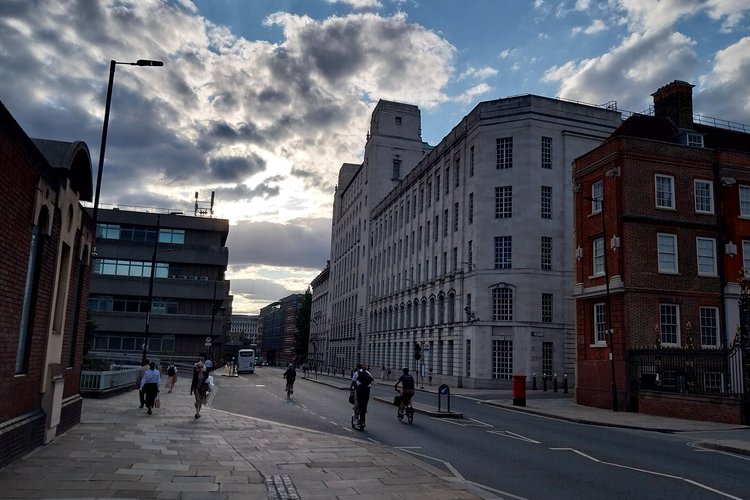
While today’s data centers are largely homogenised grey boxes differentiated by facade color, the UK’s telephone exchanges have more than 100 years of history, and come in all shapes and sizes.
“The earliest purpose-built exchanges commissioned either by the NTC or the GPO were typically very grand, civic buildings that visually communicated the significance of the new technology,” Kinch tells DCD. “As cost, time, labour and material constraints became critical after the Second World War, a more pared-back, utilitarian style developed.”
According to Kinch’s research, prior to nationalization, the NTC had been primarily leasing existing premises and adapting them when required.
In 1912, when the GPO took over, most local telephone exchanges were therefore housed in shops, offices, warehouses or other types of buildings. Purpose built telephone exchanges were at the time rare and exclusively located in larger towns and cities. However, the range of building types created problems for the engineers responsible for the layout of equipment and the majority of these exchange buildings were eventually replaced.
Many purpose-built exchanges were designed by the Ministry of Works (MOW) and its successor departments, in the early days they were often combined with Post Offices in the distinct Neo-Georgian style still recognizable today. However, the grand styles were replaced with more standard approaches, with the GPO having a number of pre-designed ‘building types’. These standard building types account for approximately two-thirds of all operational telephone exchanges in the UK today, according to Kinch.
The first standard building types were designed by the General Post Office’s own architects and engineers in the 1920s to house 200-line Unit Automatic Exchanges (UAX), predominantly located in rural areas. Slightly larger standard building types were designed by architects at the Ministry of Works.
“These types were all designed to be constructed from a range of structural materials, and could be finished in different materials, to suit material availability or to fit in with the local context,” says Kinch. “The standard designs were refined over the years, but did not change dramatically.”
As the General Post Office was a Crown Corporation, it didn’t it did not require planning permission for its buildings, though Kinch notes efforts were still made to liaise with local planning authorities as a “matter of goodwill.”
“There seems to have always been a degree of consideration for the local vernacular, even the standard building types were designed with some flexibility to fit in with their local context,” Kinch says. “Although some iconic buildings – for example Mondial House – did of course not try to fit in at all.”
Kinch notes, however, that after the Second World War, cost became a much more critical issue for the General Post Office. A Post Office-MOW joint research and design group was set up in 1957 to reduce the time and cost of buildings.
“The ‘optimized’ telephone exchange in Altrincham was completed in 1960, and the lessons learnt from it went on to inform the design of a new suite of standard building types,” she notes. “Some utilized prefabricated components, while others still used traditional forms of construction. The later building types were larger and more utilitarian than the earlier standard types, but could still be finished in different types of materials to suit the local context.”
After 1969, when the Post Office became a public corporation, it lost this ability to build without permission from local authorities, leading to “more attention” being paid to the aesthetics of the exchanges – with more money typically spent on design and materials on high street city sites. Later exchanges built from the 1970s onwards, and some of the larger exchanges were generally designed by private architects.
It was very common for telephone exchange buildings to be expanded and updated. Kinch says the standard building types were designed for future extension from the outset.
“The later extensions to early Neo Georgian buildings often contrast starkly in architectural style,” she says. “Some buildings have multiple extensions, often visually distinct from each other, added over time.”
Pieces of weird history
With so many buildings spanning more than 100 years of development, there is a wide array of fun facts and strange nuggets of information to be dug into.
The UK’s Speaking Clock service was launched in 1936 following the ‘Golden Voice’ competition won by Jane Cain, a telephonist at Victoria telephone exchange in London. The first home of the ‘Speaking Clock’ apparatus was Holborn Telephone Exchange, which is still an operational exchange today.
The Kelvedon Hatch telephone exchange in Essex was home to an underground secret nuclear bunker. Built during the Cold War, it was designed to accommodate government officials and protect them in the event of a nuclear attack. The disused Langley Green telephone exchange in Crawley, West Sussex, is now an art gallery space.
It wouldn’t be right to talk about old buildings without saying at least one is haunted, and telephone exchanges are no exception. An exchange on the corner of Stratfield Road and Oakthorpe Road in Summertown, Oxfordshire, built around 1926, is reportedly home to a spectre.
“It was something a local engineer told me,” says Kinch. “Allegedly, the police had been called out to the site because of some noise, but nothing was ever found. Whether it was the ghosts of disgruntled telephone engineers or something else, who knows!”
“I was particularly surprised to find a shooting range in the basement of Bradford Telephone Exchange,” she adds.
While a niche part of the digital infrastructure story, telephone exchanges still have their fans. The BT Telephone Exchange Enthusiasts Group on Facebook boasts close to 10,000 members with regular posts from current and former BT employees, telecoms engineers, and oddball fans.
One comment on a post notes: that at one exchange in Enfield during the 1970s, the “milkman and boy used to take a regular shortcut through the equipment floor to deliver milk to other offices at the back. Walking that is, not in his float.”
The Telephone Exchanges website boasts a near-complete library of all the current and former telephone exchanges across the UK. A labor of love by telecoms enthusiast Mike Fletcher, it provides history and details on many of the sites. A quick search on YouTube will show urban explorers lurking through empty exchanges (which DCD isn’t allowed to recommend or encourage).
In collaboration with BT Archives and Historic England, Kinch’s research was one of the first efforts to really understand the architectural history of the UK’s telephone exchanges in detail.
“There was very little information publicly available about the architectural history of the building type. Even the names of architects were difficult to uncover,” she tells us. “Understanding the relationships between the state, architecture and technological developments has been really important to demonstrate how the building type developed over time, and what these buildings can tell us about political, architectural, and technological histories.”
“There are so many more things I want to research, and I think there are plenty of surprising and delightful details to uncover in telephone exchange buildings around the country,” says Kinch. “My research was limited to England and I would love the opportunity to conduct a similar study in Scotland. I am also increasingly interested in ways to convert telephone exchange buildings to accommodate other uses, in order to secure a more long-term future for them. ”
Exchanges as targets
Sadly the bomb incident at the BT Tower wasn’t the only time an exchange was targeted. And while no one was injured at the tower, others weren’t so lucky at other sites.
Thirty-five-year-old exchange worker George Arthur was killed outside London’s Bloomsbury Exchange on Chenies Street, off Tottenham Court Road, in December 1974 after it was bombed by the Provisional IRA. A duffle bag containing a battery and wires was found and staff had been evacuated from the building. The bomb exploded seven minutes later. His wife heard about her husband’s death while she was packing their suitcases.
It was one of three attacks at exchanges in London that night. One exploded outside the Chelsea exchange on Darycott Avenue. Police had made their way there after a tip-off call, with three office injured and taken to hospital.
Another bomb, likely in or under a parked car, exploded a few minutes later near a telephone exchange off Shaftesbury Avenue in London’s West End theatre district, though nobody was harmed.
Tom Jackson, general secretary of the Union of Post Office Workers, said at the time: “If the IRA. think they’re going to bomb telephonists and postmen out of jobs, they are not going to do it.”
A telephone exchange in Coventry was bombed a month prior to the London sites. Provisional IRA Lieutenant James Patrick McDade was killed when the device exploded prematurely. A Belfast exchange was also bombed in 1989 though no one was harmed.
While not attacked, in November 1978, an unmanned telephone exchange in Mayfield, Hastings, exploded after a gas leak was ignited by a spark from the switch gear. No one was hurt – though windows of a nearby school were blown out. The area’s 1,000 phone lines were fully reconnected just a month later.
This feature first appeared in DCD>Magazine #58. Register here to read the whole magazine free of charge.





Read the orginal article: https://www.datacenterdynamics.com/en/analysis/copper-exchanges-in-all-shapes-and-sizes/