


 Rent controls introduced in Scotland in 2022, designed to cap rent increases, appear to have had the opposite effect, with most landlords now raising rents on an annual basis.
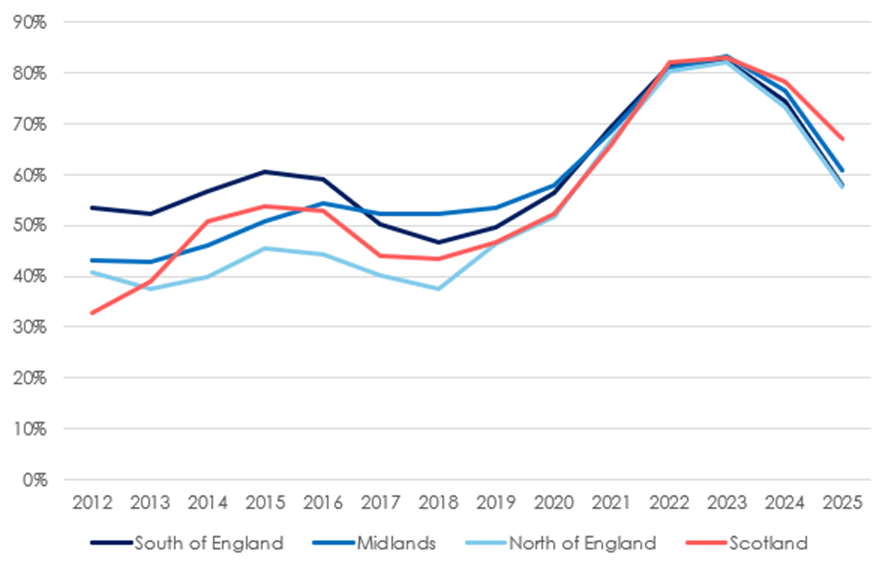
Analysing data from across the Connells group, Hamptons found that Scottish landlords are more likely to have increased rents than in England & Wales during both 2024 and 2025. So far this year, 67% of landlords in Scotland raised the rent when they had the ability to do so, the highest figure for any region and above the 58% who did so across Great Britain as a whole.
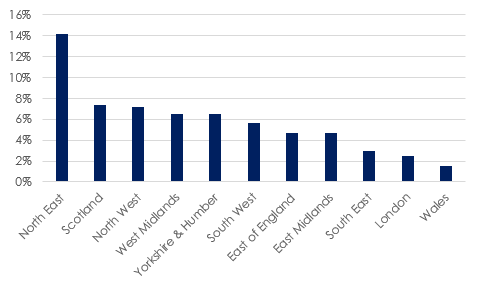
Scotland is one of only two regions in Great Britain where rents on newly let properties rose by more than 2% over the past year.
Between September 2022 to April 2023, rent increases for existing tenants in Scotland were capped at 0%. And from April 2023 to April 2024, increases were capped at 3%. Since April 2024, rent increases have been limited to the lowest of:
+ The ‘open market rent’
+ The rent proposed by the landlord
+ Or the ‘permitted rent’ where the tenant is paying at least 6% below the market rate.
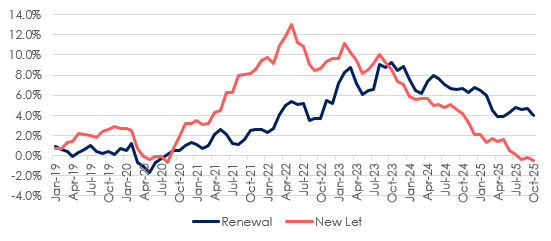
By contrast, for the third consecutive month, rents on newly let homes have fallen nationally on an annual basis, highlighting the divergent trends between Scotland and the rest of Great Britain.
Chart 1 – Share of landlords increasing the rent on contract renewal
Source: Hamptons
*Currently in England, ASTs are usually renewed annually, while in Scotland notice can be served once a year to increase the rent.
Table 1 – Share of landlords increasing the rent on contract renewal*
| 2025 YTD | |
| Scotland | 67% |
| West Midlands | 62% |
| Eastern | 62% |
| North East | 61% |
| South East | 61% |
| North West | 61% |
| East Midlands | 60% |
| London | 59% |
| Wales | 57% |
| Yorkshire & Humber | 51% |
| South West | 51% |
| Great Britain | 58% |
Source: Hamptons
For those landlords who did raise their rent, the size of the average increase was actually lower in Scotland (10.1%) compared to the Great Britain average (12.2%). Nevertheless, Scotland’s overall average rental growth is higher as a greater share of landlords in Scotland chose to increase rents over the last year.
Since June 2025, the pace of rental growth on new lets has picked up in Scotland, despite rents falling across Great Britain. Scottish rents rose by 2.5% from the same time last year, one of only two regions in Great Britain where rents rose by more than 2% over the last year.
Looking specifically at what has happened to rents since the 3% cap on rental increases in Scotland was loosened in April 2024, shows that rents on new lets in Scotland have risen by 7.3%, an increase only surpassed by the North East of England.
Chart 2 – Cumulative rental growth since April 2024 (new lets)
Source: Hamptons
And even looking longer term, newly agreed rents in Scotland are up 36% over the last five years, higher than the 32% increase across Great Britain. It’s a similar story for renewals too, with the average cost of renewed contracts rising 32% over the last five years in Scotland compared to 29% across Great Britain.
For the third consecutive month, rental growth for newly let homes has been negative across Great Britain. In the 12 months to October 2025, the average monthly cost of a newly let home fell by 0.5% to £1,399. This marks the one-year anniversary of rents reaching their all-time peak of £1,406 a month nationally.
Chart 3 – Annual change in the cost of newly agreed and renewal rents
Source: Hamptons
Rents have been falling in Inner London since the beginning of this year and now stand at £2,795, £135pcm below their peak last year. Rents in Outer London have been following this downward path since the summer.
Rents in the South East of England were flat compared to last year (0.0% growth), in the South West, rental growth was 0.3% and in the East of England, rents grew by 0.8%. This means rents may fall in other regions across the South of England in the coming months.
In October, there were 12% fewer tenants looking for a new home nationally, a metric which has been negative for the past three months in all three southern regions outside London (South East, South West, and East of England). Meanwhile, there were 8% more homes available to let in October than 12 months ago.
Rental growth for tenants renewing their contracts in Great Britain continues to grow at a rate of 4% year-on-year, with rents reaching a new peak of £1,310pcm. Even in the capital, where newly agreed rents are falling, the cost of renewing a contract rose by 3.2% over the last 12 months.
Annual rental growth by region – October 2025
| Region | New lets | Renewals | ||
| Average monthly rent | YoY % | Average monthly rent | YoY % | |
| Greater London | £2,349 | -2.7% | £2,279 | 3.2% |
| Inner London | £2,795 | -4.6% | £2,801 | 3.0% |
| Outer London | £2,021 | -1.0% | £1,895 | 3.3% |
| South | £1,362 | 0.3% | £1,275 | 3.9% |
| East of England | £1,272 | 0.8% | £1,242 | 5.7% |
| South East | £1,477 | 0.0% | £1,379 | 2.9% |
| South West | £1,277 | 0.3% | £1,150 | 3.9% |
| Midlands | £1,056 | 1.4% | £965 | 5.9% |
| East Midlands | £1,005 | 0.5% | £919 | 5.3% |
| West Midlands | £1,100 | 2.0% | £1,004 | 6.4% |
| North | £996 | 1.4% | £884 | 4.6% |
| North East | £928 | 3.8% | £756 | 6.6% |
| North West | £1,051 | 1.3% | £915 | 4.5% |
| Yorkshire & The Humber | £953 | 0.5% | £900 | 4.0% |
| Wales | £876 | -0.2% | £817 | 2.6% |
| Scotland | £1,067 | 2.5% | £875 | 3.6% |
| Great Britain | £1,399 | -0.5% | £1,310 | 4.0% |
| Great Britain (Exc London) | £1,156 | 0.8% | £1,062 | 4.4% |
Source: Hamptons
David Fell, lead analyst, at Hamptons, said: “The evidence from Scotland suggests that rent controls rarely work as intended. At best, they delay rent increases; at worst, they set a new benchmark where landlords feel compelled to increase their rents every year by the maximum allowed. Faced with uncertainty over future rules, many landlords choose to raise rents little and often rather than risk falling far below market levels.
“While the Renters’ Rights Act will give tenants more time and power to challenge rents at tribunal, the evidence suggests caps are only a sticking plaster. Longer term, the only way of making rents more affordable is to increase the number of homes available to rent and boost competition among landlords for tenants.
“Despite rents falling annually for the third straight month, landlords are still managing to agree above inflation increases when it comes to contract renewals. Typically, these are reducing the gap that opened up over the Pandemic between what tenants are currently paying, and what the property would achieve if it was re-let to a new tenant.”
Read the orginal article: https://propertyindustryeye.com/rent-controls-backfire-majority-of-scottish-landlords-raise-rents-annually/?utm_source=rss&utm_medium=rss&utm_campaign=rent-controls-backfire-majority-of-scottish-landlords-raise-rents-annually


